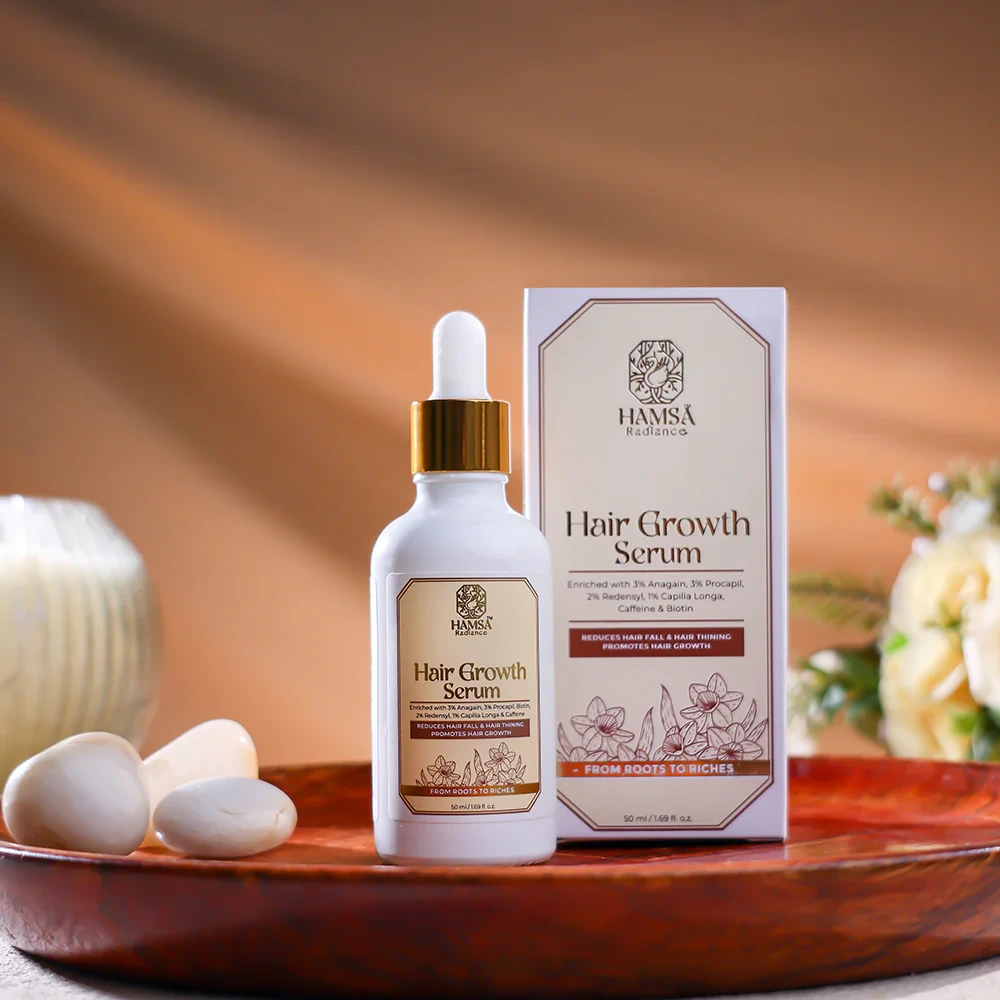
If your hairbrush is collecting more strands than it used to, you’ve probably already searched “hair growth serum” and found a wall of conflicting claims. Some brands promise visible thickness in two weeks. Others quietly disclose that “individual results vary.”
This guide cuts through that noise. It’s built around three things every reader actually needs: a clear explanation of why hair thins, an honest evidence ranking of the ingredients on the market, and a practical framework for choosing — and using — a hair growth serum correctly.
By the end, you’ll know which ingredients have real clinical backing, which are still emerging, and how to set a realistic timeline so you don’t quit a treatment right before it would have worked.
Quick Answer:
A hair growth serum can reduce shedding and support fuller-looking hair when it contains evidence-backed actives like minoxidil, Redensyl, Procapil, peptides, or rosemary-derived compounds, applied daily to a clean scalp for at least 3–6 months. No serum can regenerate dead follicles, and results vary by hair-loss type, genetics, and consistency.
What Is a Hair Growth Serum?
A hair growth serum is a leave-in topical treatment applied directly to the scalp to support follicle function, reduce shedding, and improve the conditions hair needs to grow. Unlike cosmetic hair products, serums are formulated to interact with the scalp environment rather than just coat the hair shaft.
Common formats include:
- Dropper-applied liquids
- Lightweight sprays
- Foam treatments
- Concentrated scalp ampoules
Hair growth serum vs. other hair products
| Product Type | Main Purpose | Applied To |
|---|---|---|
| Hair growth serum | Support follicles and scalp | Scalp |
| Hair oil | Improve moisture and shine | Strands |
| Conditioner | Softness and manageability | Strands |
| Styling product | Shape and hold | Strands |
Do Hair Growth Serums Actually Work?
Yes, but conditionally. A 2024 review in the Journal of Cosmetic Dermatology notes that topical actives can meaningfully extend the hair growth phase and reduce shedding in androgenetic and stress-related hair loss, but cannot revive follicles that have been dormant for years or scarred by disease.
Hair growth serums tend to work best when:
- Thinning was caught early
- Follicles are still active (not scarred or dormant for 5+ years)
- The underlying cause (stress, deficiency, hormones) is also addressed
- The product is used daily without long gaps
They tend to underperform when:
- Follicles have been inactive for years
- Hair loss is scarring (cicatricial alopecia)
- A medical condition like thyroid disease is undiagnosed
- A nutritional deficiency (iron, vitamin D, zinc) is left untreated
The #1 Reason Serums “Fail”: Quitting Too Early
Hair follicles cycle slowly. A realistic improvement pattern looks like this:
- Month 1: Little visible change; some users notice less shedding
- Months 2–3: Reduced shedding becomes more consistent
- Months 4–6: Improved density in early-stage thinning
- Month 6+: Most noticeable, measurable results
Most clinical trials on topical hair treatments measure outcomes at 16–24 weeks for this exact reason — shorter windows rarely capture real change.
How Hair Growth Actually Works: The 4-Phase Cycle
Each follicle on your scalp moves through four phases independently of its neighbors:
- Anagen (growth): The active phase, lasting 2–7 years. Longer anagen phases mean longer, denser hair.
- Catagen (transition): A short 2–3 week phase where the follicle shrinks and growth halts.
- Telogen (resting): A 3-month dormant phase where the hair stays in place but doesn’t grow.
- Exogen (shedding): The old hair releases as a new strand begins anagen underneath.
At any time, roughly 85–90% of scalp follicles are in anagen and 10–15% are in telogen — losing this balance is what produces visible thinning.
What Causes Hair Loss? (And Why It Determines Your Serum Choice)
Androgenetic Alopecia (Pattern Hair Loss)
The most common cause of progressive thinning in both men and women, driven by genetic sensitivity to DHT. Signs: receding hairline, thinning crown, widening part.
Telogen Effluvium
Triggered by acute stress, illness, surgery, rapid weight loss, or major hormonal shifts. Shedding is usually diffuse across the whole scalp rather than concentrated in one area, and it often resolves within 6–9 months once the trigger passes.
Postpartum Hair Loss
A subtype of telogen effluvium driven by the sharp drop in estrogen after childbirth, typically peaking around 3 months postpartum and improving by 6–12 months.
Nutritional Deficiencies
Low iron, vitamin D, zinc, protein, or B vitamins can shorten the anagen phase. No serum can correct a deficiency — bloodwork and dietary correction are required first.
Scalp Inflammation
Chronic irritation, excess sebum, or inflammatory scalp conditions (like seborrheic dermatitis) can impair follicle function and reduce how well topical actives are absorbed.
DHT and Follicle Miniaturization, Explained
DHT (dihydrotestosterone) is a byproduct of testosterone that, in genetically susceptible follicles, binds to receptors and gradually shrinks the follicle over successive growth cycles — a process called follicle miniaturization.
Over time, miniaturization causes:
- Progressively shorter anagen phases
- Thinner, shorter regrowth with each cycle
- Eventually, follicles that stop producing visible hair
This is why pattern hair loss is progressive without intervention, and why ingredients that influence the scalp’s hormonal or inflammatory environment are studied more closely than purely cosmetic ones.
Hair Growth Ingredients Ranked by Scientific Evidence
| Ingredient | Evidence Strength | Primary Mechanism |
|---|---|---|
| Minoxidil | Strong (FDA-approved, multiple RCTs) | Extends anagen phase, increases follicle size |
| Redensyl | Moderate | Activates hair stem cells |
| Peptide complexes | Moderate | Improves follicle micro-environment |
| Rosemary extract | Moderate | Supports scalp circulation, anti-inflammatory |
| Procapil | Emerging | Reduces DHT-related follicle stress |
| Baicapil | Emerging | Supports follicle vitality |
| Caffeine | Limited–Moderate | Mild follicle stimulation |
| Biotin | Limited (unless deficient) | Nutritional cofactor only |
Minoxidil: The Clinical Benchmark
Minoxidil is the most studied non-prescription hair-loss ingredient, FDA-approved since 1988 for androgenetic alopecia. Clinical trials commonly show meaningful increases in hair count by week 16–24 of consistent twice-daily use. It works best on early, active thinning and requires ongoing use — stopping typically reverses gains within months.
Redensyl: The Marketed Minoxidil Alternative
Redensyl is patented by Induchem and marketed around stem-cell activation in the hair follicle bulge. Early manufacturer-funded studies show density improvements, but independent, large-scale clinical trials remain limited compared to minoxidil — a gap worth knowing before assuming it’s a direct substitute.
Peptides and Growth-Support Complexes
Peptides are short amino-acid chains used to support the follicle’s surrounding environment rather than directly stimulate growth. They’re common in premium serums positioned for long-term scalp maintenance rather than fast transformation.
Caffeine
Caffeine is widely added to shampoos and serums based on lab studies showing it may counteract testosterone-driven growth suppression in isolated hair follicles. In practice, it performs best as a supporting ingredient alongside stronger actives, not as a standalone solution.
Hair Growth Serum vs. Minoxidil vs. Finasteride
| Factor | Hair Growth Serum | Minoxidil | Finasteride |
|---|---|---|---|
| Formula | Varies by brand | Standardized (2% or 5%) | Standardized (oral, prescription) |
| Mechanism | Ingredient-dependent | Extends anagen phase | Blocks DHT production |
| Evidence | Varies | Strong | Strong (for men) |
| Access | OTC | OTC | Prescription only |
| Best for | Broad scalp support | Active pattern thinning | DHT-driven hair loss |
Which is better? For pattern hair loss specifically, minoxidil and finasteride have the strongest clinical evidence. A multi-ingredient serum is better suited to people wanting broader scalp support or who can’t use either drug. Many dermatologists do combine minoxidil with a complementary serum — but always check ingredient compatibility and consult a professional first.
How to Choose a Hair Growth Serum by Hair Loss Type
Early thinning: Redensyl, peptides, caffeine, niacinamide, rosemary extract Excessive shedding: Procapil, peptide complexes, niacinamide, calming botanicals Receding hairline: Strong-evidence actives (minoxidil) deserve priority; consistency matters more here since hairlines respond slower Female diffuse thinning: Redensyl, peptides, biotin, rosemary extract Scalp irritation present: Prioritize soothing, fragrance-light formulas before adding active ingredients
The 5-Factor Selection Framework
Evaluate any product against:
- Active ingredients — are they named and dosed?
- Evidence strength — strong, moderate, or emerging?
- Scalp compatibility — fragrance, alcohol, allergens?
- Ease of use — daily routine fit?
- Long-term affordability — can you sustain 6–12 months?
How to Apply Hair Growth Serum (Step-by-Step)
- Start with a clean, dry or towel-dried scalp.
- Part hair into sections to expose the scalp directly.
- Apply the manufacturer’s recommended dose to thinning areas.
- Massage gently for 1–2 minutes to aid absorption.
- Leave on — don’t rinse — and let it fully dry before styling.
- Repeat once or twice daily, exactly as directed.
Common mistakes: applying only to hair strands instead of scalp, overusing product, skipping days, switching brands every few weeks, and expecting visible change inside the first month.
Realistic Results Timeline
| Timeframe | What You May Notice |
|---|---|
| Weeks 1–4 | Better scalp hydration; visible regrowth uncommon |
| Months 2–3 | Reduced shedding, improved manageability |
| Months 4–6 | Early density gains in active follicles |
| Months 6–12 | Most visible, measurable improvement |
Side Effects and Safety
Most serums are well tolerated. Reported reactions include itching, dryness, redness, and occasional temporary increases in shedding as old hairs are pushed out by new growth (common with minoxidil in the first 2–8 weeks). Patch-test any new product on the inner arm for 24–48 hours first. Anyone pregnant or breastfeeding should review ingredients with a doctor, since minoxidil and some actives aren’t recommended during this time.
When to See a Dermatologist
Seek professional evaluation if you notice sudden hair loss, distinct bald patches, scalp pain or scarring, or no improvement after 6+ months of consistent serum use. A dermatologist can rule out thyroid disease, autoimmune conditions, scarring alopecia, and deficiencies that a topical product cannot fix on its own.
Common Myths vs. Facts
| Myth | Fact |
|---|---|
| Serums work overnight | Visible change typically takes 3–6 months |
| More product = faster results | Overuse doesn’t speed up the growth cycle and can irritate the scalp |
| All ingredients are equally effective | Evidence strength varies dramatically by ingredient |
| Hair oil and hair growth serum are the same | Oils target shine and softness; serums target follicle function |
| Once hair returns, you can stop treatment | Most active ingredients require ongoing use to maintain gains |
Key Takeaways
- Minoxidil has the strongest clinical evidence for hair regrowth; Redensyl, peptides, and rosemary extract show moderate, promising support.
- Hair growth serums work best on early, active thinning — not long-dormant or scarred follicles.
- Most users need 3–6 months of daily, consistent use before seeing measurable density change.
- Match the ingredient to your hair loss type: early thinning, shedding, hairline recession, or diffuse female thinning each respond differently.
- A serum is one part of a routine — scalp health, nutrition, and realistic expectations matter just as much as the product itself.
- See a dermatologist for sudden loss, scarring, or no improvement after six months.
If you’re evaluating a specific product, check its label against the evidence table above before buying — and commit to at least a 6-month trial before judging results.
Frequently Asked Questions
What is the best hair growth serum ingredient? Minoxidil currently has the strongest clinical evidence among widely available ingredients for stimulating regrowth in androgenetic alopecia.
Do hair growth serums actually work? Some do. Effectiveness depends on the cause of hair loss, ingredient quality, and consistent long-term use — typically 3–6 months minimum.
Can hair growth serums regrow bald spots? It depends on whether follicles in that area are still active. Long-dormant or scarred follicles are much harder to revive with topical treatment alone.
Is Redensyl better than minoxidil? Not necessarily — they work through different mechanisms, and minoxidil has far more independent clinical research behind it.
Can I use a hair growth serum with minoxidil? Some people combine both as part of a broader routine, but ingredient compatibility and timing should be checked with a dermatologist first.
How long should I use a hair growth serum before judging results?
Most clinical evidence and dermatologist guidance points to at least 4–6 months of consistent, daily use before evaluating effectiveness.
Is hair growth serum safe for women? Many formulations are designed specifically for women, but anyone pregnant, breastfeeding, or on medication should review ingredients with a doctor first.
What causes a hair growth serum to “fail”? The most common reasons are inconsistent use, mismatched ingredients for the actual cause of hair loss, advanced or scarring hair loss, and unaddressed nutritional or hormonal issues.