Haircutting and Styling: A Practical Guide for Every Hair Type
Understand cutting techniques, texture, density, face framing, styling routines, salon language, maintenance, and realistic grow-out before your next appointment.
Quick Answer
Successful haircutting and styling begin with five factors: texture, density, growth patterns, lifestyle, and maintenance tolerance. Choose a cut that works with your everyday hair, then ask how it will behave air-dried, heat-styled, tied back, and grown out.
A great haircut should complement natural texture, fit your routine, grow out evenly, and remain manageable after the first wash. This guide helps salon clients, barber clients, and beginners understand how professional cuts are planned.
The 5–5–5 Haircut Check
- Can I style it in five minutes on a busy morning?
- Will it still look intentional after five weeks?
- Can I describe it using five clear details?
Those details are desired length, perimeter, layers, fringe, and finish.
Haircutting and Styling at a Glance
| Your Priority | Strong Starting Options | Main Consideration |
|---|---|---|
| Fuller-looking fine hair | Blunt bob, box bob, solid lob | Avoid excessive thinning |
| Less bulk in thick hair | Internal layers, shag, textured lob | Preserve the outer shape |
| Better curl definition | Rounded layers, curly shag, tapered cut | Allow for shrinkage |
| Minimal daily styling | Collarbone cut, U-shape, soft crop | Salon upkeep may still be frequent |
| Easy ponytails | Lob, clavicut, long layers | Keep front pieces long enough |
| Strong visual change | Pixie, French bob, wolf cut, fringe | Plan the grow-out stage |
| Professional versatility | Blunt lob, scissor taper, rounded curls | Choose a controlled outline |
| Softer movement | Butterfly layers, curtain fringe, feathering | May require directed drying |
Understanding Texture, Density, and Growth Patterns
Hair Texture
Straight hair lies flat or bends; wavy hair forms S-shapes; curly hair forms loops and spirals; coily hair forms tight coils or zigzags. Texture changes shrinkage, separation, and volume.
Strand Diameter
Fine, medium, and coarse describe each strand—not overall fullness. Fine strands may not tolerate aggressive texturizing even in dense hair.
Hair Density
Low density often benefits from stronger outlines. Medium density supports many layers. High density may need controlled internal weight removal.
Growth Patterns
Cowlicks, double crowns, strong parts, low hairlines, and uneven growth affect how fringe, crown layers, and short cuts settle.
Hair Condition
Bleaching, chemical straightening, heat damage, and breakage can limit razoring, thinning, and layering options.
Lifestyle
Styling time, ponytail needs, workplace preferences, climate, and appointment frequency should influence the design.
Professional Haircutting Techniques Explained
| Technique | What It Does | Useful For | Main Risk |
|---|---|---|---|
| Blunt cutting | Creates a solid edge | Fine hair, bobs, strong perimeters | Can feel heavy on dense hair |
| Layering | Creates different internal lengths | Movement, curls, thick hair | Too many layers weaken ends |
| Graduation | Builds stacked weight | Bobs, tapers, short shapes | Poor placement creates bulk |
| Point cutting | Breaks a rigid edge | Softening straight or dense hair | Can thin fine ends |
| Slide cutting | Creates flowing movement | Long layers, dense hair | Unsuitable for fragile textures |
| Razor cutting | Produces tapered edges | Shags and selected textures | May worsen damage or frizz |
| Clipper cutting | Creates short controlled lengths | Fades, tapers, crops | Short work grows out visibly |
| Shear-over-comb | Refines short shapes | Soft tapers and blended sides | Needs technical control |
| Internal layering | Removes hidden weight | Dense or heavy hair | Overcutting creates holes |
| Dry detailing | Refines natural finish | Curls, cowlicks, precision | Preparation must be consistent |
Blunt Cutting
Creates a strong baseline that can make fine ends look fuller. Thick hair may need hidden shaping behind the clean outline.
Graduation
Builds weight through shorter lengths beneath longer ones. Ask where the weight line will sit.
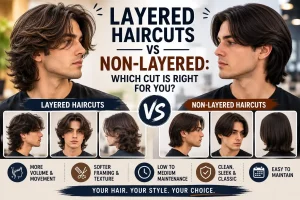
Layering
Removes weight and creates movement. Short crown layers lift; long internal layers move without heavily altering the exterior.
Texturizing
Changes density or edge softness within a shape. It is not the same as layering and should never be automatic.
Scissors, Razors, Clippers, and Thinning Shears
Scissors
Highly versatile for blunt, layered, graduated, and softly textured finishes. Ideal when the perimeter must stay full.
Razors
Create airy, tapered, lived-in edges. Fragile, porous, or damaged ends may respond poorly.
Clippers
Produce consistent short lengths for fades, tapers, crops, and undercuts. Guard numbers do not describe fade height or transition.
Thinning Shears
Remove selected strands. Overuse may create internal short hairs, puffiness, or a weakened perimeter.
Wet Cutting vs Dry Cutting
| Method | Main Advantage | Useful For | Limitation |
|---|---|---|---|
| Wet cutting | Controlled tension and sectioning | Outlines, layers, major length changes | Hides natural shrinkage |
| Dry cutting | Shows true movement and length | Curls, cowlicks, fine ends, detailing | Preparation must stay consistent |
| Combination | Structure plus customization | Most textures and complex shapes | Needs more time and skill |
Best Short Haircuts for Modern Styling
Classic Pixie
Short sides and back with adjustable crown and fringe. Discuss ear coverage, neckline, crown length, and fringe direction.
Bixie
Combines pixie lightness with a fuller bob outline. Flexible and useful while growing out a pixie.
French Bob
A compact jaw-area shape with optional fringe. Confirm where it will sit when fully dry.
Italian Bob
A fuller chin-to-shoulder perimeter with movement. Use restrained layering to protect the ends.
Textured Crop
Short separated top sections with tapered, faded, or scissor-cut sides. Keep enough top length to show texture.
Curly Pixie
Preserves enough length for curl formation while controlling the sides and back. Assess shrinkage area by area.
Medium-Length Haircuts With Versatility
Collarbone Lob
Long enough for many ponytails while removing tired ends. Adaptable across straight, wavy, curly, and coily textures.
Clavicut
Ends close to the collarbone with a simple outline. Confirm whether it sits above, on, or below the shoulders when dry.
Medium Shag
Uses crown layers, movement, and optional fringe. Avoid cutting the crown so short that grow-out becomes difficult.
Textured Lob
Maintains the lob outline while removing controlled internal weight. Texture should be restrained on fine hair.
Rounded Curly Cut
Distributes volume around the head and can emphasize width, height, or lower fullness.
Shoulder-Length Cut
Versatile but may flip outward where hair touches the shoulders. Length placement matters.
Long Haircuts That Preserve Fullness
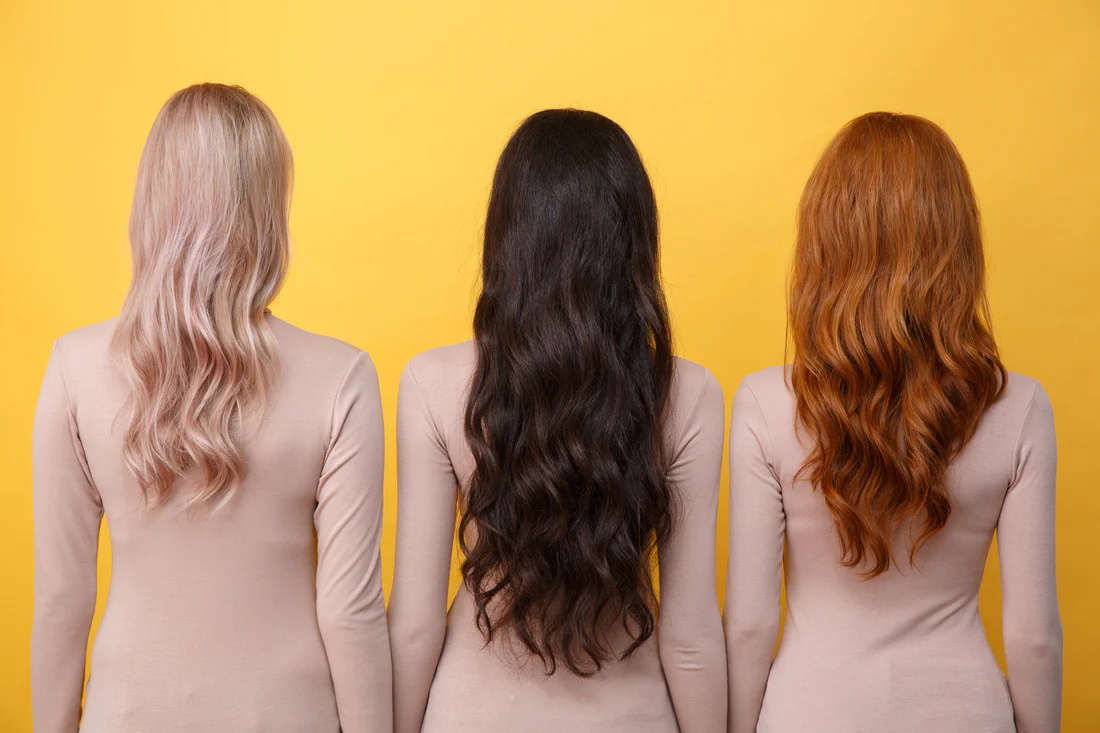
Butterfly Haircut
Combines shorter face framing with long flowing layers for a blowout effect. Best when density supports shorter upper sections.
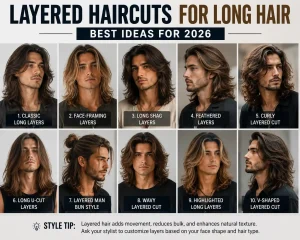
U-Shaped Cut
Curves gently through the back and retains more side length than a V-shape.
V-Shaped Cut
Creates a dramatic pointed back on long dense hair but reduces visual fullness at the sides.
Invisible Layers
Remove internal weight without visible surface steps, preserving a clean exterior.
Long Shag
Concentrates texture through the crown and front while retaining lower length.
One-Length Cut
Supports fine, straight, or low-density hair with a strong perimeter and optional subtle face framing.
Layered Haircuts: Choosing the Right Type
| Layer Type | Best Use | Styling Need | Watch-Out |
|---|---|---|---|
| Long layers | Movement without major shortening | Low–medium | May disappear on straight hair |
| Face framing | Highlighting the front | Low–medium | Short pieces escape ponytails |
| Crown layers | Lift and shag texture | Medium | Can stand around strong crowns |
| Internal layers | Hidden weight removal | Low | Overcutting creates hollows |
| Curly layers | Volume distribution | Low–medium | Shrinkage exposes placement |
| Butterfly layers | Dramatic face movement | Medium–high | May need blow-drying |
| Graduated layers | Structured weight | Medium | Wrong placement creates bulk |
Layers should solve a specific problem: lift, weight reduction, face framing, curl release, or fringe connection. Always confirm where the shortest layer will finish when dry.
Haircuts With Bangs
Curtain Bangs
Open through the center and blend into longer sides. Usually need directed drying.
Wispy Bangs
Use fewer strands for a lighter front but may separate when oily.
Blunt Bangs
Create a strong line and often need frequent trimming.
Curly Bangs
Preserve natural pattern and require shrinkage-aware placement.
Micro Bangs
Finish well above the brows and pass through several visible grow-out stages.
Before Choosing Fringe
Discuss cowlicks, dry position, no-heat styling, trim frequency, and complimentary fringe trims.
Haircuts for Fine, Thick, and Textured Hair
Fine or Low-Density Hair
Consider Nordic bob, box bob, blunt lob, soft pixie, one-length long cut, or light graduation. Protect the visible perimeter and avoid automatic thinning.
Thick or Dense Hair
Try a long shag, textured lob, butterfly cut, wolf cut, U-shape, or internally shaped bob. Remove weight strategically rather than thinning the surface.
Wavy Hair
Preserve wave groups, account for width, and use layers that work with air-drying or diffusing.
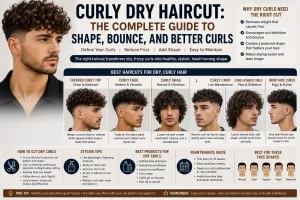
Curly Hair
Rounded cuts, curly shags, bobs, and curl-aware layers should be planned around dry length and variable spring.
Coily Hair
Tapered and layered shapes can control the outline or distribute volume. Avoid over-thinning that creates gaps or weak ends.
Textured-Hair Checklist
Show your normal style, explain shrinkage and wash day, identify unusual sections, confirm dry length, and request a realistic home routine.
Haircuts for Different Face Shapes
Face shape should guide customization, not impose rules. Highlight features you enjoy instead of trying to “correct” them.
| Face Shape | Optional Design Approach | Flexible Ideas |
|---|---|---|
| Round | Vertical movement or controlled width | Lob, long layers, textured crop |
| Oval | Let texture and routine lead | Bob, pixie, shag, long layers |
| Square | Emphasize structure or curves | Blunt bob, waves, side fringe |
| Heart | Movement near the jaw | Chin bob, lob, curtain fringe |
| Long | Fringe or side volume | Rounded bob, curls, medium shag |
| Diamond | Highlight or soften cheekbones | Bixie, tucked bob, face frame |
| Pear | Upper volume if desired | Layered crop, curls, side fringe |
Men’s and Gender-Neutral Haircuts
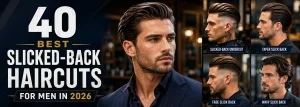
Textured Crop
Short separated length above with tapered or faded sides. Confirm whether the front falls forward, up, or sideways.
Low Taper
Refines the ears and neckline with a softer grow-out than a high skin fade.
Mid or High Fade
Creates strong contrast and may need frequent maintenance.
Scissor Cut
Preserves softness at the sides and neckline for flexible styling and forgiving growth.
Curly Taper
Keeps natural volume above while refining the lower outline.
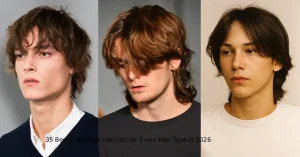
Modern Mullet or Flow
Choose subtle or obvious disconnection for a mullet; shape ears and neckline carefully for medium flow.
Low-Maintenance and Professional Haircuts
| Haircut | Daily Effort | Salon Upkeep | Grow-Out |
|---|---|---|---|
| Blunt lob | Low | Moderate | Easy |
| Textured crop | Low | Frequent | Moderate |
| Long U-shape | Low | Infrequent | Easy |
| Precision bob | Low–medium | Frequent | Moderate |
| Rounded curly cut | Low–medium | Moderate | Easy |
| Soft shag | Low | Infrequent | Easy |
| Skin fade | Low | Very frequent | Visible |
| Scissor taper | Low | Moderate | Soft |
| Butterfly cut | Medium | Moderate | Easy |
| Full fringe | Medium | Frequent | Visible |
Styling Your Haircut at Home
Straight Hair
Use light heat protection, direct the roots toward the part, and choose a paddle brush for smoothness or round brush for curve.
Wavy Hair
Apply mousse or wave cream to wet hair, scrunch upward, and air-dry or diffuse on low without repeated touching.
Curly Hair
Apply leave-in where needed, add gel or cream to wet hair, distribute by section, scrunch, diffuse gently, and soften the cast when dry.
Coily Hair
Work in sections, apply moisture and hold, define with fingers, brush, twists, or coils, dry fully, and avoid hairline tension.
Short Hair
Warm a small amount of product in the hands. Apply from the back forward so the fringe is not overloaded.
Realistic Routine
Ask the stylist to demonstrate a weekday routine, not only a full salon finish.
Styling Tools and Finishing Methods
| Tool | Best Use | Practical Tip |
|---|---|---|
| Paddle brush | Smooth drying | Keep airflow downward |
| Round brush | Volume and curved ends | Match barrel to hair length |
| Diffuser | Wave, curl, coil definition | Use low airflow |
| Flat iron | Smoothness and detailed bends | Use moderate heat and few passes |
| Curling iron | Waves and directed curls | Match barrel to desired movement |
| Blow-dry brush | Convenient volume | Avoid repeated passes |
| Wide-tooth comb | Wet detangling | Begin at the ends |
| Edge brush | Hairline detail | Avoid excessive pressure |
How to Ask for the Right Haircut
A haircut name is only a starting point. Bring two or three references showing the front, side, and back, ideally with texture and density similar to yours.
- Finished dry length: show the exact point with your hand.
- Perimeter: choose blunt, curved, tapered, broken, or softly textured.
- Shortest layer: confirm where it lands when dry.
- Face framing: decide whether pieces must fit into a ponytail.
- Fringe: discuss cowlicks, shrinkage, and trim frequency.
- Normal routine: state your real styling time and tools.
- Maintenance: say how often you will return.
- Grow-out: ask how the shape changes between appointments.
- Non-negotiables: identify areas you do not want exposed or shortened.
Haircut Consultation Red Flags
- The stylist does not examine natural texture.
- Shrinkage or cowlick concerns are dismissed.
- The final length remains unclear.
- An exact result is promised from a different texture.
- Your daily routine is never discussed.
- Significant thinning is suggested without explanation.
- You are pressured into a dramatic change.
- Chemical damage is ignored.
- Grow-out and maintenance remain unexplained.
Corrective Haircuts and Growing Out a Cut
Identify the exact issue: uneven sides, thin perimeter, disconnected layers, cowlick conflict, unwanted width, or dependence on heat styling.
Over-short layers, heavily thinned ends, and overly short fringe often need growth rather than more cutting. Ask for a staged plan.
Haircut Maintenance Schedule
| Haircut or Detail | Common Maintenance Range |
|---|---|
| Skin fade | 2–4 weeks |
| Short taper | 3–6 weeks |
| Precision pixie | 4–8 weeks |
| Full bangs | 3–6 weeks |
| Bob | 6–10 weeks |
| Lob | 8–12 weeks |
| Medium layers | 8–14 weeks |
| Curly shaped cut | 8–16 weeks |
| Long layers | 10–16 weeks |
| Long one-length cut | 12–20 weeks |
Book sooner when the neckline loses shape, fringe blocks vision, ends tangle, or styling becomes harder.
Real-World Haircut Examples
Fine Straight Hair
Better: jaw-length blunt bob with limited internal shaping. Avoid: many short surface layers requiring blow-drying.
Dense Wavy Hair
Better: collarbone lob below the shoulder with controlled internal weight removal. Avoid: random surface thinning.
Strong Curl Shrinkage
Better: agree on dry chin-level position and assess springy areas individually. Avoid: selecting length from wet hair.
Curtain Bang Cowlick
Better: keep fringe longer, shift the opening, and test drying direction. Avoid: forced symmetry.
Professional, Low Upkeep
Better: collarbone cut, soft scissor taper, or rounded curly shape. Avoid: highly precise cuts requiring frequent reshaping.
Quick Summary
- Start with texture, density, growth patterns, condition, lifestyle, and maintenance.
- Choose techniques that support the desired outline and movement.
- Confirm finished dry length and shortest layers before cutting.
- Account for shrinkage, cowlicks, glasses, ponytails, and shoulder position.
- Ask for a realistic home styling routine and grow-out plan.
- Use the 5–5–5 check before a dramatic change.
Frequently Asked Questions
What is included in a haircut and styling appointment?
Services vary. A standard booking may include consultation, shampoo, cut, blow-dry, and finish. Confirm treatments, hot tools, curl styling, beard work, and extra-long-hair charges.
How do I know which haircut will suit me?
Begin with texture, density, growth patterns, routine, and maintenance. Face shape can guide smaller details.
Should I wash my hair first?
Follow the salon’s instructions. Clean, detangled hair is often easier to assess, while curl specialists may request your normal styled pattern.
Should curly hair be cut wet or dry?
Both can work. Wet cutting gives structure; dry cutting reveals movement and shrinkage. Many specialists combine them.
What makes fine hair look fuller?
Blunt bobs, solid lobs, compact pixies, and one-length cuts create stronger outlines. Limited layers can prevent flatness.
Is razor cutting suitable for every hair type?
No. It can create softness but may not suit fragile, porous, or severely damaged ends.
Why does my haircut look different after washing?
Salon blowouts redirect and stretch hair. Home drying may reveal more shrinkage, wave, cowlicks, and volume.
What should I do if I dislike my haircut?
Identify and photograph the concern, contact the salon promptly, and ask about its adjustment policy. Avoid major home corrections.
Should cutting happen before or after coloring?
It depends on the cut and color plan. Book a combined consultation for dramatic cutting, highlights, bleach, or straightening.
How much hair should I ask to remove?
Show the finished point with your hand and clarify wet versus dry length. For curls and coils, discuss shrinkage first.
Conclusion
Good haircutting and styling connect technical structure with real life. The right cut respects your texture, supports your preferred finish, and remains manageable between appointments.
Start with the 5–5–5 check, take realistic reference photos, and bring the consultation checklist to your stylist.
Editorial and safety note: This guide provides general education. Major corrections, chemical services, severe damage, and dramatic transformations should be handled by an experienced licensed professional.