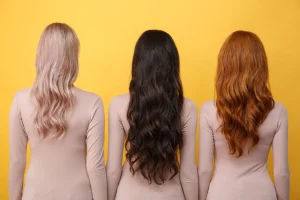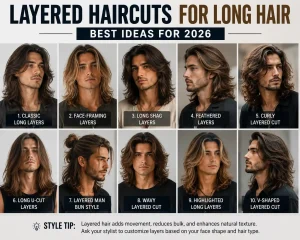
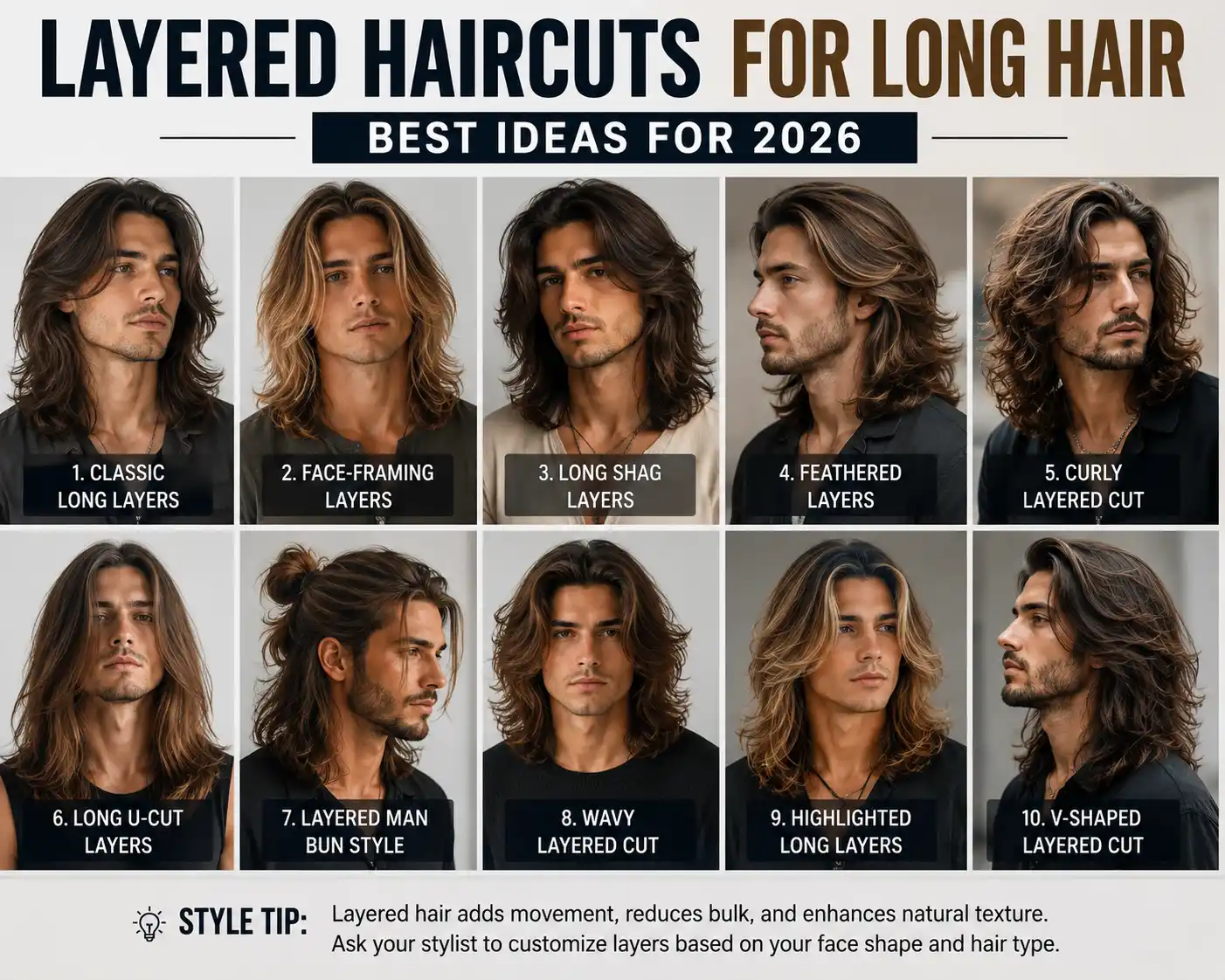
Long hair can look beautiful while still feeling flat, heavy, shapeless, or difficult to style. The right layers solve those problems without taking away the length you worked hard to grow.
The key is not simply asking for “long layers.” You need to choose where the shortest layer begins, how much weight is removed, and what shape the ends create.
This guide explains the best layered haircuts for long hair by texture, density, face shape, styling time, and maintenance. You will also learn which cuts are easiest to air-dry, which work with ponytails, and exactly what to tell your stylist.
Quick Answer
The best long layered haircut keeps enough weight through the ends while adding movement where your hair needs it. Fine hair usually suits minimal or hidden layers, while thick hair can handle stronger face framing and internal weight removal.
Choose the shortest layer by its dry position, not just its measured length. This is especially important for wavy, curly, and coily hair.
Key Takeaways
• Keep the bottom edge strong if your ends already look thin.
• Use internal layers to remove bulk without creating choppy steps.
• Choose face-framing pieces based on their dry length.
• Butterfly cuts usually need more styling than ghost layers.
• Keep front sections longer if you wear ponytails often.
• Match the haircut to your natural texture, not a styled reference photo.
How to Choose Long Layers in Five Steps
A beautiful reference photo is useful, but it does not tell the whole story. The same cut can behave very differently on fine straight hair, dense waves, or tight curls.
Use these five decisions to narrow your options before your salon appointment.
Identify Your Natural Texture
Start with how your hair behaves when it is clean and air-dried.
• Straight hair shows cutting lines clearly and needs smooth blending.
• Wavy hair often gains bounce when heavy sections are released.
• Curly hair needs layers that account for shrinkage and varied curl patterns.
• Coily hair benefits from careful shape planning and protected end density.
Separate Strand Thickness From Hair Density
These terms do not mean the same thing.
Fine hair has narrow individual strands. Low-density hair has fewer strands overall. Someone can have fine but dense hair, or coarse strands with lower density.
This distinction affects how much weight a stylist can safely remove.
Choose the Shortest Layer
The shortest layer controls how dramatic the haircut feels.
| Shortest Layer Starts At | Overall Effect | Maintenance |
|---|---|---|
| Cheekbone | Bold face framing and visible lift | Medium to high |
| Jaw | Noticeable shape with flexible styling | Medium |
| Chin | Soft framing that grows out well | Low to medium |
| Collarbone | Subtle movement and easy ponytails | Low |
| Below shoulders | Almost one-length appearance | Very low |
Select the Back Shape
Choose whether you want a blunt, U-shaped, or V-shaped perimeter.
A blunt edge looks dense and strong. A U-shape creates a rounded flow. A V-shape preserves a dramatic center length while shortening the sides.
Be Honest About Styling
A haircut should suit the routine you actually follow.
Someone who enjoys round-brush blowouts may love dramatic butterfly layers. Someone who air-dries every morning may prefer long blended layers, ghost layers, or a rounded curl shape.
What Are Long Layers?

Long layers are sections cut at different lengths while the overall haircut remains long. They can add movement, volume, separation, or weight control without creating a short hairstyle.
Not every layer has the same purpose. Understanding the three main layer types makes salon conversations much clearer.
Surface Layers
Surface layers are visible through the top and outside of the haircut. They create obvious movement, texture, or volume.
You often see them in butterfly cuts, shags, wolf cuts, and feathered styles.
Internal Layers
Internal layers sit underneath the surface. They remove weight or create movement without making the exterior look heavily layered.
They work especially well for thick, dense, straight, or wavy hair.
Perimeter Layers
Perimeter layers shape the bottom outline of the haircut. They create a rounded U-shape, pointed V-shape, or softly graduated edge.
They determine how full or tapered the ends appear from the back.
Best Layered Haircuts for Long Hair in 2026
The strongest long-layered cuts balance a deliberate shape with realistic maintenance. The goal is not to add as many layers as possible.
These options range from almost invisible shaping to dramatic, high-volume cuts.
Long Luxe Layers
Long luxe layers begin below the chin or collarbone and flow through the lower lengths. The overall edge remains full, polished, and expensive-looking.
They work well for straight, wavy, fine, or medium-density hair. A smooth blowout shows the shape clearly, but the cut can also air-dry naturally.
Best for: Subtle movement and a polished finish
Styling effort: Low to medium
Salon wording: “Keep the perimeter full and add long, blended layers below my collarbone.”
Ghost Layers
Ghost layers are hidden internal sections that create movement without changing the visible length dramatically. The surface still appears smooth and almost one-length.
This is one of the safest choices for people who want layers but fear thin ends.
Best for: Fine hair, straight hair, subtle volume
Styling effort: Low
Salon wording: “Add hidden internal layers, but keep the surface and bottom edge looking full.”
Soft Butterfly Layers
A soft butterfly cut uses shorter front pieces that blend into long, flowing back sections. It creates lift without the dramatic separation of a classic butterfly shape.
The cut looks best with curved ends, rollers, or a round-brush blowout. Naturally wavy hair may need less styling.
Best for: Face framing and full-bodied movement
Styling effort: Medium
Salon wording: “I want a soft butterfly shape with connected layers and no short crown pieces.”
Classic Butterfly Haircut
A classic butterfly haircut creates the appearance of two connected lengths. The front may begin around the cheekbones or jaw, while the back remains much longer.
The dramatic shape seen in photographs often comes from styling as much as cutting.
Best for: Thick or medium-density hair and regular blowouts
Styling effort: Medium to high
Maintenance: About 6–10 weeks for defined framing
C-Shaped Layers
C-shaped layers curve around the face and continue through the sides. They may sweep inward near the chin before turning outward through the lower lengths.
They create a soft, controlled finish on straight or lightly wavy hair.
Best for: Polished movement and face framing
Styling effort: Medium
Salon wording: “Create a connected C-shape from my face frame into the longer side layers.”
Feathered Long Layers
Feathered layers use light, sweeping sections that move away from the face. They bring softness and bounce to long hair without creating a shaggy finish.
The look suits medium or thick hair particularly well.
Best for: Volume and flowing ends
Styling effort: Medium
Watch for: Too much feathering can weaken fine ends
Rounded Cascade Layers
Rounded cascade layers gradually move from shorter front pieces into longer back sections. The transitions remain smooth rather than sharply disconnected.
This option works well when you want visible layers without a highly dramatic silhouette.
Best for: Straight, wavy, or blow-dried hair
Styling effort: Low to medium
Maintenance: Easy grow-out when the transitions remain long
Chandelier Layers
Chandelier layers create several flowing levels that appear to “hang” through the hair. They are usually more visible than ghost layers but softer than a shag.
This style can add shape to dense, straight, or wavy hair.
Best for: Long hair that needs movement through the middle
Styling effort: Medium
Salon wording: “Add connected layers through the midlengths without removing too much perimeter weight.”
Long Mermaid Layers
Mermaid layers keep most of the hair long and flowing, with gentle shaping through the ends and around the face.
They pair naturally with broad waves and work well for people who want an almost one-length result.
Best for: Waist-length hair and loose waves
Styling effort: Low to medium
Maintenance: Low
Long Shag
A long shag uses shorter crown sections, face framing, and textured ends. It creates a relaxed shape with more lift near the top.
Wavy and curly textures often reveal the cut naturally. Straight hair may need styling to prevent the layers from lying flat.
Best for: Natural texture and an undone finish
Styling effort: Low on waves, medium on straight hair
Watch for: Heavy texturizing may make fine ends look sparse
Soft Wolf Cut
A soft wolf cut combines crown lift with a longer lower section. It is less disconnected than a bold wolf cut and easier to grow out.
It provides more edge than butterfly layers but less choppiness than a traditional wolf shape.
Best for: Wavy, curly, medium, or thick hair
Styling effort: Medium
Maintenance: Medium
U-Shaped Blended Layers
This cut combines a rounded back outline with soft surface or internal layering. It protects fullness while creating a balanced flow from every angle.
It is one of the most versatile options for long hair.
Best for: Nearly every texture and density
Styling effort: Low
Maintenance: Low to medium
Face-Framing Layers by Starting Length
:max_bytes(150000):strip_icc()/blonde-straight-85113771580f4952a40752b85262b5f6.jpg)
Face-framing pieces can change a haircut more than the layers in the back. Their starting point affects how bold the result looks and whether the pieces stay inside a ponytail.
Always discuss where the shortest piece will sit after your hair dries.
Cheekbone Layers
Cheekbone layers create visible lift around the eyes and upper face. They blend naturally with curtain bangs or a sweeping blowout.
They may fall out of ponytails and require regular styling.
Best for: Dramatic framing
Commitment: High
Jaw-Length Layers
Jaw-length sections add structure without behaving like full bangs. They can soften the haircut’s outer line or highlight the jaw.
They suit straight, wavy, and curly textures when shrinkage is considered.
Best for: Noticeable but flexible framing
Commitment: Medium
Chin-Length Layers
Chin-length face framing works with many hairstyles and grows out smoothly. The pieces can often tuck behind the ears.
This is a safe starting point for someone trying face framing for the first time.
Best for: Versatility
Commitment: Low to medium
Collarbone Layers
Collarbone-length pieces create gentle movement and usually fit into a mid-height ponytail.
They are especially useful for fine hair because they add shape without removing much front density.
Best for: Low-maintenance framing
Commitment: Low
Chest-Level Layers
Chest-level framing is very subtle. It adds separation while preserving an almost one-length front.
This placement works well for extra-long hair or anyone nervous about short layers.
Best for: Minimal change
Commitment: Very low
Butterfly Cut vs. Shag vs. Wolf Cut
These three cuts all use layers, but they create very different silhouettes.
| Feature | Butterfly Cut | Long Shag | Soft Wolf Cut |
|---|---|---|---|
| Main shape | Wide, airy, polished | Textured and relaxed | Lifted crown with longer ends |
| Shortest area | Face and upper sides | Crown and face | Crown and face |
| Layer connection | Smooth | Textured | Moderately disconnected |
| Best texture | Straight, wavy, thick | Wavy, curly | Wavy, curly, thick |
| Styling need | Medium to high | Low to medium | Medium |
| Blowout friendly | Excellent | Optional | Optional |
| Air-dry friendly | Moderate | Strong | Strong on natural texture |
| Fine-hair risk | Can thin ends if overlayered | High if heavily textured | Medium |
| Ponytail control | Depends on front length | Short pieces may escape | Crown pieces may escape |
Choose a butterfly cut for polished volume, a long shag for softer texture, or a wolf cut for stronger crown lift and contrast.
Best Long Layers for Straight Hair

Straight hair displays every cutting line. Poorly blended layers may look stepped, uneven, or disconnected.
The best cuts create movement without leaving visible shelves.
Strong Options
• Ghost layers for subtle internal lift
• Blunt base with long layers for full-looking ends
• C-shaped layers for curved face framing
• Shallow U-shaped layers for a rounded back
• Feathered layers for blowout-friendly movement
• Collarbone face framing for low maintenance
For fine straight hair, keep the shortest internal layer closer to the perimeter. A large gap between the upper and lower layers may make the ends look transparent.
For dense straight hair, internal layering can remove heaviness without creating an overly textured surface.
Best Layers for Long Wavy Hair
Wavy hair often tells you where it naturally wants to be layered. When excess weight is released, the wave pattern can spring upward and separate.
Cut too high around the sides, however, and the shape may become wider than expected.
Strong Options
• Long air-dry layers
• Rounded U-shaped layers
• Low-crown shags
• Soft butterfly layers
• Internal weight-removal layers
• Jaw-to-collarbone face framing
Ask your stylist to evaluate your hair in its usual dry state. Heavy styling products can hide the natural wave pattern during the consultation.
A good wavy cut should still look balanced without curling every section.
How to Layer Long Curly and Coily Hair
Curly and coily hair should be planned around its dry shape, not only its stretched or wet length. Different areas can shrink by different amounts.
A curl near the temple may dry much shorter than a curl at the back, even when both are cut to the same wet length.
Recommended Shapes
• Rounded curly layers for balanced volume
• Curl-by-curl face framing
• Long curly shags with controlled crown height
• Internal weight removal for dense curls
• Strong perimeters for fine or lower-density curls
• Long coily layers that preserve full ends
Questions to Ask Your Stylist
• Will you establish the shape wet, dry, or with both methods?
• How will you account for shrinkage around my face?
• Will the shortest curls still reach my preferred style?
• How will the cut look when stretched, braided, or tied back?
• Do you regularly work with my curl pattern and density?
For a major curly or coily haircut, choose a stylist who can show examples of similar natural textures.
Density-Preserving Layers for Fine Hair
Fine hair can absolutely have layers. The problem occurs when too much hair is removed or when the shortest sections sit far above the baseline.
The most density-preserving cuts keep a solid perimeter and use only a few long, connected layers.
Best Choices
• Ghost layers
• Minimal internal layers
• Blunt base with soft graduation
• Shallow U-shaped perimeter
• Collarbone-level face framing
• One-length surface with hidden movement
What to Avoid
• Heavy razor texturizing through the ends
• Many short crown layers
• Deep V-shaped perimeters on low-density hair
• Extremely feathered ends
• Thick bangs that remove too much front density
Salon Wording
“My strands are fine, so I want movement without making the bottom edge look thinner. Please keep the perimeter strong and show me the shortest layer before cutting.”
Internal Layers for Thick Hair
Thick hair can become heavy, slow to dry, or wide through the lower section. The solution is not always adding visible short layers.
Internal layers can remove bulk beneath the surface while keeping the exterior smooth.
Best Choices
• Hidden internal weight removal
• Long feathered layers
• Deep U-shaped layers
• Soft butterfly cuts
• Underlayer shaping
• Long textured shags for naturally wavy hair
Important Distinction
“Thick hair” may describe:
• Wide individual strands
• A high number of strands
• Coarse texture
• Dense curls
• A combination of these features
Tell your stylist which issue bothers you most. You may want less drying time, less width, more movement, or easier styling.
Avoid asking for aggressive thinning throughout the entire head. Unplanned thinning can create flyaways, puffiness, or a shape that becomes harder to control.
Long Layered Haircuts With Bangs

Bangs create a stronger change than most long layers. They also require more frequent maintenance.
Choose a fringe that matches your natural texture, forehead area, and willingness to style it.
Curtain Bangs
Curtain bangs part near the center and blend into cheekbone or jaw layers. They are one of the easiest fringe styles to grow out.
Best for: Butterfly cuts and feathered layers
Maintenance: About 4–8 weeks
Bottleneck Bangs
Bottleneck bangs are shorter near the center and gradually lengthen toward the sides. They create a curved opening around the eyes.
Best for: Soft face framing
Styling: Usually needs a round brush or roller
Wispy Bangs
Wispy bangs use lighter sections that do not fully cover the forehead. They work well when you want detail without a heavy fringe.
Best for: Fine or medium-density hair
Watch for: Very sparse bangs can separate quickly on oily hair
Side-Swept Bangs
Side-swept bangs use a longer angled section that flows across the forehead. They blend easily with long face framing.
Best for: Off-center parts and formal styles
Maintenance: Low to medium
Curly Bangs
Curly bangs are shaped according to their dry spring and curl pattern. They can be soft, rounded, piecey, or full.
Best for: Curly shags and rounded layered cuts
Important: Agree on the dry length before cutting
Cheekbone Fringe
Cheekbone fringe is an extra-long bang that can tuck behind the ears. It offers the effect of fringe without the same commitment.
Best for: First-time bang wearers
Maintenance: Low
Blunt, U-Shaped, or V-Shaped Ends
The back perimeter changes how full and long your haircut appears.
| Perimeter | Appearance | Best For | Main Tradeoff |
|---|---|---|---|
| Blunt | Straight, dense edge | Fine or low-density hair | Less movement |
| Soft U-shape | Rounded and balanced | Most textures | Less dramatic length |
| Deep U-shape | Flowing, curved outline | Thick or wavy hair | Shorter side sections |
| Gentle V-shape | Subtle center point | Medium or thick hair | Slightly lighter sides |
| Deep V-shape | Dramatic pointed back | Dense, extra-long hair | Can make side ends look thin |
Choose a Blunt Base When
• Your ends look thin
• You want maximum visual density
• You prefer sleek styling
• You do not want a pointed back
Choose a U-Shape When
• You want a rounded, flowing silhouette
• You wear your hair loose often
• You want layers that grow out smoothly
• You need a balance between length and fullness
Choose a V-Shape When
• Preserving the longest center point matters
• Your hair is dense enough to support shorter sides
• You want a dramatic back view
• You enjoy waves or feathered styling
Best Long Layers for Every Face Shape
Face shape can help guide layer placement, but it should not become a strict rule. Your texture, parting, density, and favorite features matter just as much.
Use these ideas as starting points rather than limits.
Oval Face
Most starting lengths work well. Cheekbone, jaw, or chin framing can highlight different features.
Round Face
Longer front sections below the chin can create a more vertical flow. Crown volume may also add height.
Avoid rules that say round faces cannot have short layers. The final shape and styling matter more.
Square Face
Curved jaw or collarbone layers can soften the outer line of the haircut. C-shaped sections also work well.
Heart-Shaped Face
Chin-level movement can add fullness around the lower face. Curtain bangs can connect the forehead area with the side layers.
Diamond Face
Cheekbone-to-jaw framing can create a smooth transition around the widest part of the face.
Oblong or Long Face
Side volume, cheek-level framing, and curtain bangs can add visual width through the middle.
Very long, flat layers with no side movement may make the overall shape feel more vertical.
Triangle Face
Crown lift and cheekbone-level movement can balance a stronger lower outline.
Unsure of Your Face Shape?
Choose the feature you want to highlight. Your stylist can place the shortest layer near your eyes, cheekbones, jaw, or collarbone based on that goal.
Low-Maintenance Long Layered Haircuts
Low maintenance does not mean maintenance-free. It means the haircut still looks intentional when air-dried, tied back, or left several weeks between appointments.
The easiest layers usually begin lower and blend gradually.
Best Low-Maintenance Options
• Ghost layers
• Long blended layers
• Shallow U-shaped layers
• Collarbone face framing
• Blunt base with internal layers
• Air-dry layers for natural waves
• Rounded long layers for curls
• Layers beginning below the shoulders
Features That Increase Maintenance
• Short bangs
• Cheekbone-level face framing
• Short crown layers
• Strong butterfly separation
• Highly feathered ends
• Straight haircuts designed around daily volume
Approximate Maintenance Guide
| Haircut | Daily Styling | Typical Shape Refresh |
|---|---|---|
| Ghost layers | 0–10 minutes | 10–14 weeks |
| Long blended layers | 5–15 minutes | 8–12 weeks |
| U-shaped layers | 5–15 minutes | 8–12 weeks |
| Butterfly cut | 15–30 minutes | 6–10 weeks |
| Long shag | 5–20 minutes | 6–10 weeks |
| Soft wolf cut | 10–20 minutes | 6–10 weeks |
| Bangs with layers | 5–15 minutes | Bangs may need 4–8 weeks |
These ranges are estimates. Hair growth, damage, texture, and preferred precision affect the timing.
How to Style Long Layered Hair
Different styling methods reveal different parts of a layered haircut. You do not need to use every technique.
Choose the one that suits your texture and available time.
Air-Dried Texture
Apply a lightweight styling product to damp hair. Arrange your part and allow the hair to dry without excessive touching.
This method works best with long blended, wavy, curly, or shaggy layers.
Round-Brush Blowout
Lift the roots and direct the front layers away from the face. Curve the lower sections inward or outward based on your chosen shape.
Butterfly, feathered, and C-shaped cuts respond especially well.
Velcro Rollers
Place rollers around the crown and front after blow-drying. Let the hair cool before removing them.
This can create bounce without repeatedly passing a hot tool over the same section.
Diffused Curls
Dry curls upward in sections while avoiding unnecessary disturbance. Stop before the hair becomes overly dry.
Diffusing helps reveal rounded layers and crown lift.
Flat-Iron Bends
Create loose bends through the midlengths instead of tight curls. Alternate directions for a softer finish.
This method works well on subtle straight-hair layers.
Heatless Overnight Waves
Wrap slightly damp hair loosely and allow it to dry overnight. Avoid pulling the sections too tightly.
Heatless waves can reveal long layers without daily hot-tool use.
Sleek Styling
Smooth the surface and allow the perimeter to create the main visual effect.
Ghost layers, blunt-base layers, and U-shaped cuts work well with a sleek finish.
Ponytails and Half-Up Styles
Check whether your shortest front pieces reach the hair tie. If they do not, use clips, pins, or light hold around the face.
Tell your stylist before cutting if ponytail control is a priority.
What to Ask Your Stylist for Long Layers
“Long layers” is not a complete instruction. Two stylists can hear those words and create very different results.
A good consultation should cover your length, shortest layer, perimeter, density, texture, styling routine, and maintenance goals.
Salon Consultation Checklist
• How much overall length do I want to keep?
• Where should the shortest front layer sit when dry?
• Do I want visible surface layers or hidden internal layers?
• Should the back be blunt, U-shaped, or V-shaped?
• Must all front pieces fit into a ponytail?
• Do I usually air-dry, diffuse, straighten, or blow-dry?
• How much daily styling am I willing to do?
• Do my ends already look thin?
• Does my hair shrink when dry?
• How often can I return for shaping?
Exact Salon Wording for Fine Hair
“Please keep a strong bottom edge and use only a few long or hidden layers. I want movement without transparent ends.”
Exact Salon Wording for Thick Hair
“Please remove weight internally instead of adding short layers everywhere. I want the surface to stay smooth.”
Exact Salon Wording for Curly Hair
“Please plan the shortest layers according to their dry curl length and account for shrinkage around my face.”
Exact Salon Wording for a Butterfly Cut
“I want shorter face-framing sections connected to long back layers. Please keep the crown blended and avoid making the ends too thin.”
Exact Salon Wording for Low-Maintenance Layers
“I usually air-dry and wear ponytails, so I need long, connected layers that grow out smoothly.”
Common Long-Layer Mistakes to Avoid
Asking Only for “Lots of Layers”
This phrase gives the stylist little useful direction. It may lead to more weight removal than you expected.
Better approach: Specify the shortest layer, back shape, and desired fullness.
Choosing a Reference Photo With Different Hair
A blow-dried butterfly cut on dense straight hair may not behave the same way on fine waves or tight curls.
Better approach: Bring photos showing a texture and density similar to yours.
Ignoring the Unstyled Result
Some haircuts appear dramatically different after curling or blow-drying.
Better approach: Ask how the haircut will look when air-dried or worn naturally.
Cutting Face Frames Too Short
Short pieces may fall out of ponytails and require regular styling.
Better approach: Test the proposed length by holding a section near your cheek, jaw, or collarbone.
Removing Too Much Weight From Fine Hair
Excessive layers or texturizing may leave the lower section looking sparse.
Better approach: Keep a solid baseline and limit the number of short sections.
Over-Thinning Thick Hair
Aggressive thinning can create puffiness and short flyaways as the hair grows.
Better approach: Request strategic internal weight removal.
Forgetting Curl Shrinkage
A wet chin-length curl may dry near the cheekbone.
Better approach: Discuss the desired dry position before cutting.
Choosing a High-Maintenance Cut for a Low-Maintenance Routine
Dramatic butterfly layers or short bangs may not show clearly without styling.
Better approach: Choose lower, blended layers when you prefer air-drying.
How Long Layers Grow Out
Long layers usually grow out more smoothly than short, highly disconnected layers. The shortest section determines when the shape begins to feel different.
After About Eight Weeks
Face framing may sit lower, while the overall haircut still holds its shape. Bangs may need attention earlier.
After About Twelve Weeks
Butterfly, shag, and wolf shapes may lose some lift. Long blended layers often remain wearable.
After About Sixteen Weeks
The haircut may feel heavier, especially through the lower sides. Internal layers can lose their weight-reducing effect as the hair grows.
Schedule a trim based on how the haircut behaves, not only the calendar. Damaged ends, tangling, and lost shape may signal that it is time for a refresh.
When One-Length Hair May Be Better
Layers are not automatically the best choice for every goal.
You may prefer a one-length or nearly one-length cut when:
• You want the thickest possible bottom edge.
• Your hair has very low density.
• Every strand must fit into a ponytail or braid.
• You prefer a sharp, sleek silhouette.
• You do not want any visible texture.
• Your ends are already fragile or heavily damaged.
A stylist may still recommend tiny perimeter adjustments or hidden internal shaping. You do not need dramatic layers to improve how long hair falls.
Frequently Asked Questions
Are layers good for long hair?
Yes. Layers can add movement, lift, shape, or weight control while preserving the overall length.
The result depends on placement. Fine hair often suits fewer layers, while dense hair can support stronger internal shaping.
Do layers make long hair look thinner?
Layers can make hair look thinner when too much weight is removed from the ends. Short sections placed far above the perimeter may also create a transparent lower edge.
A blunt baseline, ghost layers, or minimal long layers can preserve visual fullness.
What type of layers is best for long hair?
The best type depends on your goal.
Choose ghost layers for subtle movement, butterfly layers for volume, internal layers for thick hair, or long blended layers for low maintenance.
Are long layers better than short layers?
Long layers are generally easier to grow out and more likely to fit into ponytails. They also protect fullness through the lower section.
Short layers create more lift and texture but usually need more styling and maintenance.
What is the difference between butterfly layers and regular layers?
Regular long layers may begin anywhere and blend evenly throughout the haircut. Butterfly layers create more contrast between shorter front sections and longer back lengths.
The butterfly shape often appears fuller after a blowout or roller set.
Is a butterfly haircut good for fine hair?
It can work when the layers remain long and limited. Heavy front layering may remove too much density from fine or lower-density hair.
Ask for a soft butterfly version with a strong baseline.
What is the difference between a butterfly cut and a wolf cut?
A butterfly cut has polished, sweeping face layers and a fuller back. A wolf cut has shorter crown sections, greater separation, and a more textured finish.
Butterfly cuts usually look smoother, while wolf cuts feel more relaxed and edgy.
Should curly long hair be layered?
Layers can help curly hair form a balanced shape and reduce excessive heaviness. They can also add lift around the crown or face.
The stylist must account for shrinkage, density, and different curl patterns.
Should curly hair be cut wet or dry?
Some stylists establish the main structure wet and refine the shape dry. Others work primarily with the dry curl pattern.
The best method depends on your texture, styling habits, and the stylist’s technique.
What layers are best for fine straight hair?
Ghost layers, minimal internal layers, collarbone face framing, and a blunt-base layered cut are strong choices.
Avoid removing too much weight from the bottom few inches.
Which layers are easiest to air-dry?
Long blended layers, ghost layers, rounded wavy layers, curl-aware shaping, and low-crown shags are usually air-dry friendly.
The cut should follow your natural texture instead of relying on a daily blowout.
Can long layers still fit into a ponytail?
Yes, when the shortest layers are long enough to reach the hair tie. Chin or collarbone pieces are easier to secure than cheekbone layers or short bangs.
Tell your stylist that ponytail compatibility is important.
Is a U-shaped or V-shaped cut better?
A U-shape creates a rounded outline and usually keeps the sides fuller. A V-shape creates a longer center point and a more dramatic back view.
Fine hair often benefits from a blunt or shallow U-shape. Dense hair can support a deeper V.
How often should long layered hair be trimmed?
Many long layered cuts hold their shape for about 8–12 weeks. Very subtle layers may go longer, while bangs or dramatic face framing may need earlier attention.
Your hair growth, damage, and preferred shape affect the timing.
What should I tell my stylist before getting layers?
Explain how much length you want to keep, where the shortest layer should sit, and how you normally style your hair.
Also discuss your preferred perimeter, ponytail needs, natural texture, density, and maintenance schedule.
Conclusion
The best layered haircuts for long hair do more than create movement. They solve a specific problem, whether that means lifting flat roots, reducing bulk, shaping curls, framing the face, or protecting fine ends.
Before your appointment, choose your preferred shortest layer, back shape, and styling commitment. Bring front and back reference photos showing hair similar to yours, then ask your stylist to repeat the plan before cutting begins.
A clear consultation is what turns a beautiful inspiration photo into a haircut that works in real life.