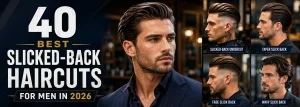
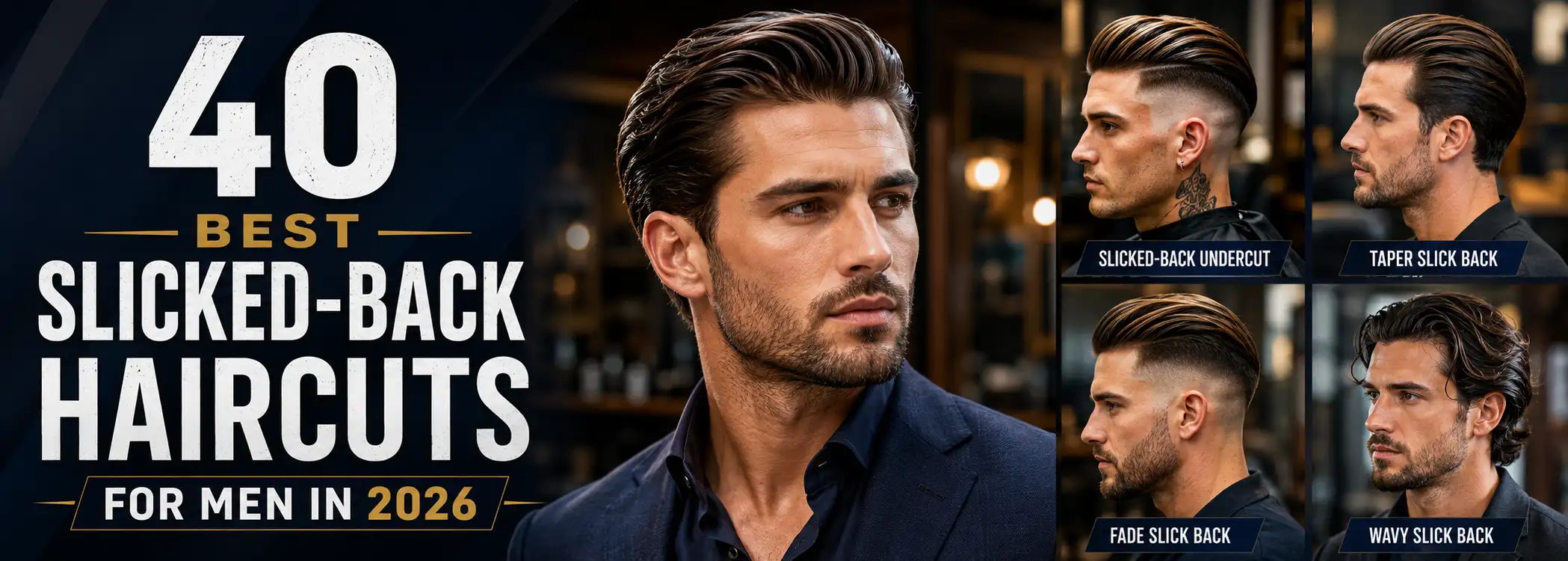
A good slicked-back haircut begins with the cut, not a heavy layer of pomade. The top needs enough length to move backward, while the sides and crown must support the final shape.
This guide covers 40 distinct slick-back haircuts for men, from classic scissor cuts to fades, tapers, undercuts, curls, and longer flows. You’ll also learn how to match the cut to your hair type, face shape, morning routine, and maintenance budget.
The strongest versions in 2026 feel softer and more personal than the rigid, glossy slick backs of the past. Current men’s grooming coverage continues to favor natural texture, longer movement, and styles that work with the hair rather than forcing every strand flat.
Quick Answer
For most men, the best haircut for slicked-back hair has four to five inches through the front, slightly less length near the crown, and enough internal shape to prevent the hair from collapsing.
Choose a low taper for subtle contrast, a fade for sharper sides, an undercut for bold separation, or a layered scissor cut for natural flow.
TL;DR
• Keep enough front length to clear the hairline.
• Choose a taper for softer, easier grow-out.
• Pick a fade for stronger side contrast.
• Preserve natural movement in wavy or curly hair.
• Avoid heavy thinning on fine or dry hair.
• Bring front, side, and back reference photos.
What Is a Slicked-Back Haircut?

A slicked-back haircut leaves enough length on top for the hair to move away from the forehead. The sides may be cut with scissors, tapered around the edges, faded very short, or disconnected through an undercut.
The haircut creates the foundation. Blow-drying, combing, and styling products create the finished direction and level of shine.
A classic slick back lies flatter and looks smoother. A brush back keeps more separation and texture, while a pompadour adds greater height through the front.
Slick Back vs. Brush Back vs. Pompadour
| Style | Main Shape | Finish | Daily Effort |
|---|---|---|---|
| Classic slick back | Flat or gently raised | Smooth, controlled | Moderate |
| Brush back | Loose and flowing | Natural or matte | Easy to moderate |
| Pompadour | High front volume | Structured | Moderate to high |
| Side-part slick back | Diagonal backward flow | Clean and defined | Moderate |
| Textured slick back | Separated backward movement | Matte or low shine | Easy to moderate |
Best Slicked-Back Haircuts at a Glance
Use this table to narrow your choices before exploring the complete list.
| Your Goal | Best Starting Option | Styling Effort | Typical Upkeep |
|---|---|---|---|
| Soft professional finish | Low taper slick back | Moderate | 4–6 weeks |
| Strong side contrast | Mid or skin fade slick back | Moderate | 2–4 weeks |
| Natural movement | Layered scissor slick back | Easy to moderate | 6–8 weeks |
| Easy grow-out | Temple or neckline taper | Easy | 4–6 weeks |
| Bold modern shape | Disconnected undercut | Moderate | 3–5 weeks |
| Fine-hair fullness | Short blunt slick back | Easy to moderate | 4–6 weeks |
| Thick-hair control | Internally layered slick back | Moderate | 5–7 weeks |
| Curly definition | Curly low-taper pushback | Moderate | 4–6 weeks |
| Long-haired style | Collar-length scissor slick | Moderate | 8–12 weeks |
| Lowest daily effort | Short textured brush back | Easy | 4–6 weeks |
Maintenance ranges are practical estimates rather than strict rules. Hair growth rate, fade height, neckline shape, and personal neatness standards all affect timing.
Classic and Professional Slicked-Back Haircuts
Classic slick backs keep the top connected to the sides instead of creating a dramatic contrast. They suit work, formal events, and anyone who prefers a cut that grows out smoothly.
These versions can look polished without becoming shiny or rigid. A low-shine cream or flexible paste often creates a more wearable finish than heavy gel.
1. Classic Scissor-Cut Slick Back
The classic scissor slick back keeps moderate fullness around the sides and enough length through the top for a smooth backward sweep. It looks refined without exposing much scalp.
This is a strong choice for straight, wavy, or moderately thick hair. It also grows out more evenly than a skin fade or disconnected undercut.
Best for: Work, formal events, medium hair
Difficulty: Moderate
Maintenance: Every 5–7 weeks
Ask your barber: “Keep four to five inches in front, shorten gradually toward the crown, and blend the sides with scissors.”
2. Executive Contour Slick Back
The executive contour uses a visible side part and directs the hair backward at a slight angle. It creates cleaner structure than a straight-back style.
This shape works especially well when a natural part or cowlick already pushes the front toward one side. It feels formal but remains flexible enough for daily wear.
Best for: Professional settings and straight hair
Difficulty: Moderate
Maintenance: Every 4–6 weeks
Ask your barber: “Keep a natural side part, leave enough length to comb back, and taper the sideburns and neckline.”
3. Natural Side-Part Slick Back
This variation uses a softer, less defined part than the executive contour. The hair moves diagonally backward without a shaved line or hard separation.
It is useful for men who want a polished style that does not appear overly formal. The loose part also hides minor irregularities in density better than deep comb lines.
Best for: Fine, straight, or lightly wavy hair
Difficulty: Easy to moderate
Maintenance: Every 5–7 weeks
Ask your barber: “Follow my natural part and keep the transition soft rather than cutting a hard part.”
4. Low-Profile Slick Back
The low-profile slick back stays close to the scalp and avoids a tall front. It has a smooth outline but less volume than a quiff or pompadour.
This makes it useful for longer or narrower face shapes. It also fits conservative offices and formal occasions where dramatic height may feel excessive.
Best for: Oblong faces and formal wear
Difficulty: Easy to moderate
Maintenance: Every 4–6 weeks
Ask your barber: “Keep the top long enough to lie back, but avoid extra height or short crown layers.”
5. Rounded Classic Slick Back
A rounded slick back follows the natural curve of the head. The sides stay connected, and the top has gentle fullness rather than sharp corners.
The softer outline works well for square or angular features. It can also help dense hair look controlled without making the head appear too narrow.
Best for: Thick hair and angular faces
Difficulty: Moderate
Maintenance: Every 5–7 weeks
Ask your barber: “Keep the shape rounded through the upper sides and avoid squaring the temple area too sharply.”
6. Textured Classic Brush Back
This cut keeps the connected shape of a classic slick back but adds light separation through the top. The finish appears touchable rather than perfectly combed.
It is one of the easiest ways to modernize the style. Finger styling also makes it more forgiving when the hair shifts during the day.
Best for: Casual offices and wavy hair
Difficulty: Easy
Maintenance: Every 5–7 weeks
Ask your barber: “Add gentle internal texture while keeping the outer shape full and connected.”
7. Slicked Quiff
The slicked quiff lifts the front before directing it backward. It creates more height than a classic slick back but less roundness than a full pompadour.
The front should be longest, with gradual shortening toward the crown. Avoid removing too much support from the center of the top.
Best for: Round faces and thick straight hair
Difficulty: Moderate to high
Maintenance: Every 4–6 weeks
Ask your barber: “Leave the front longest for lift and reduce the height gradually toward the crown.”
8. Swept-Back Pompadour
A swept-back pompadour builds visible height at the hairline, then curves smoothly toward the crown. It has a stronger profile than a standard slick back.
This cut works best when the hair has enough density to support the front. Blow-drying is usually required, so it may not suit a very short morning routine.
Best for: Thick straight or wavy hair
Difficulty: High
Maintenance: Every 4–5 weeks
Ask your barber: “Keep five or more inches in front and create enough internal support for a rounded pompadour.”
Slick Back Fade Haircuts
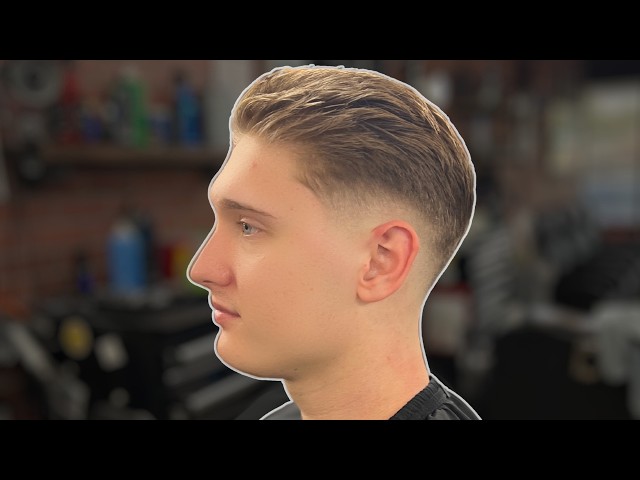
A fade creates a gradual transition from longer hair into very short sides. The height of the fade controls how much contrast the haircut shows.
Low fades feel more balanced and professional. High and skin fades appear sharper but usually require more frequent cleanups.
9. Low Fade Slick Back
A low fade slick back begins close to the ears and neckline. Most of the upper-side weight remains intact, helping the top connect naturally.
This is one of the most versatile fade options. It gives the haircut a clean edge without making the top appear disconnected.
Best for: Work, medium hair, first-time fades
Difficulty: Moderate
Maintenance: Every 3–5 weeks
Ask your barber: “Keep the fade low and preserve enough weight above it to support the slicked-back top.”
10. Mid Fade Slick Back
The mid fade begins around the temple area and removes more side weight than a low fade. It creates a clear contrast without becoming as severe as a high fade.
This shape works well with medium-density hair and a structured top. It may make the top look narrower on very long faces.
Best for: Oval, round, and square faces
Difficulty: Moderate
Maintenance: Every 3–4 weeks
Ask your barber: “Start the fade near the middle of the sides and keep the transition smooth into the longer top.”
11. High Fade Slick Back
A high fade slick back removes most of the hair around the sides before reaching the longer top. The result is bold, narrow, and highly defined.
It places all visual attention on the top and forehead. Men with long or narrow faces may prefer a lower fade that preserves more side width.
Best for: Strong contrast and dense top hair
Difficulty: Moderate
Maintenance: Every 2–4 weeks
Ask your barber: “Take the fade high but keep enough weight near the ridge to prevent the top from sticking out.”
12. Skin Fade Slick Back
The skin fade slick back blends the sides down to bare skin. It creates the cleanest and most dramatic contrast in this guide.
The style looks especially sharp during the first two weeks. It loses that fresh outline faster than a taper or shadow fade.
Best for: Frequent barber visits and bold styling
Difficulty: Moderate
Maintenance: Every 2–3 weeks
Ask your barber: “Give me a low or mid skin fade and keep the top connected unless I request an undercut.”
13. Shadow Fade Slick Back
A shadow fade keeps a small amount of visible hair at its shortest point. It appears softer than a skin fade while still removing lower-side bulk.
This is a practical middle ground for men who want a clean fade without exposing the scalp completely.
Best for: Professional wear and sensitive scalps
Difficulty: Moderate
Maintenance: Every 3–5 weeks
Ask your barber: “Use a shadow fade rather than taking the sides down to skin.”
14. Drop Fade Slick Back
A drop fade curves lower behind the ears instead of following a straight horizontal line. That lower curve preserves more weight around the back of the head.
It works well when the slicked-back top extends into a fuller crown. The shape also adds interest from the side and rear views.
Best for: Dense crowns and medium-length tops
Difficulty: Moderate
Maintenance: Every 3–4 weeks
Ask your barber: “Let the fade drop behind the ears so the crown keeps enough weight.”
15. Temple Fade Brush Back
A temple fade removes hair mainly around the sideburns and temple corners. The rest of the sides remain fuller.
This creates a clean front outline without changing the entire haircut. It is especially useful for longer brush backs and curly styles.
Best for: Longer sides, curls, and subtle contrast
Difficulty: Easy to moderate
Maintenance: Every 3–5 weeks
Ask your barber: “Fade only the temple and sideburn area, then keep the upper sides full.”
Slick Back Taper Haircuts

A taper shortens the hair mainly around the temples, sideburns, and neckline. It usually leaves more fullness than a fade.
Tapers are ideal when you want cleaner edges without losing the natural shape of the sides. They also tend to grow out more softly.
16. Low Taper Slick Back
The low taper slick back cleans the sideburns and neckline while leaving the upper sides mostly untouched. It offers a refined finish with minimal contrast.
This is one of the safest choices for work, school, and first-time slick-back wearers.
Best for: Most hair types and professional settings
Difficulty: Easy to moderate
Maintenance: Every 4–6 weeks
Ask your barber: “Taper only the lower temples and neckline, and leave the upper sides connected.”
17. Temple Taper Brush Back
A temple taper focuses on the corners near the forehead and sideburns. The back and upper sides retain their natural length.
It works particularly well for wavy, curly, and medium-length hair because it cleans the face without flattening the overall silhouette.
Best for: Wavy or curly hair
Difficulty: Easy
Maintenance: Every 4–6 weeks
Ask your barber: “Clean the temple corners with a low taper and keep the rest of the sides natural.”
18. Neck Taper Slick Back
The neck taper leaves the sides almost untouched and gradually shortens the hair at the nape. It is subtle from the front but makes longer hair look tidier from behind.
This option suits men growing their hair past the ears. It removes neck bulk without changing the main shape.
Best for: Medium and long scissor cuts
Difficulty: Easy
Maintenance: Every 4–7 weeks
Ask your barber: “Taper the neckline softly and preserve the length around my ears and temples.”
19. Scissor Taper Slick Back
A scissor taper creates gradual shortening through the sides without using an extremely short clipper setting. The result looks softer and fuller.
It is a strong option for formal haircuts, mature styles, and anyone who dislikes exposed skin around the sides.
Best for: Thick hair and conservative settings
Difficulty: Moderate
Maintenance: Every 5–7 weeks
Ask your barber: “Use scissors or scissor-over-comb to taper the sides while keeping visible fullness.”
Slick Back Undercut Haircuts
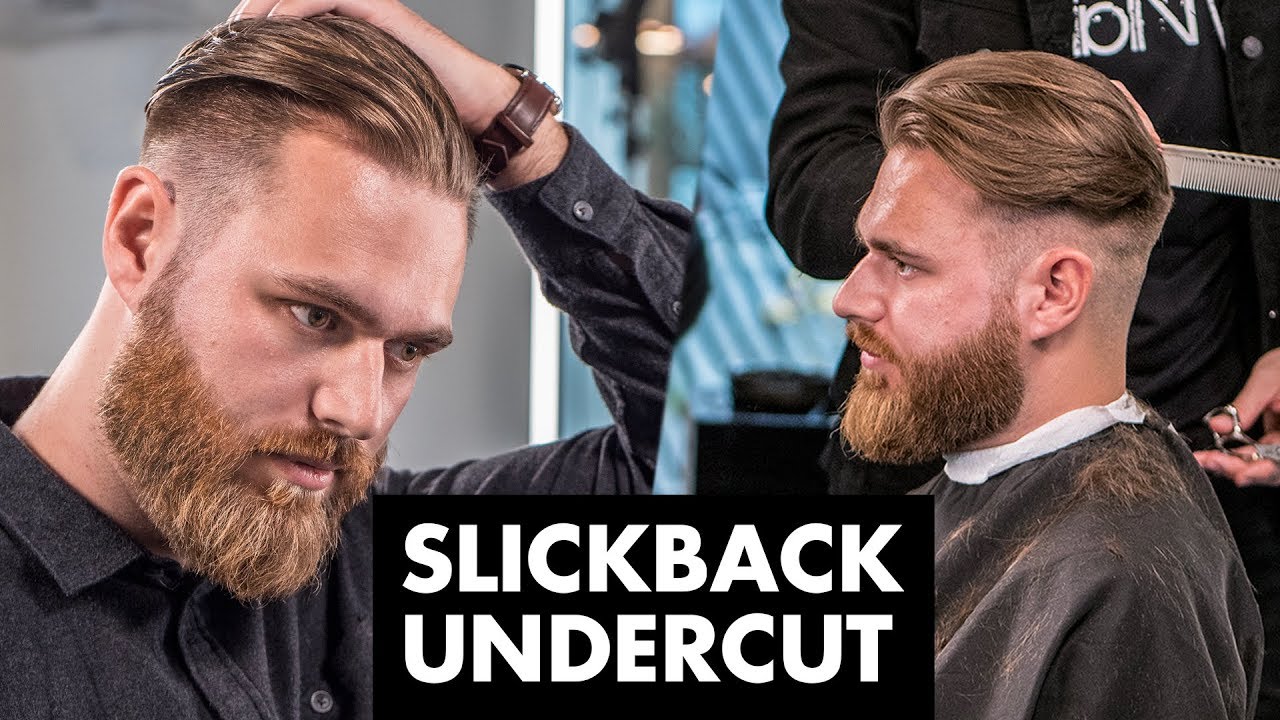
An undercut keeps the top much longer than the sides. The transition may be completely disconnected or softened with a small blend.
Undercuts create strong shape and reduce side bulk. However, they can become awkward during grow-out because the top and sides remain very different lengths.
20. Disconnected Slick Back Undercut
The disconnected undercut has no gradual blend between the long top and short sides. The contrast is immediate and clearly visible.
It gives thick hair a powerful outline and makes the sides quick to style. The top must remain long enough to cover or complement the disconnection.
Best for: Thick straight hair and bold looks
Difficulty: Moderate
Maintenance: Every 3–5 weeks
Ask your barber: “Keep the top completely disconnected from the clipped sides without blending the ridge.”
21. Blended Slick Back Undercut
The blended undercut keeps strong contrast but adds a small transition near the upper sides. It looks less abrupt than full disconnection.
This version grows out more smoothly and offers greater styling flexibility. The hair can often be worn forward or parted when it is not slicked back.
Best for: Versatility and easier grow-out
Difficulty: Moderate
Maintenance: Every 4–6 weeks
Ask your barber: “Keep undercut-level contrast but soften the connection near the ridge.”
22. Undercut Fade Slick Back
This cut combines a disconnected or nearly disconnected top with a fade through the lower sides. It creates several levels of contrast.
The result is detailed and modern but requires careful blending. It suits men who are comfortable maintaining both the fade and long top.
Best for: Defined modern styles
Difficulty: Moderate to high
Maintenance: Every 2–4 weeks
Ask your barber: “Keep the top separated, then fade the lower sides while preserving a clean ridge.”
23. Curly Slick Back Undercut
A curly undercut removes side bulk while keeping enough top length for the curls to move backward. The curls should remain visible rather than being forced completely flat.
This version works best when the top is shaped around its natural shrinkage and direction. A curl-aware barber can prevent an uneven or boxy result.
Best for: Curly and tightly wavy hair
Difficulty: Moderate
Maintenance: Every 4–6 weeks
Ask your barber: “Keep enough curl length on top to push back, and avoid thinning the surface.”
Short Slicked-Back Haircuts

Short hair can move backward once the front is long enough to clear the hairline. It will create a compact pushback rather than a flowing traditional slick back.
These cuts are easier to wash and dry. They may still require control around cowlicks and short front pieces.
24. Short Textured Brush Back
The short textured brush back keeps roughly three inches through the front and adds separation through the ends.
It is less formal than a smooth slick back and requires less product. Finger styling creates a better result than deep comb lines.
Best for: Active routines and straight hair
Difficulty: Easy
Maintenance: Every 4–6 weeks
Ask your barber: “Leave the front long enough to push back and add light point-cut texture.”
25. Ivy League Pushback
An Ivy League pushback combines a short, tapered haircut with extra front length. The front can move backward or slightly to one side.
It is one of the most practical options for work or school. It can also be restyled forward when you want a more casual look.
Best for: Short hair and conservative settings
Difficulty: Easy
Maintenance: Every 3–5 weeks
Ask your barber: “Cut an Ivy League shape but leave extra length through the front for a pushback.”
26. Mini Pompadour Slick Back
The mini pompadour creates a small amount of front lift before moving backward. It gives short hair more shape without requiring dramatic height.
A blow dryer helps, but the routine should remain manageable. Avoid a high fade if you want the haircut to look balanced as it grows.
Best for: Short thick or straight hair
Difficulty: Moderate
Maintenance: Every 4–5 weeks
Ask your barber: “Leave the front slightly longer than the rest of the top for a small pompadour.”
27. Cropped Side-Part Slick
This compact style uses a short natural part and directs the front diagonally backward. It feels cleaner and more structured than a loose brush back.
The diagonal direction is useful for hair that resists being pushed straight back.
Best for: Cowlicks and straight hair
Difficulty: Easy to moderate
Maintenance: Every 4–6 weeks
Ask your barber: “Follow my natural part and keep enough front length to sweep back and across.”
Medium-Length Slicked-Back Haircuts

Medium hair offers the most flexibility for a slick back. It can lie flat, form a pompadour, keep waves, or flow behind the ears.
The crown and upper sides must be balanced carefully. Too much thinning can make the top separate or lose support.
28. Medium Layered Brush Back
This cut uses long internal layers to help the top move backward without forming one heavy block. The ends remain full enough to look healthy.
It suits straight and wavy hair, especially when you prefer a natural finish rather than visible comb lines.
Best for: Medium straight or wavy hair
Difficulty: Easy to moderate
Maintenance: Every 6–8 weeks
Ask your barber: “Add long internal layers that support backward movement without thinning the perimeter.”
29. Medium Scissor-Cut Flow
A medium scissor flow keeps fuller sides, a connected crown, and enough length to move behind the ears.
It has less contrast than a fade and looks good even when lightly styled. This is an excellent option for men growing out a shorter cut.
Best for: Grow-out stages and natural movement
Difficulty: Easy
Maintenance: Every 6–8 weeks
Ask your barber: “Shape the whole haircut with scissors and keep enough side length to flow behind the ears.”
30. Ear-Tucked Slick Back
The hair is shaped to sit neatly behind the ears while the top moves backward. It creates a controlled outline without shortening the sides.
This style suits professional environments that allow medium-length hair. It also offers an easy way to manage the sides during grow-out.
Best for: Medium to long straight or wavy hair
Difficulty: Easy
Maintenance: Every 6–8 weeks
Ask your barber: “Keep enough side length to tuck behind my ears and clean the shape around the neckline.”
31. Medium Slick Back With a Natural Part
A subtle part creates diagonal movement through medium-length hair. The top stays loose rather than forming a rigid side-part shape.
This is useful when straight-back styling exposes an uneven hairline or makes the front feel too severe.
Best for: Broad foreheads and natural cowlicks
Difficulty: Moderate
Maintenance: Every 5–7 weeks
Ask your barber: “Keep a soft natural part and preserve enough front length for diagonal backward movement.”
Long and Texture-Specific Slicked-Back Haircuts

Long slick backs need balanced layers and clean ends. The goal is to remove excess bulk without creating short surface pieces that lift or frizz.
Current men’s hair trends continue to support longer, looser shapes that show individual texture rather than hiding it.
32. Collar-Length Scissor Slick Back
This style reaches the collar and keeps a connected shape around the ears and nape. Light internal layering prevents the hair from falling as one heavy sheet.
It works well with straight or softly wavy hair. The cut can be tucked, tied, or worn loose on days when you do not want a slick finish.
Best for: Medium-long hair and flexible styling
Difficulty: Moderate
Maintenance: Every 8–10 weeks
Ask your stylist: “Keep the perimeter strong and add only enough internal layering for backward movement.”
33. Long Layered Brush Back
The long layered brush back uses long, blended layers through the crown and sides. The layers help the hair fall away from the face without removing overall length.
This style looks best when it retains natural movement. Avoid short crown layers unless you want more volume and visible texture.
Best for: Thick, straight, or wavy hair
Difficulty: Moderate
Maintenance: Every 8–12 weeks
Ask your stylist: “Add long layers that remove internal weight while keeping the outer length full.”
34. Shoulder-Length Slick Back
A shoulder-length slick back creates a dramatic, flowing outline. The cut should include clean ends and enough shaping around the face to prevent heaviness.
It can be worn loose, tucked behind the ears, or secured into a low tie. A small temple or neckline taper can add neatness without sacrificing length.
Best for: Long straight or wavy hair
Difficulty: Moderate
Maintenance: Every 10–12 weeks
Ask your stylist: “Preserve the shoulder length, clean the ends, and shape the front to move away from my face.”
35. Matte Slick Back for Straight Hair
Straight hair can show every product line and cutting mark. A softly textured top with a matte finish prevents the style from looking flat or oily.
The perimeter should remain strong, especially when the hair is fine. Excessive point cutting may make the ends appear weak.
Best for: Straight hair and natural finishes
Difficulty: Easy to moderate
Maintenance: Every 5–7 weeks
Ask your barber: “Keep the outer shape full and add only light internal texture for separation.”
36. Loose Slick Back for Wavy Hair
This style follows the natural wave pattern instead of combing every bend flat. The front moves backward while the surface remains loose and dimensional.
Longer layers usually behave better than short surface layers. Finger styling helps preserve the wave pattern.
Best for: Medium or long wavy hair
Difficulty: Easy to moderate
Maintenance: Every 6–8 weeks
Ask your barber: “Shape the waves for backward movement and avoid short layers that may create frizz.”
37. Curly Low-Taper Pushback
A low taper cleans the edges while the curly top moves upward and backward. The finished style keeps curl definition instead of creating a smooth shell.
The cut should account for shrinkage and density. Judge the top length when the curls are dry or close to their natural state.
Best for: Loose to medium curls
Difficulty: Moderate
Maintenance: Every 4–6 weeks
Ask your barber: “Keep enough curl length to push back and taper only the temples and neckline.”
38. Rounded Coily Brush Back
The rounded coily brush back creates a smooth outer silhouette while preserving the natural coil pattern inside the shape.
The hairline should not be pulled backward with excessive tension. A rounded taper often blends more naturally than a very high, squared fade.
Best for: Coily and tightly curled hair
Difficulty: Moderate
Maintenance: Every 4–6 weeks
Ask your barber: “Keep a rounded shape, preserve coil definition, and clean the edges without flattening the top.”
39. Blunt Slick Back for Fine Hair
Fine hair often appears fuller when the ends stay relatively blunt. The top should remain long enough to move backward but not so long that it separates into thin strands.
A low taper or scissor-cut side usually creates a smoother density transition than a high skin fade.
Best for: Fine strands or moderate density
Difficulty: Easy to moderate
Maintenance: Every 4–6 weeks
Ask your barber: “Preserve density through the ends and avoid aggressive thinning shears.”
40. Internally Layered Slick Back for Thick Hair
Thick hair needs weight removal inside the haircut rather than short pieces cut across the surface. Internal layering allows the top to settle while preserving a smooth exterior.
This technique works with tapers, fades, and scissor-cut sides. The right amount of weight should remain near the crown to prevent the hair from standing up.
Best for: Dense, coarse, or heavy hair
Difficulty: Moderate
Maintenance: Every 5–7 weeks
Ask your barber: “Remove bulk underneath the surface, but keep enough crown weight for the hair to lie backward.”
How to Choose a Slick Back for Your Hair Type
Hair texture affects how easily the top moves, how much length it needs, and which finish looks natural.
Do not choose a haircut only because it looks good on someone with a different texture. Use the photo for shape, then ask your barber to adapt the construction.
| Hair Type | Best Approach | Avoid |
|---|---|---|
| Straight hair | Light texture, strong perimeter, moderate top length | Heavy product and excessive thinning |
| Wavy hair | Long layers and finger styling | Flattening every wave |
| Curly hair | Curl-preserving top with tapered edges | Cutting without considering shrinkage |
| Coily hair | Rounded shape and low-tension styling | Forcing the surface completely flat |
| Fine hair | Blunt ends, gentle taper, lightweight finish | Long oily strands and deep comb lines |
| Thick hair | Internal weight removal and crown control | Short surface layers that create lift |
| Coarse hair | Hydration, longer top length, controlled debulking | Very short top lengths that resist direction |
Fine Hair vs. Low-Density Hair
Fine hair describes the thickness of each strand. Low density means fewer strands are growing within an area.
A person can have fine strands but high density, or thick strands with lower density. Your barber should consider both before adding texture or choosing a high-contrast fade.
Avoid using a haircut to diagnose hair changes. Sudden or unexplained shedding should be discussed with an appropriate health professional.
Best Slick Back Haircuts by Face Shape

Face shape is a useful guide, not a fixed rule. Your profile, forehead, hairline, beard, and personal preferences also affect the result.
The main goal is to balance top height with side fullness.
| Face Shape | Helpful Adjustment | Consider Avoiding |
|---|---|---|
| Oval | Most slick backs work well | Unnecessary extreme height |
| Round | Moderate front lift and controlled sides | Very flat top with wide sides |
| Square | Soft taper or textured top | Overly rigid squared corners |
| Oblong | Lower top and fuller upper sides | High fade with tall pompadour |
| Heart-shaped | Soft front volume and temple weight | Very narrow, exposed temples |
| Diamond | Maintain width near upper sides | Extremely tight temple fades |
| Triangle | Add measured volume through top and temples | Removing all side width |
Slick Backs for a Round Face
A small amount of front height can create a longer vertical line. A low or mid fade may also reduce width around the lower sides.
Avoid building an oversized pompadour. Moderate height usually looks more balanced and requires less effort.
Slick Backs for a Long or Oblong Face
Keep the front lower and preserve some fullness above the ears. A scissor taper or low fade is usually more balanced than a high skin fade.
A side-directed slick back can also break up the vertical line.
Slick Backs for a Broad Forehead
A severe straight-back style exposes the full hairline. A softer side-part slick or diagonal brush back can feel less stark.
You can also keep gentle lift rather than pulling the front tightly against the scalp.
How Long Does Hair Need to Be for a Slick Back?
Many short pushbacks become possible once the front reaches roughly three inches, while a smoother traditional slick back often benefits from four to five inches. Texture, shrinkage, cowlicks, and growth direction can change the usable length. Current barber-oriented guidance commonly places slicked-back tops within a three-to-five-inch starting range.
Use these ranges as consultation points rather than rigid measurements.
| Desired Result | Approximate Front Length |
|---|---|
| Short pushback | Around 3 inches |
| Compact slick back | 3–4 inches |
| Classic slick back | 4–5 inches |
| Side-part slick back | 3–5 inches |
| Pompadour slick back | 4–6 inches |
| Long flowing slick back | 6 inches or longer |
Curly and coily hair may need greater stretched length because the visible dry length becomes shorter after shrinkage.
How to Style Slicked-Back Hair
The haircut determines whether the style is easy or difficult. Styling should guide the hair in the direction the cut already supports.
A modern slick back does not need to look wet or rigid. Texture-forward versions often use less product and more blow-drying.
Step-by-Step Styling Method
- Start with clean, towel-damp hair. Hair should be damp enough to reshape but not dripping wet.
- Apply a lightweight pre-styler. Use a small amount of cream or mousse when you need control without heaviness.
- Dry the hair backward. Direct the airflow from the forehead toward the crown while lifting or smoothing with your fingers or brush.
- Work product between your palms. Warm a small amount before spreading it through the mid-lengths and ends.
- Shape the front first. Create the desired height, part, or diagonal direction before finishing the crown.
- Use a comb or fingers. A comb creates cleaner lines. Fingers create a softer, more natural finish.
- Add product only where needed. Do not coat the roots with a large amount at the start.
- Set lightly when necessary. A flexible hairspray can improve hold without creating a hard shell.
Current styling guidance generally recommends choosing product weight according to texture: lightweight creams or pastes for fine hair, flexible pastes for waves and curls, and stronger hold for dense or long hair.
Best Product Type for a Slick Back
The right product depends on the desired finish and hair density. Brand matters less than weight, hold, shine, and flexibility.
Start with less product than you expect. It is easier to add another small amount than remove an oily coating.
| Desired Finish | Product Type | Best For |
|---|---|---|
| Natural and flexible | Styling cream | Medium, wavy, or dry hair |
| Matte and textured | Paste or clay | Straight, short, or thick hair |
| Classic medium shine | Water-based pomade | Traditional slick backs |
| Strong wet look | Firm gel | Formal or highly controlled styles |
| Lightweight volume | Mousse or texture spray | Fine or flat hair |
| Curl definition | Flexible curl cream | Curly and coily hair |
| Extra hold | Flexible hairspray | Humidity or long events |
How to Avoid a Greasy Slick Back
• Apply product to the mid-lengths and ends first.
• Use only the residue on your hands near the roots.
• Avoid combining several high-shine products.
• Choose lightweight products for fine or low-density hair.
• Dry the hair into shape before adding heavy hold.
• Use fingers instead of deep comb lines for a softer finish.
• Wash out old product before adding another full layer.
What to Ask Your Barber
A reference photo communicates the general shape, but it does not explain the cut underneath. Bring images showing the front, side, and back.
Choose references with a texture and density similar to yours whenever possible.
General Slick Back Barber Script
“Leave about four to five inches through the front and shorten the top gradually toward the crown. Keep enough weight for the hair to move backward without separating. Blend the top into the sides, add light internal texture, and avoid making the ends thin.”
Low Taper Slick Back Script
“Keep the top medium length with enough front length to brush back. Taper only the temples, sideburns, and neckline. Leave the upper sides full and connected.”
Fade Slick Back Script
“Leave four to five inches on top and shorten slightly toward the crown. Give me a low or mid fade, but keep enough weight near the ridge so the top does not stick out.”
Disconnected Undercut Script
“Keep the top long and disconnected from the sides. Clip the sides short without blending into the top, and leave enough front length to flow backward.”
Curly Slick Back Script
“Keep enough curl length on top to move backward when dry. Preserve the curl pattern, avoid aggressive thinning, and clean the temples and neckline with a low taper.”
Long Scissor Slick Back Script
“Maintain the overall length, clean the perimeter, and add long internal layers for movement. Keep the crown connected and avoid short surface layers.”
What Your Barber Should Check
A skilled consultation should consider more than the reference photo.
Your barber or stylist should assess:
• Front growth direction
• Cowlicks near the hairline
• Crown position and rotation
• Hair density through the top
• Strand thickness
• Curl shrinkage
• Forehead and face proportions
• Current side length
• Previous undercut or fade lines
• Daily styling time
Tell your barber how the style behaves after washing. Hair that appears cooperative in the chair may move differently when you style it at home.
Slick Back Maintenance Guide
The shorter the sides, the sooner the haircut loses its clean outline. Longer scissor cuts grow out more gradually but still need reshaping.
| Haircut Type | Cleanup Range | Full Reshape Range |
|---|---|---|
| Skin fade | 2–3 weeks | 3–4 weeks |
| Mid or high fade | 2–4 weeks | 4 weeks |
| Low fade | 3–5 weeks | 4–6 weeks |
| Temple or low taper | 4–6 weeks | 6 weeks |
| Scissor taper | 5–7 weeks | 6–8 weeks |
| Disconnected undercut | 3–5 weeks | 5–7 weeks |
| Medium scissor cut | 6–8 weeks | 8 weeks |
| Long layered cut | 8–12 weeks | 10–12 weeks |
Which Slick Back Grows Out Best?
A low taper or scissor-cut slick back usually grows out more smoothly because the top and sides remain connected.
A skin fade shows regrowth quickly, while a disconnected undercut may develop an awkward shelf as the sides become longer.
How to Grow Out a Slick Back Undercut
• Let the sides grow without repeatedly cutting them back to the original length.
• Keep the top long enough to cover the ridge during the early stages.
• Ask for small blending adjustments rather than another full undercut.
• Use a side part or loose brush back while the sides catch up.
• Schedule reshaping every six to eight weeks.
• Expect the process to take several months, depending on the original contrast.
Common Slick Back Haircut Mistakes
Removing Too Much Crown Weight
The crown supports the backward flow. If it is cut too short or thinned heavily, the hair may separate, stand up, or fall forward.
Ask the barber to preserve enough connection between the front and crown.
Choosing a Fade That Is Too High
A high fade can make the haircut look narrow and top-heavy. It may also exaggerate length in an oblong face.
Start lower when you are unsure. The fade can always be taken higher during a future appointment.
Copying a Different Hair Texture
A straight-hair reference may not behave like curly or coarse hair. Focus on the silhouette, then adapt the layering and length.
Bring a second image with a texture closer to your own.
Using Too Much Product
Heavy product can separate fine hair, flatten waves, and make the scalp more visible.
Begin with a small amount and build only where control is missing.
Asking for “Texture” Without Explaining the Goal
Texture can mean internal layering, point cutting, razor work, or visible separation. These techniques do not produce the same result.
Explain whether you want less bulk, more movement, or a rougher finish.
Ignoring the Grow-Out
A skin fade or disconnected undercut may look excellent on day one but demand more appointments.
Choose a taper or scissor cut when longer maintenance intervals matter.
Flattening Curly Hair
Curly hair does not need to become straight to move backward. Forcing it flat may remove the texture that makes the style work.
Request a pushed-back shape that keeps visible curl definition.
Slicked-Back Haircuts for Work, School, and Formal Events
A professional haircut should fit the standards of your own workplace or school. There is no single style that applies to every environment.
Cuts with softer contrast and natural shine usually adapt to more settings.
Best Work-Friendly Options
• Classic scissor slick back
• Executive contour
• Natural side-part slick back
• Low taper slick back
• Scissor taper slick back
• Medium scissor flow
• Ear-tucked slick back
• Low-profile slick back
Best Formal Options
• Classic scissor slick back
• Executive contour
• Swept-back pompadour
• Low fade slick back
• Low-profile slick back
• Side-part slick back
Best School-Friendly Options
• Ivy League pushback
• Short textured brush back
• Low taper slick back
• Cropped side-part slick
• Mini pompadour
• Temple taper brush back
Frequently Asked Questions
What haircut is best for slicked-back hair?
The most versatile option is a medium-length top with a low taper or scissor-cut sides. It creates enough backward movement without requiring extreme contrast.
Choose a fade for a sharper result or a layered scissor cut for softer flow.
Is a slick back a haircut or a hairstyle?
It can refer to both. The haircut leaves the necessary length and creates the supporting shape.
The finished slick back is created by drying, combing, and styling the hair backward.
How long should my hair be before I slick it back?
Around three inches can create a short pushback. Four to five inches usually provides smoother movement and more styling options.
Curly or coily hair may require additional stretched length because of shrinkage.
Can very short hair be slicked back?
Very short hair cannot create a long flowing slick back, but it can form a compact pushback or mini pompadour.
Keep the front slightly longer than the crown to establish a clear backward direction.
Does slicked-back hair work with curls?
Yes. Curly hair can be shaped upward and backward while keeping visible curl definition.
The goal is controlled direction, not forcing the curls completely flat.
Which slick back is easiest to maintain?
A short brush back, Ivy League pushback, or low taper slick back is usually easier than a pompadour, skin fade, or disconnected undercut.
Choose a natural finish when you want to reduce daily styling time.
What is the difference between a taper and a fade?
A taper shortens the hair mainly around the temples and neckline. It leaves more fullness through the sides.
A fade removes more side length and creates a stronger transition from short to long.
Is slicked-back hair professional?
It can be professional when the cut is neat, proportioned, and appropriate for the setting. Low tapers, side parts, and scissor cuts tend to be the most adaptable options.
A natural or medium-shine finish often feels more understated than a rigid wet look.
How do I stop a slick back from looking greasy?
Use a smaller amount of product and apply it through the mid-lengths before touching the roots.
Choose a low-shine cream, paste, or clay when your hair is fine or naturally oily.
Do I have to blow-dry slicked-back hair?
Not always, but blow-drying makes the direction and volume easier to control. It also reduces the amount of heavy styling product needed.
Short or naturally cooperative hair may work with simple towel drying and a flexible cream.
Can a slick back hide a receding hairline?
A slick back exposes the hairline rather than covering it. Some men prefer that clean, open look, while others feel more comfortable with a side sweep or textured style.
Choose the direction that makes you feel confident rather than treating one haircut as a universal solution.
Should I choose a matte or shiny finish?
Choose matte or low shine for a softer, more casual appearance. Select medium or higher shine for a classic or formal finish.
Hair density also matters because high shine can make fine or separated strands appear more visible.
Conclusion
The best slicked-back haircut is not always the sharpest fade or tallest pompadour. It is the version that works with your texture, growth pattern, styling ability, and maintenance schedule.
Start by choosing the side treatment: scissor cut, taper, fade, or undercut. Then decide whether you want a flat classic finish, natural brush back, side part, or added front volume.
Save one primary reference and one softer alternative. Show both to your barber, explain your daily routine, and ask which version will work best with your crown, density, and natural direction.