By a Licensed Cosmetologist with 10+ Years in Protective Styling | Reviewed by a Certified Trichologist
Last Updated: June 2026
Whether you’re sitting in a stylist’s chair for the first time or you’ve had more braid appointments than you can count, choosing the right braided hairstyle still isn’t simple. The options have multiplied dramatically — knotless braids alone come in dozens of variations, and newer techniques like stitch-feed combinations and boho knotless hybrids have changed what’s possible in a single appointment.
The challenge most people face isn’t finding inspiration. It’s finding honest information. Which styles actually last? Which ones hurt? What does a style really look like after four weeks, not just on install day? What should 4C-haired naturals avoid, and why? What are the best braids for short hair, and which styles work for men?
This guide answers all of that. It covers 45+ braided hairstyles across every major category — individual braids, scalp styles, updos, half-up styles, men’s braids, kids’ braids, and everything in between — with real descriptions of how each style feels to wear, how long it genuinely lasts, and which hair types each style suits best.
Quick Answer: What Are Braided Hairstyles?
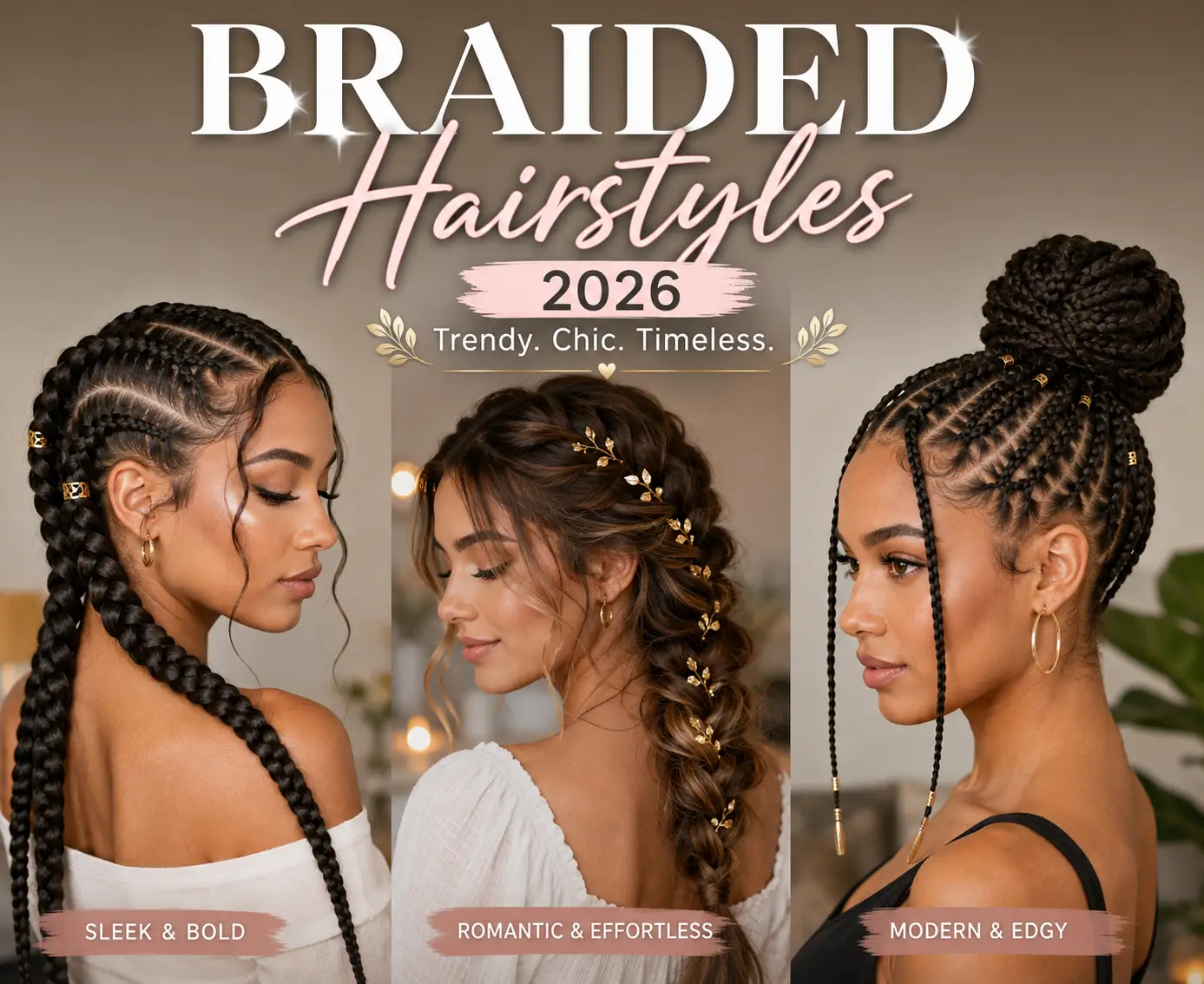
Braided hairstyles are styles created by interlacing three or more strands of natural hair, extension hair, or both into a structured pattern. The most popular types of braids include box braids, knotless braids, cornrows, Fulani braids, goddess braids, boho braids, stitch braids, lemonade braids, Dutch braids, and French braids.
The best braid style for you depends on:
- Your hair type and density (fine, medium, thick; 3A through 4C)
- Scalp sensitivity and history of tension-related discomfort
- Desired maintenance level and daily routine
- Length and occasion — everyday wear, vacation, wedding, or prom
- Lifestyle — active, professional, or creative
Why Braided Hairstyles Stay Popular
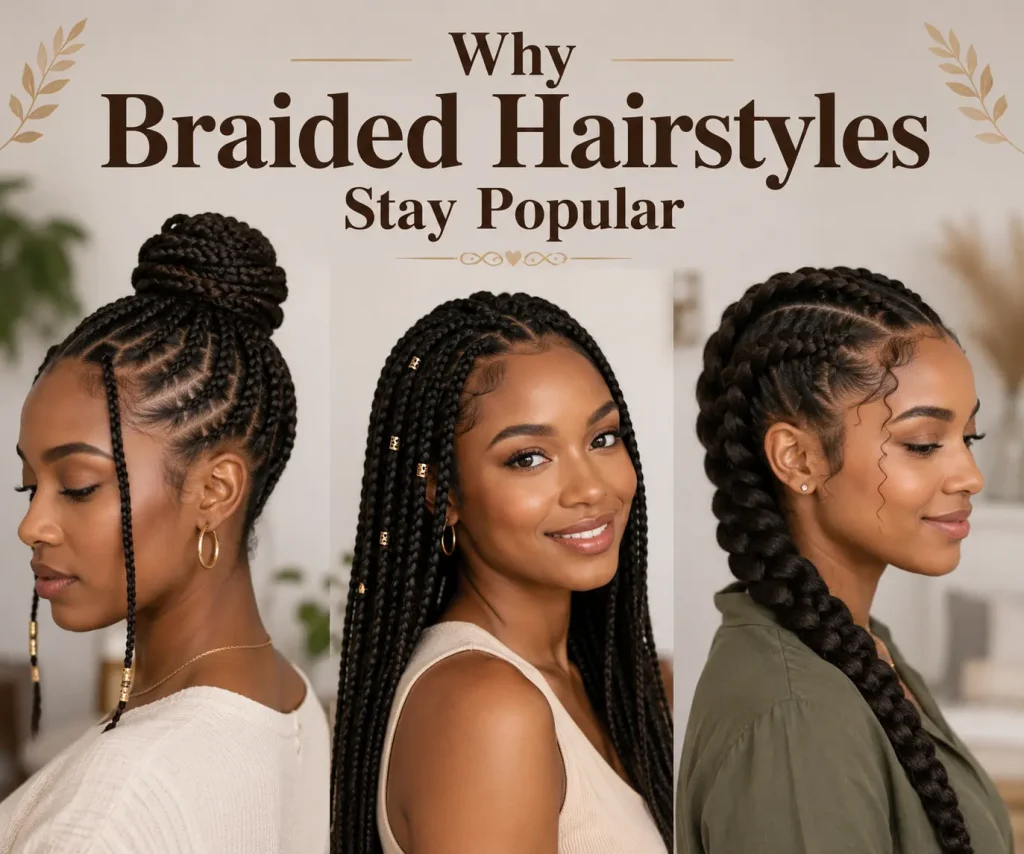
Braiding has existed across cultures for thousands of years — documented in ancient Egypt, West Africa, Indigenous communities across multiple continents, and Northern Europe. It hasn’t survived that long because of trends. It’s survived because it works practically, aesthetically, and for hair health when done correctly.
In 2026, braided hairstyles for Black women and African American women remain the most culturally significant and stylistically diverse category in protective styling. But the appeal has expanded — braids are now widely worn across all hair textures, all genders, and all ages.
The practical advantages are real and measurable. A set of medium knotless braids installed on a Sunday afternoon can eliminate daily styling decisions for the next four to six weeks. That’s genuine, reclaimed time. For people with natural hair, 4C hair, curly hair, or textured hair generally, braids reduce the daily manipulation — the combing, brushing, heat styling — that causes most mechanical breakage.
Modern braid techniques have also evolved substantially. Lighter installation methods, more natural-looking hairlines, softer finishes, and curly-end textures have made today’s braids more comfortable and realistic-looking than styles from even five years ago.
Common Reasons People Get Braided Hairstyles
| Reason | Why It Matters |
|---|---|
| Protective styling | Reduces daily manipulation and heat damage |
| Easier daily routine | Eliminates styling time for weeks |
| Vacation and travel | Low-maintenance in any climate |
| Gym and active lifestyle | Keeps hair secure during workouts |
| Professional appearance | Sleek, polished, office-appropriate |
| Hair growth retention | Reduces mechanical breakage over time |
| Cultural expression | Deep roots in African braiding traditions |
| Creative self-expression | Endless color, pattern, and style options |
Types of Braids: Complete Style Guide
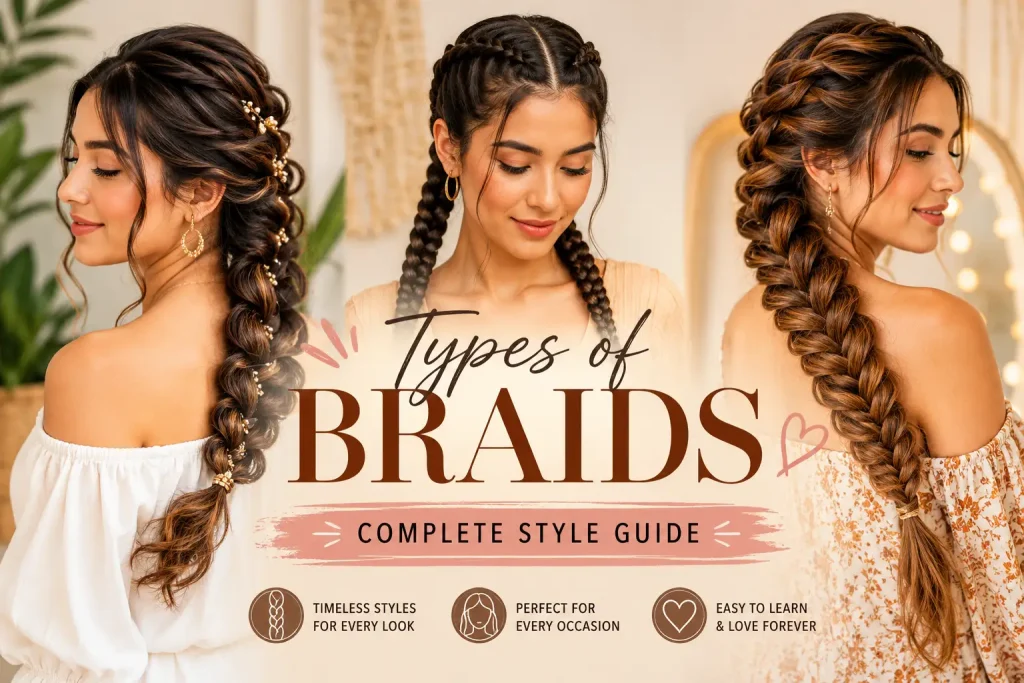
Before diving into individual styles, it helps to understand the main types of braids and how they differ technically. This is the foundation for choosing the right style for your hair, scalp, and lifestyle.
Individual braids (box braids, knotless braids, micro braids) hang freely from the scalp and are created from square or triangular sections. They offer the most styling flexibility.
Scalp braids (cornrows, stitch braids, Ghana braids, goddess braids) lie flat against the scalp surface. They’re lighter, more athletic-friendly, and generally faster to install.
Combination styles (Fulani braids, tribal braids, half-up styles) mix scalp braiding techniques with individual hanging braids in the same install.
Technique-based styles (feed-in braids, knotless technique, Dutch braids, French braids) describe the method used rather than the finished shape — these techniques can be applied within many different styles.
Knotless Braids: The Style That Changed Everything
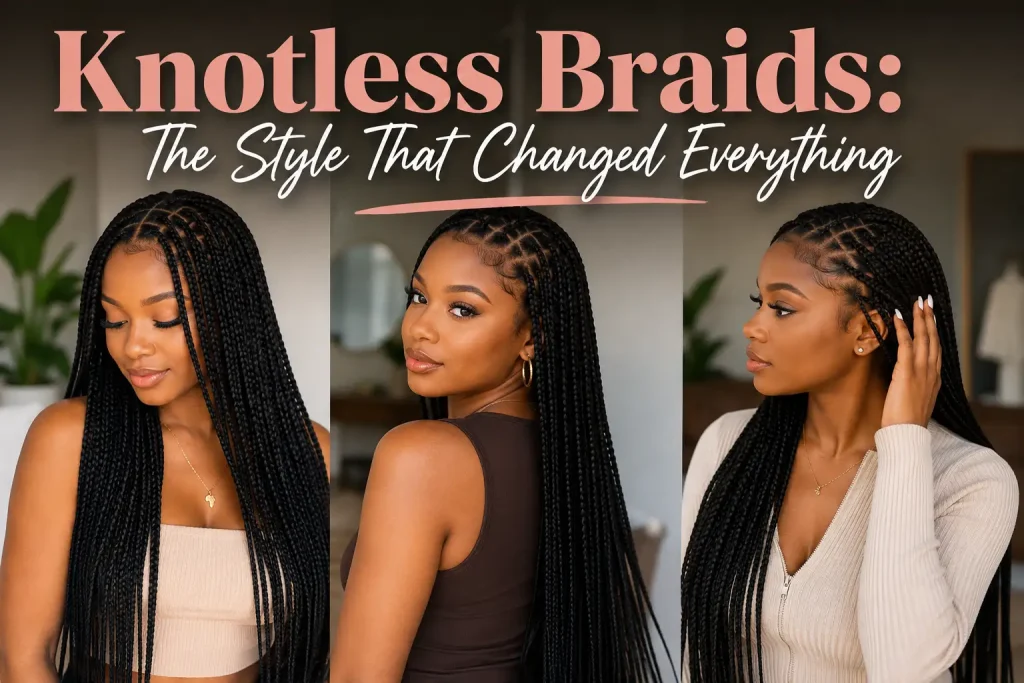
Knotless braids are currently the most requested protective braid style, and the reasons go beyond trend. They represent a genuine technical improvement over traditional box braids for most wearers.
How Knotless Braids Work
Traditional box braids begin with a small overhand knot that anchors extension hair to your natural hair right at the root. That knot concentrates weight and tension at the follicle immediately — and stays there for the entire wear period.
Knotless braids eliminate that anchor entirely. The stylist begins with your natural hair only, then gradually feeds extension hair into the braid as it progresses down the strand. By the time the extension hair carries most of the braid’s weight, it’s already several inches from the scalp. The result is a braid that lies flatter, moves more freely, and puts meaningfully less tension at the root.
This difference matters significantly for long-term scalp health. Traction alopecia — gradual hairline recession caused by chronic pulling — is one of the most common forms of hair loss in people who wear braids regularly. Lower-tension installation methods reduce cumulative follicle stress over years of protective styling.
Popular Knotless Braid Variations
- Medium knotless braids — The most balanced option. Comfortable, versatile, achievable in most salons.
- Small knotless braids — More definition, longer install time, exceptional styling versatility.
- Large knotless braids — Faster install, bold look, slightly less styling flexibility.
- Knotless braids with curly ends — Extension hair left unbraided at the tips for a soft, textured finish. One of the defining styles of 2025–2026.
- Boho knotless braids — Loose curly strands throughout the braid, not just at the ends. Creates a romantic, lived-in finish.
- Ombre knotless braids — Two-tone extension hair transitioning from dark roots to lighter tips.
- Jumbo knotless braids — 6–10 large braids total. Dramatic, fast to install.
- Triangle-part knotless braids — Geometric scalp sections creating a visible pattern when braids are pulled back.
- Knotless braids with beads — Wooden or metallic beads added throughout or at the ends.
Who Knotless Braids Work Best For
Anyone with a sensitive scalp, people prone to headaches after braid installs, first-time braid clients, and anyone who frequently wears their braids in updos or ponytails. Works well on 3A through 4C textures. Fine-haired naturals should choose medium rather than small braids to keep overall weight manageable.
Install time: 4–8 hours. Typical wear: 4–6 weeks.
Box Braids: The Classic That Still Wins
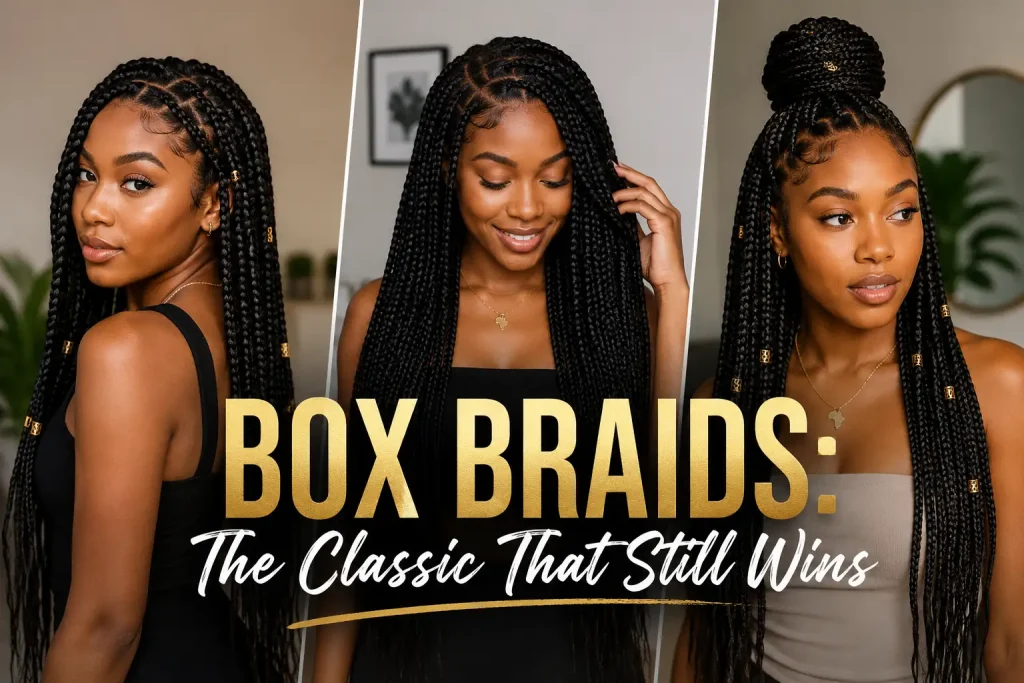
The Box braids have been a dominant protective style for decades, and they haven’t stayed popular by accident. The square-sectioned, fully extended individual braid offers longevity, styling versatility, and visual impact that most other styles struggle to match.
The primary distinction from knotless braids is the knot anchor at the root — extension hair is folded over and knotted before braiding begins, creating a firmer, more structured braid that holds its shape longer. The trade-off is more initial tension and a less natural-looking hairline.
Popular Box Braid Styles
- Jumbo box braids — 10–20 large braids. Bold, fast to install, great for casual styling.
- Medium box braids — The classic balance. Around 30–60 braids total. Excellent for everyday and formal styling.
- Small box braids — 80–150+ braids. More styling options, longer install (often 8–12 hours).
- Micro box braids — 200+ braids. Maximum longevity but the highest install commitment.
- Waist-length box braids — Any size taken to waist length or longer. Dramatically bold.
- Braided bob — Braid length at chin to shoulder. Lower weight, faster install.
- Triangle-part box braids — Geometric sections creating a visible scalp pattern.
- Ombre box braids — Two-tone extension hair from darker roots to lighter tips.
- Colored box braids — Burgundy, honey blonde, ocean blue, and auburn are trending in 2026.
- Layered box braids — Different lengths throughout the style for dimension and movement.
Box Braid Size and Longevity Guide
| Braid Size | Install Time | Average Longevity |
|---|---|---|
| Micro | 10–14 hours | 8–10 weeks |
| Small | 8–12 hours | 7–8 weeks |
| Medium | 5–8 hours | 6–8 weeks |
| Large | 3–5 hours | 4–6 weeks |
| Jumbo | 2–3 hours | 3–5 weeks |
Typical wear: 6–8 weeks with proper maintenance.
Cornrow Hairstyles: More Versatile Than Most People Realize
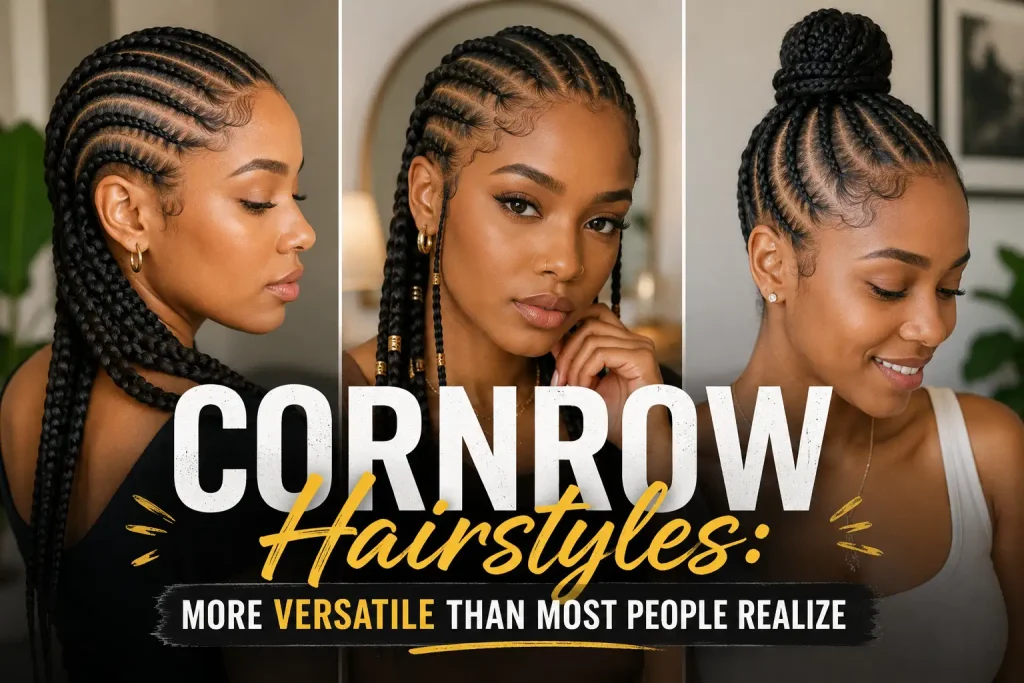
Cornrows are among the oldest and most culturally significant braid styles in the world, with documented roots across West African, Egyptian, and Indigenous cultures. In 2026, modern cornrow styling has expanded far beyond simple straight-back rows into elaborate freestyle patterns, stitch variations, and hybrid styles.
Unlike box braids, cornrows sit against the scalp in raised rows. The stylist braids continuously along the scalp surface, adding hair underhand at each stitch. The result is a flat, neat row that conforms to the head shape.
Popular Cornrow Styles
- Straight-back cornrows — The classic. 4–10 clean rows from the front hairline to the nape.
- Feed-in cornrows — Extension hair gradually added as braiding progresses, creating a naturally fuller appearance.
- Curved cornrows — Rows curving around the head in half-circles or C-shapes.
- Zigzag cornrows — Angular, geometric parting for a bold scalp pattern.
- Freestyle cornrow patterns — Custom designs: spirals, waves, geometric shapes, mixed widths.
- Cornrow ponytail — Multiple rows converging into a ponytail or bun.
- Side-parted cornrows — Rows sweeping asymmetrically to one side.
- Half cornrows, half free braids — Scalp rows at the top transitioning to hanging individual braids.
- Cornrow bob — Rows feeding into a short style ending at the chin or jaw.
- Stitch cornrows — Extra-sharp parting with gel work for crisp definition.
Why Cornrows Are Ideal for Active Lifestyles
Because cornrows sit flush against the scalp, they’re the most practical braid style for athletes, frequent gym-goers, and swimmers. No swinging length to manage, no heavy extensions weighing down a ponytail, and excellent scalp access for post-workout cleansing. They also install faster and cost less than individual braid styles.
Typical wear: 2–4 weeks.
Fulani Braids: Cultural Heritage Meets Modern Styling
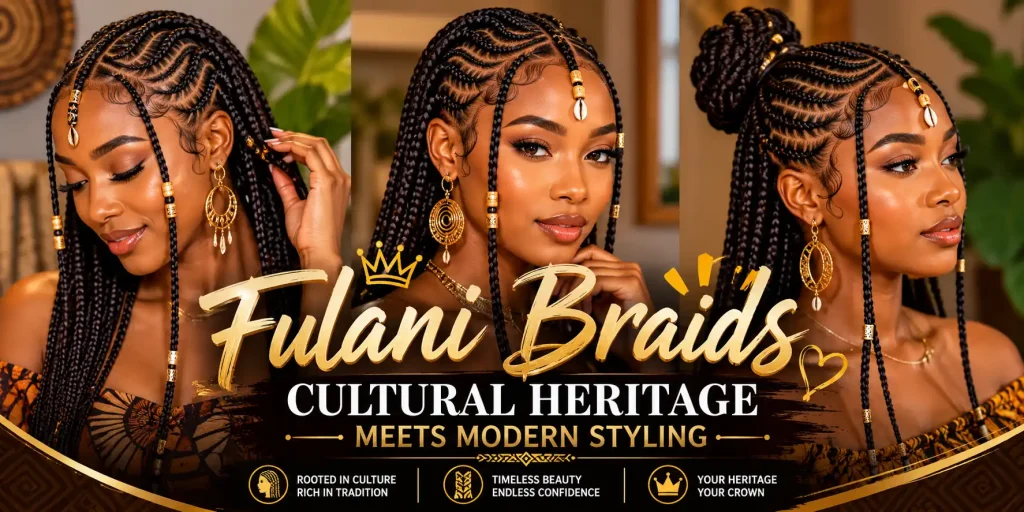
The Fulani braids originate with the Fula (Fulani) people of West and Central Africa, a community with a rich tradition of using specific braid patterns, beads, and accessories as cultural identity markers. They’ve experienced significant global resurgence, now worn in forms that blend traditional elements with contemporary technique.
Signature features include a center braid or cornrow running front to nape, face-framing braids on either side, decorative beads or metallic cuffs, and detailed geometric scalp parting.
Popular Fulani Braid Variations
- Classic Fulani braids — Center braid, side cornrows feeding into individual braids, face-framing pieces with beads.
- Modern Fulani with knotless technique — Traditional layout with lower-tension installation.
- Fulani with curly ends — Individual braids left loose at tips for a softer finish.
- Tribal Fulani mix — More elaborate scalp patterns with multiple cornrow sections.
- Jumbo Fulani braids — Fewer, larger individual braids for a bolder look.
Gold metallic cuffs against dark hair create one of the most striking combinations in braided hairstyle accessorizing. Ask your stylist to use thread wrapping above each bead to keep them secure for the full wear period.
Typical wear: 3–6 weeks.
Boho Braids: The Texture-Forward Trend of 2025–2026
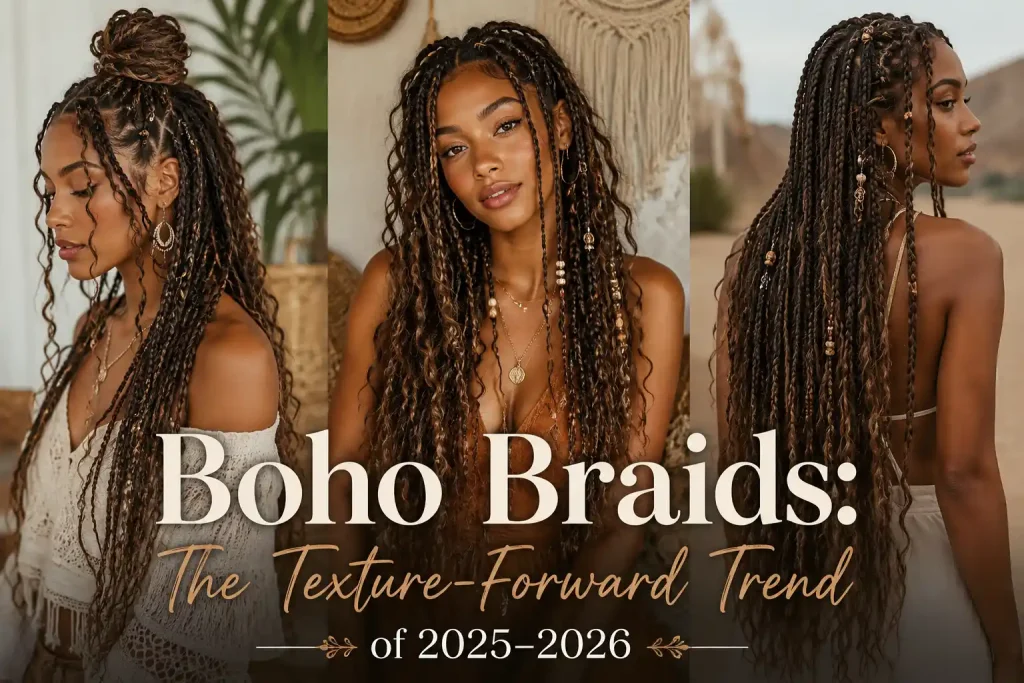
The Boho braids are having a defining moment in 2025–2026, and it’s easy to understand why. Unlike most braid styles that aim for sleekness from root to tip, boho braids intentionally incorporate loose, curly strands throughout — creating movement, dimension, and a finish that feels romantic and lived-in rather than rigidly polished.
The term describes a styling approach rather than a single technique. The common thread is the incorporation of loose textured hair alongside neat braided sections — either curly extension hair left unincorporated, natural hair pulled loose from braids, or a combination of both.
Important maintenance reality: The loose curly sections frizz faster than the braided sections, especially in humidity, after workouts, and during sleep. Without active upkeep — refreshing curls with mousse every 3–5 days, wearing a satin bonnet nightly — boho braids can look unkempt within 1–2 weeks even if the braided sections remain intact.
Boho Braid Maintenance Essentials
- Satin bonnet or silk pillowcase — Non-negotiable for preserving curl definition overnight
- Lightweight curl refresher spray — Apply to loose sections every 3–4 days and scrunch gently
- Edge control — Small amount on face-framing hairline pieces keeps them defined
- Lightweight scalp oil — Applied every 5–7 days to keep the scalp comfortable
Typical wear: 3–5 weeks for the full boho effect.
Goddess Braids: Sculpted, Elegant, and Underrated
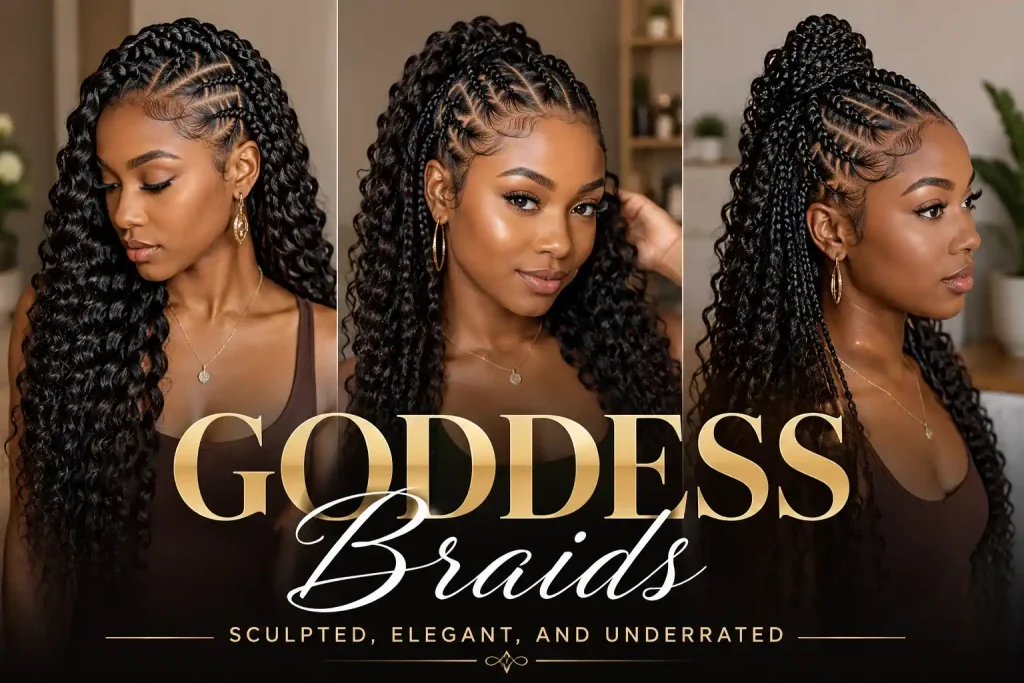
The Goddess braids are thicker, raised cornrow-style braids that create an elevated, sculptural appearance. Think of them as oversized cornrows — but braided with extra volume, creating a chunky, rounded ridge that can be styled into elaborate patterns.
They install relatively quickly, look striking in photos, and work beautifully from casual daily wear to wedding hairstyles and formal events. Popular variations include:
- Crown goddess braids — Two large braids wrapped like a halo around the head
- Jumbo goddess braids — 2–4 very large braids across the scalp
- Goddess braid bun — Braids feeding into a large structured bun at the crown or nape
- Side-swept goddess braids — All braids gathering over one shoulder
- Goddess braids with natural curls — Braids left partially loose at ends, blending with a defined wash-and-go
- Low goddess braid updo — Feeding into a sculptural bun at the nape
Typical wear: 2–4 weeks.
Stitch Braids: The Sleekest Scalp Style Available
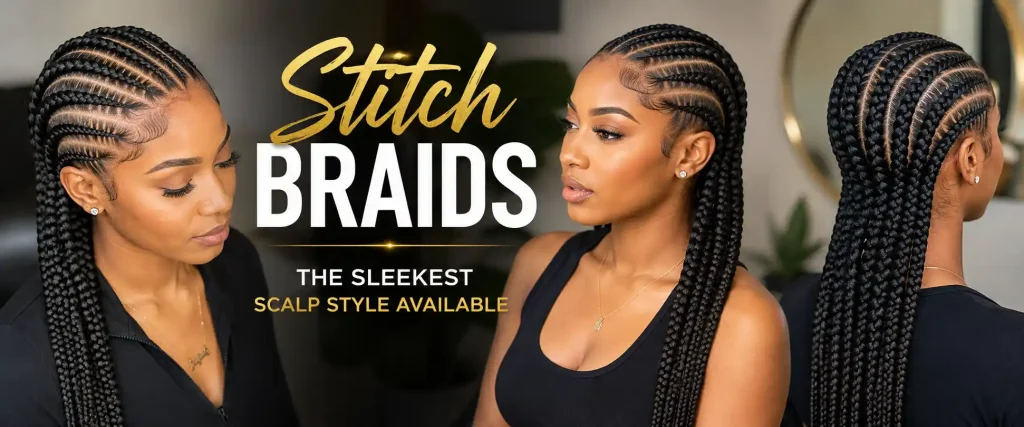
The Stitch braids are a cornrow evolution characterized by extremely clean, sharp “stitched” partings that create a precise, geometric look. The name comes from the visual effect — the braid appears stitched to the scalp in perfectly even intervals. Stylists use a rat-tail comb for sharp horizontal guide lines and styling gel throughout to keep each row crisp.
Popular Stitch Braid Styles
- Straight-back stitch braids — Extremely neat, professional, and polished
- Curved stitch braids — Rows curving across the scalp in a wave or C-curve
- Stitch braid ponytail — All rows converging into a high, mid, or low ponytail
- Side-part stitch braids — Asymmetrical parting sweeping to one side
- Heart-part stitch braids — Heart-shaped section at the crown, popular for younger wearers
- Crisscross stitch braids — Intersecting rows creating an X-pattern
- Stitch braids with designs — Numbers, initials, stars, or geometric shapes in the parting
Typical wear: 2–4 weeks.
Feed-In Braids: The Foundation Most People Overlook
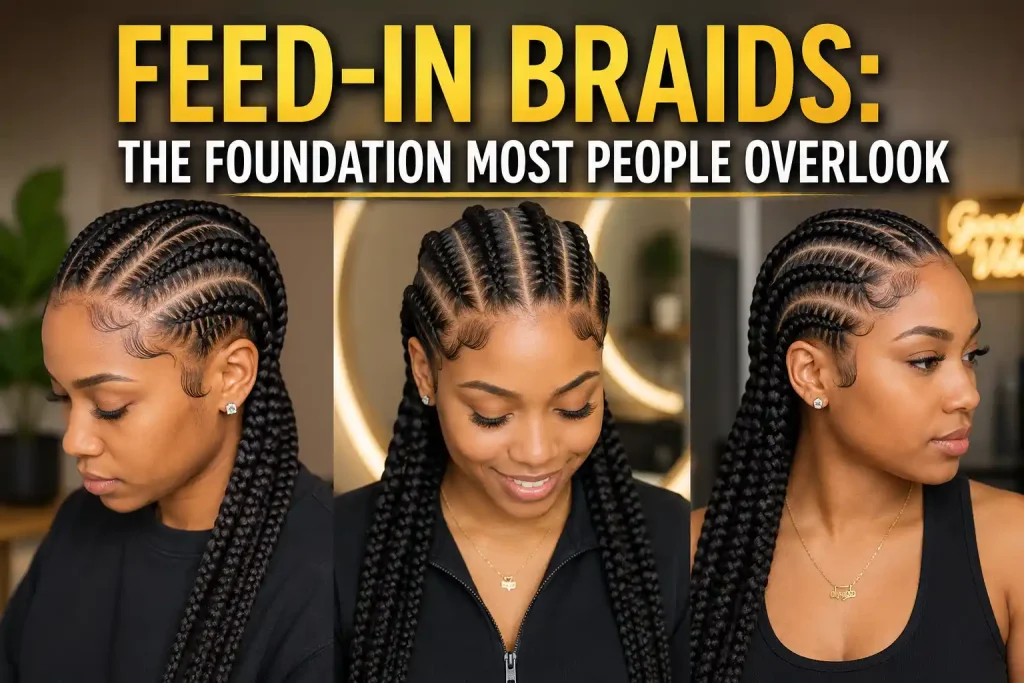
The Feed-in braids describe a technique rather than a finished style — but it’s one of the most impactful developments in modern braiding and worth understanding on its own.
The technique involves gradually adding extension hair to a braid as it progresses, rather than adding all extension hair at once at the root. This creates braids that appear to grow naturally from a very thin root to a fuller body, producing a significantly more natural-looking hairline.
Feed-in technique is used most often in:
- Feed-in cornrows — Rows starting thin at the hairline and building to a fuller body
- Feed-in box braids — The same principle applied to individual braids
- Feed-in ponytails — Multiple cornrows converging into one seamless ponytail
Micro Braids: Small in Size, Big in Commitment
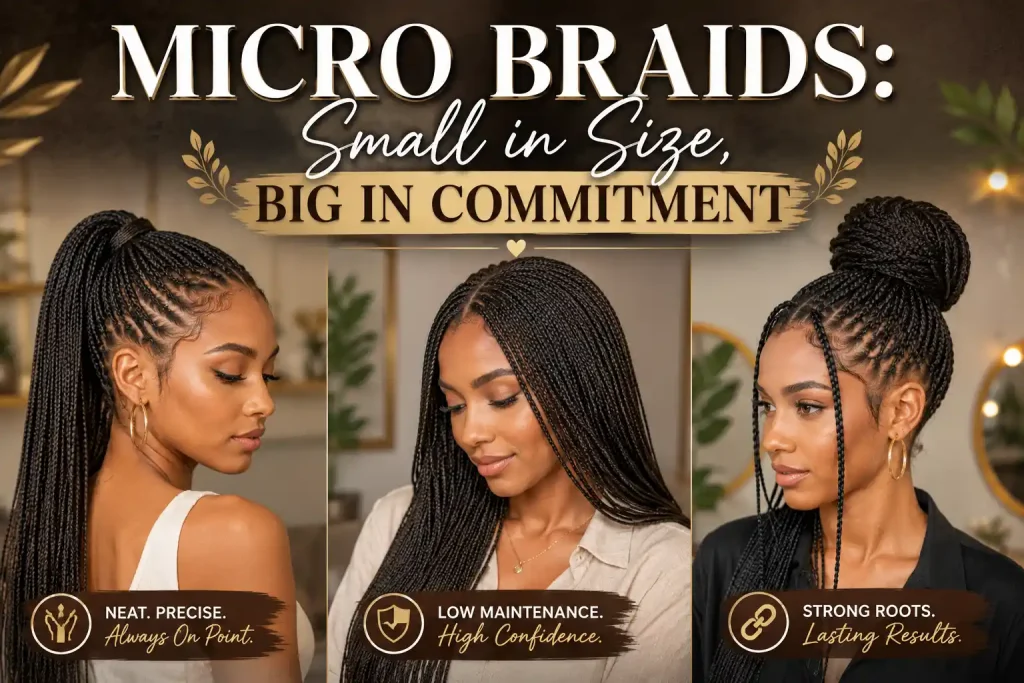
The Micro braids are among the most time-intensive protective styles available — and also the most rewarding for those with the patience. Each individual braid is extremely thin, typically created from very small square sections. A full head of micro braids involves 200–400+ individual braids with install time ranging from 12–20 hours, often split across two appointments.
The payoff: micro braids can last 8–12 weeks — the longest natural longevity of any individual braid style. They’re exceptionally versatile and can be styled in ways that resemble loose natural hair.
Important scalp note: People with fine hair or a history of traction alopecia should consult a trichologist before choosing micro braids. The cumulative tension across hundreds of anchor points is significant even if each individual braid is installed gently.
Lemonade Braids: Side-Swept and Statement-Making
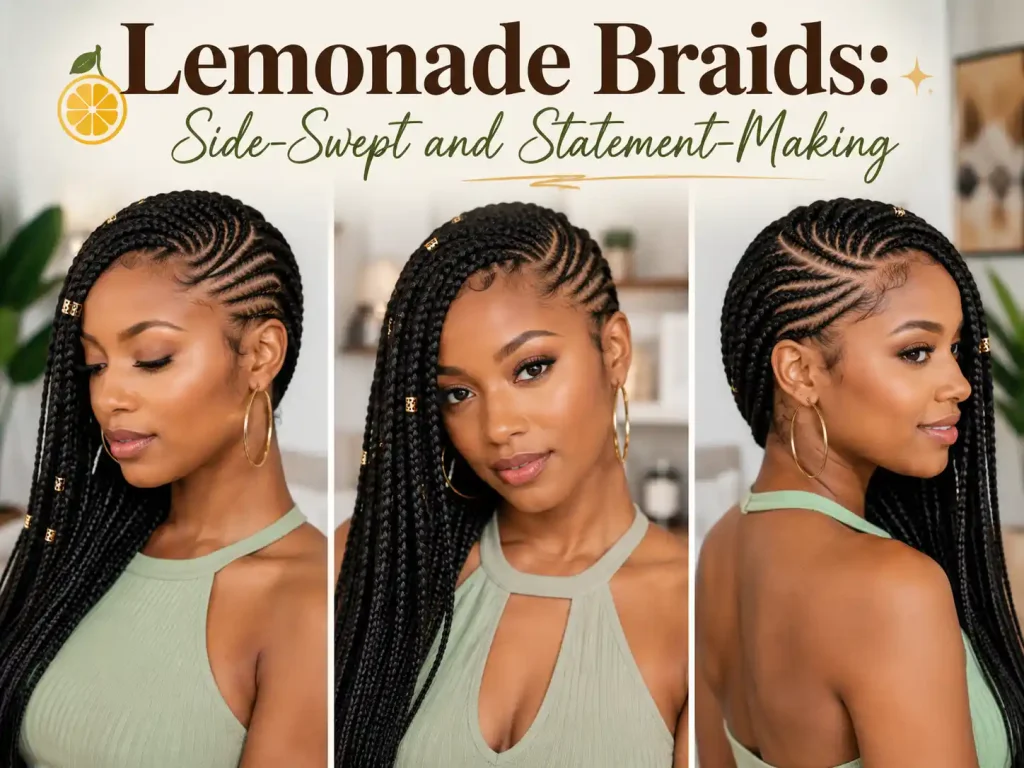
The Lemonade braids are cornrows styled dramatically to one side, typically extending past the shoulder. They gained massive cultural visibility in 2016 and remain a powerful choice for bold, asymmetrical styling.
The braids are usually installed with feed-in technique for a smooth, tapered start at the hairline, with rows sweeping in crescent-shaped patterns that follow the head contour. Modern variations include mixed-size rows, ombre coloring, and versions incorporating a partial updo at the back.
Tribal Braids: Pattern-Led and Highly Personal
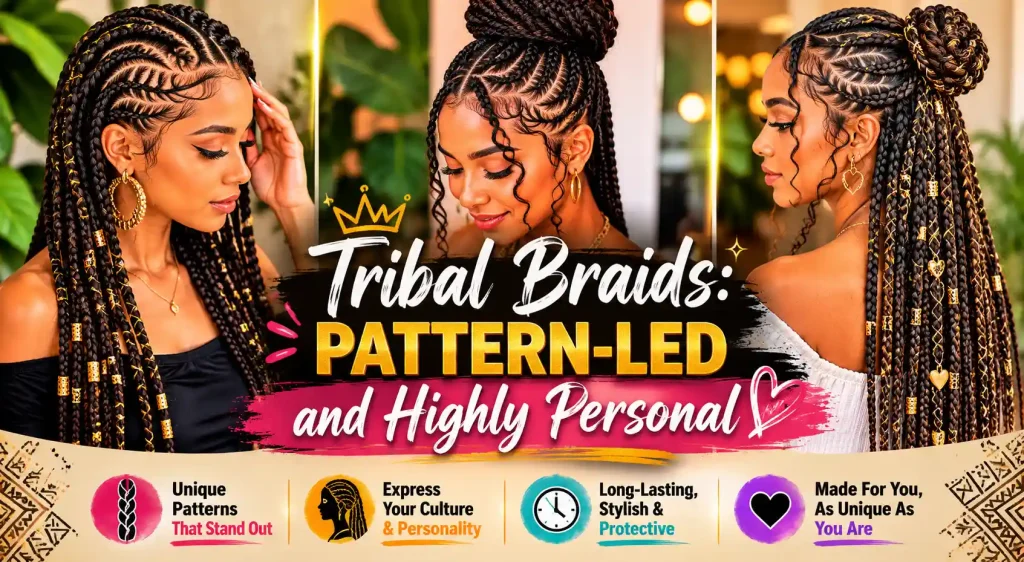
The Tribal braids describe styles with elaborate scalp patterns, detailed parting designs, and decorative elements — most often beads, shells, and metallic accessories. They draw from Fulani, Yoruba, and other West and Central African braiding traditions.
A tribal braid install is as much about the parting design as the braid type. The stylist creates a custom scalp map — geometric sections, curved patterns, asymmetrical designs — visible when braids are pulled back or styled up. No two tribal braid installs are identical.
Braided Bobs: The Protective Style for People Who Love Short Hair
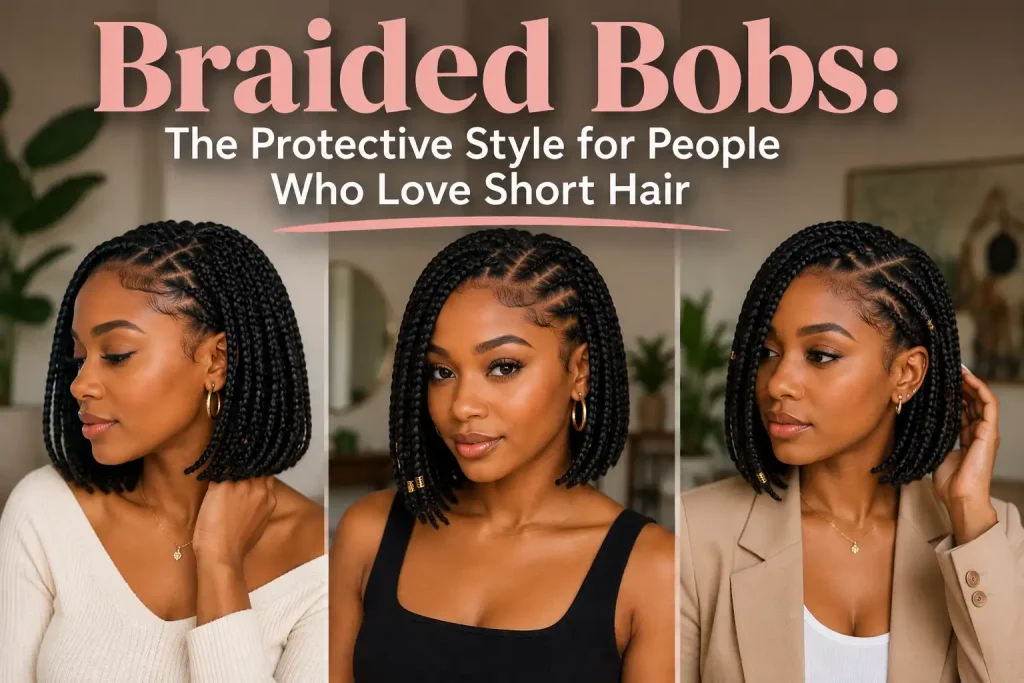
The braided bob has become one of the fastest-growing braid categories over the last two years, largely because it solves a common problem: the weight and heat of very long extension hair.
A braided bob can be created by installing braids at a short length from the start, or by installing longer braids and having the stylist cut them to bob length. Popular variations include:
- Knotless bob braids — Softer roots, lighter weight, clean bob silhouette
- Box braid bob — Classic structure at chin to shoulder length
- Cornrow bob — Scalp rows feeding into a short style
- Stacked bob braids — Multiple lengths creating layered dimension
- Asymmetrical bob braids — Longer on one side for a fashion-forward effect
Ghana Braids: The Original Feed-In Style
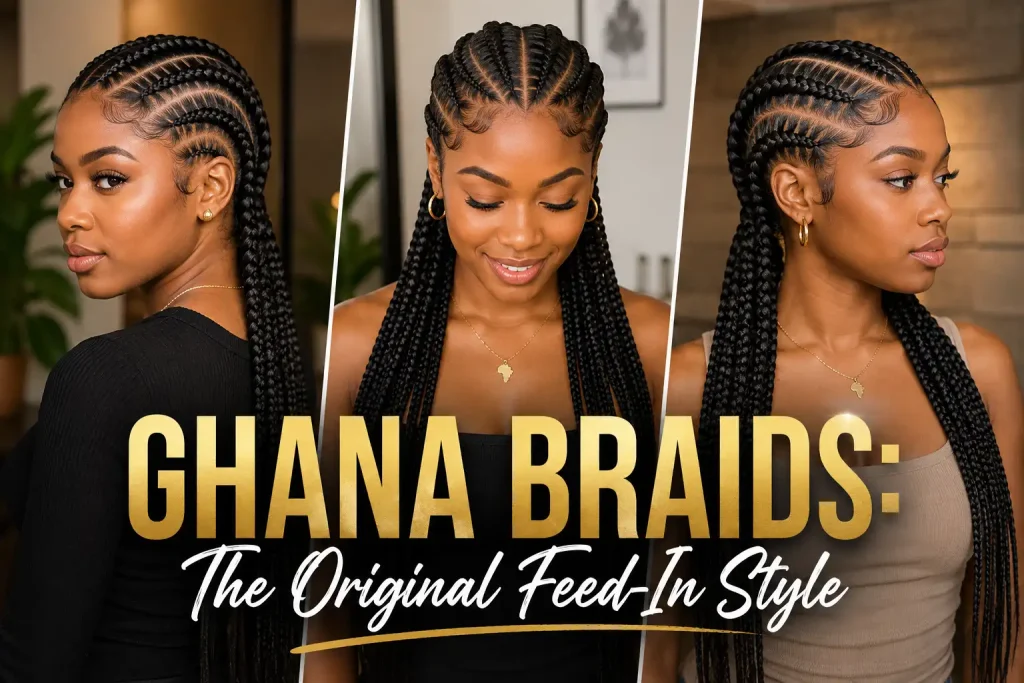
The Ghana braids — also called banana braids or invisible cornrows — are large, thick cornrows created with the feed-in technique. They’re among the original and most prominent traditional African braid styles, distinguished by their progressive thickness: each row begins extremely thin at the hairline, then builds steadily in body and width across the scalp.
The result has a sculptural, almost three-dimensional quality different from both standard cornrows and goddess braids. Ghana braids are also widely used as a base style for extensions, sitting cleanly and flatly under wigs and weaves.
Butterfly Braids: The Newest Trend Worth Knowing
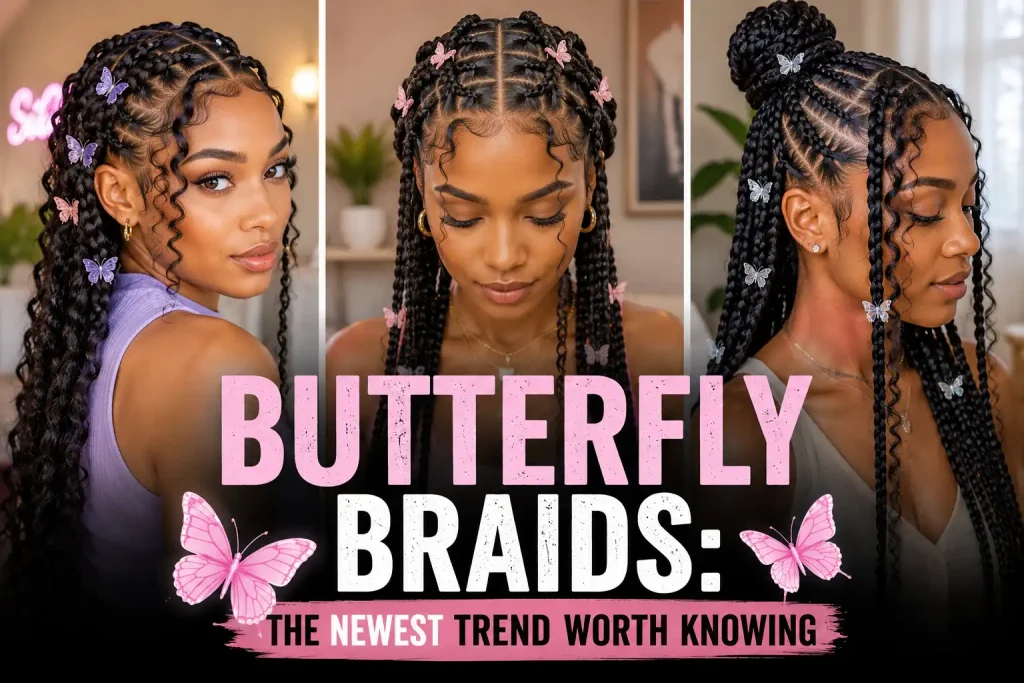
The Butterfly braids are one of the most significant emerging styles of 2025–2026. The technique involves creating a loop or bow effect within the braid itself — extension hair is folded and left partially exposed rather than fully incorporated, creating small “butterfly wing” shapes every few inches along the braid.
The style is visually striking and still relatively rare. Finding a stylist with butterfly braid experience requires deliberate searching — ask specifically for portfolio photos of this technique, not general braid work.
Dutch Braids and French Braids
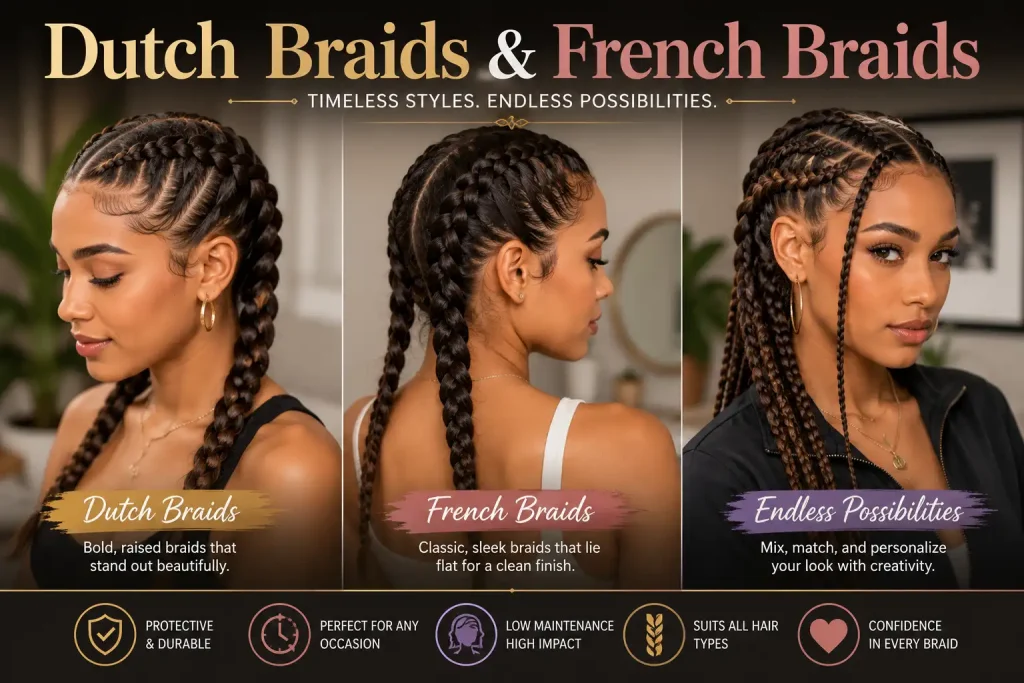
The Dutch braids and French braids are among the most universally recognized braid types across all hair textures and backgrounds. Both create a woven, raised appearance across the scalp — but they differ in one key technical detail.
A French braid is created by adding hair over each section as you braid, producing a braid that sits on top of the hair. A Dutch braid adds hair under each section, producing a raised, three-dimensional braid that stands out from the scalp more prominently. Dutch braids are sometimes called “reverse French braids” or “inside-out braids.”
Both styles are popular across all hair types, including straight hair braids, curly hair with braids, and natural hair braids. They work beautifully as braided hairstyles for white girls and women with straight to wavy textures who want protective or decorative braiding without extensions.
Popular variations include:
- Two Dutch braids — Side-by-side braids creating a classic athletic look
- French braid black hair styles — French braiding techniques on natural or relaxed textures
- Dutch braid updo — Braids that converge into a bun or updo
- Four braids hairstyle — Two Dutch braids on each side for a fuller, more elaborate look
- Six braids hairstyle — Multiple rows for added density and pattern
Bubble Braids: Fun, Modern, and Low-Tension
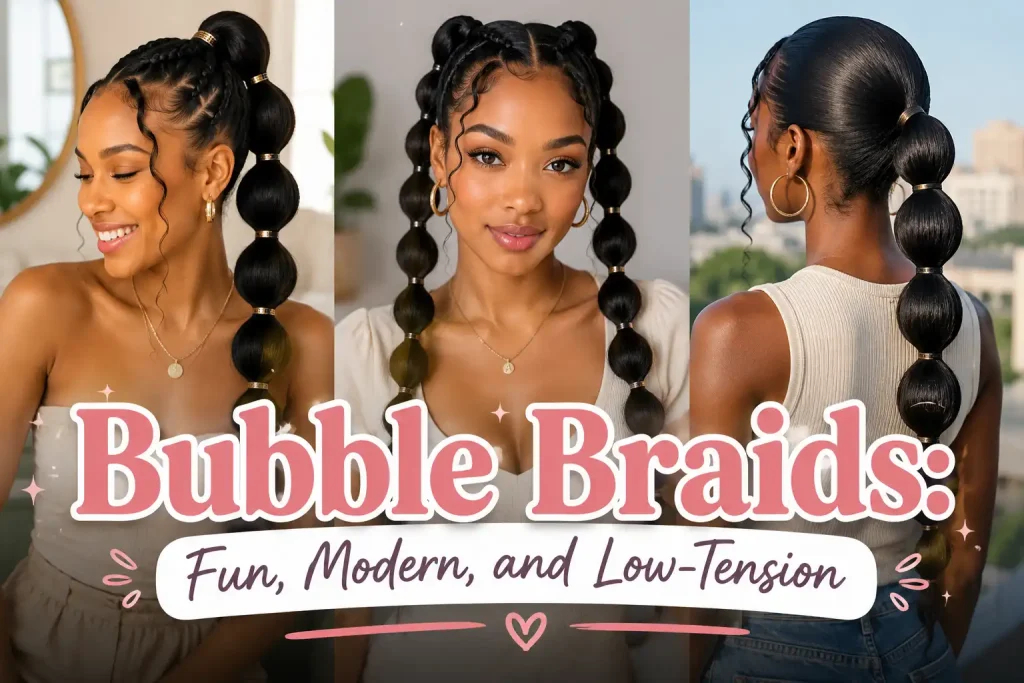
The Bubble braids are one of the more approachable trending styles — created by securing a braid or ponytail at regular intervals with hair ties to create a series of puffed “bubble” sections. The style requires relatively little technique, works on multiple hair types, and creates a playful, modern look with minimal scalp tension.
Bubble braid variations include:
- Single bubble braid down the center
- Double bubble braids on each side
- Bubble braid ponytail — a regular ponytail with the bubble effect along its length
- Bubble braids with extensions for added fullness
Because they use elastic ties rather than tight braiding, bubble braids are one of the gentlest styles for edges and fine hair.
Mohawk Braids: Bold, Structured, and Striking
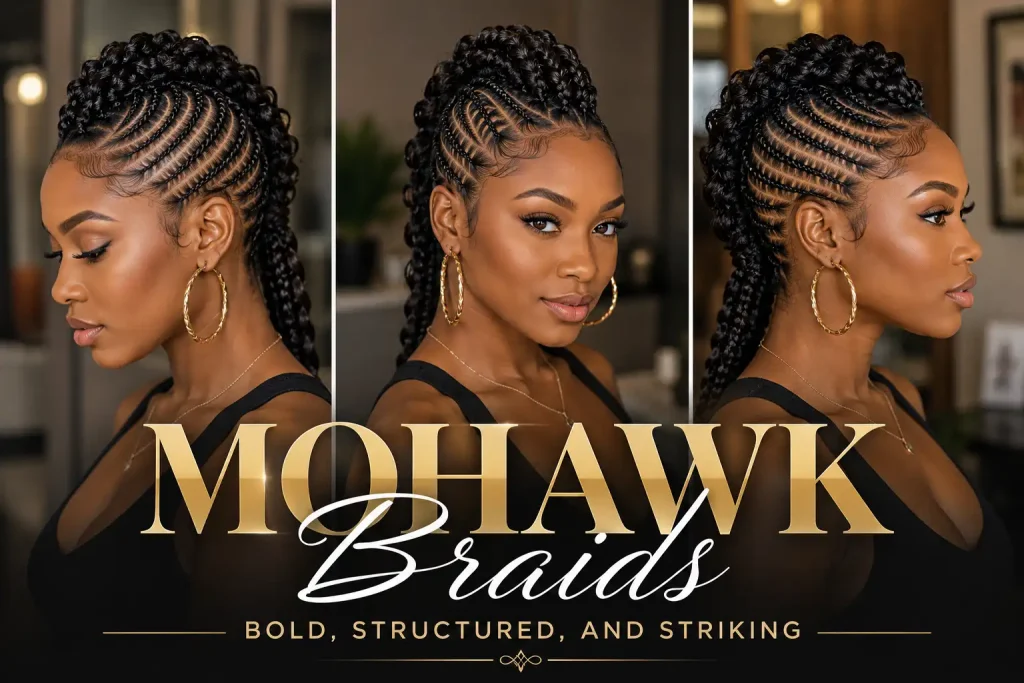
Braided mohawk hairstyles combine scalp braids with a raised center section, creating the visual effect of a mohawk through braiding rather than cutting or shaving. The center braids are typically left larger, fuller, or styled upward while side sections are braided closely to the scalp.
Popular mohawk braid variations include:
- Cornrow mohawk — Side cornrows feeding into a natural hair puff or braid at the crown
- Braided mohawk with curls — Center section left with defined curls or a twist-out for texture contrast
- Children’s braided mohawk — A widely popular style for little girls, often with beads along the center
- Curly braided mohawk — Center section featuring defined coils or loose curls
- Braids in mohawk style — Individual braids arranged to create the mohawk silhouette
Braided mohawks work especially well for kids’ hairstyles and school-appropriate styles because they’re secure, neat, and hold up well throughout an active day.
Viking Braids: Structured, Historical, and Trending
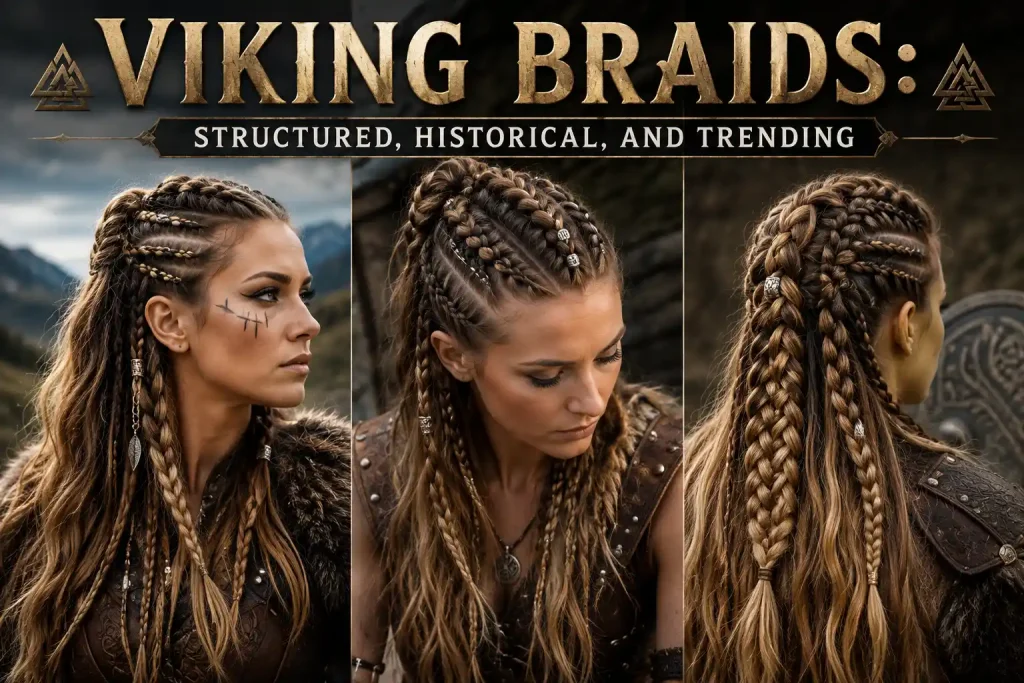
The Viking braids draw from Norse and Scandinavian braiding traditions — characterized by thick, structured braids worn close to the scalp, often with warrior-inspired geometric patterns. In contemporary styling, Viking braided hairstyles typically feature Dutch braids, thick rope braids, and intricate side braids.
The style has gained mainstream popularity through media and cultural interest in Norse aesthetics. Modern interpretations work on multiple hair types and lengths, though longer, thicker hair creates the most authentic visual impact.
Viking braid variations commonly include:
- Viking side braids — Thick Dutch braids along each temple
- Viking warrior braid — A single thick rope braid or fishtail down the center back
- Viking crown braid — Braids wrapping around the head in a crown formation
Crochet Braids: The Fastest Full-Look Installation
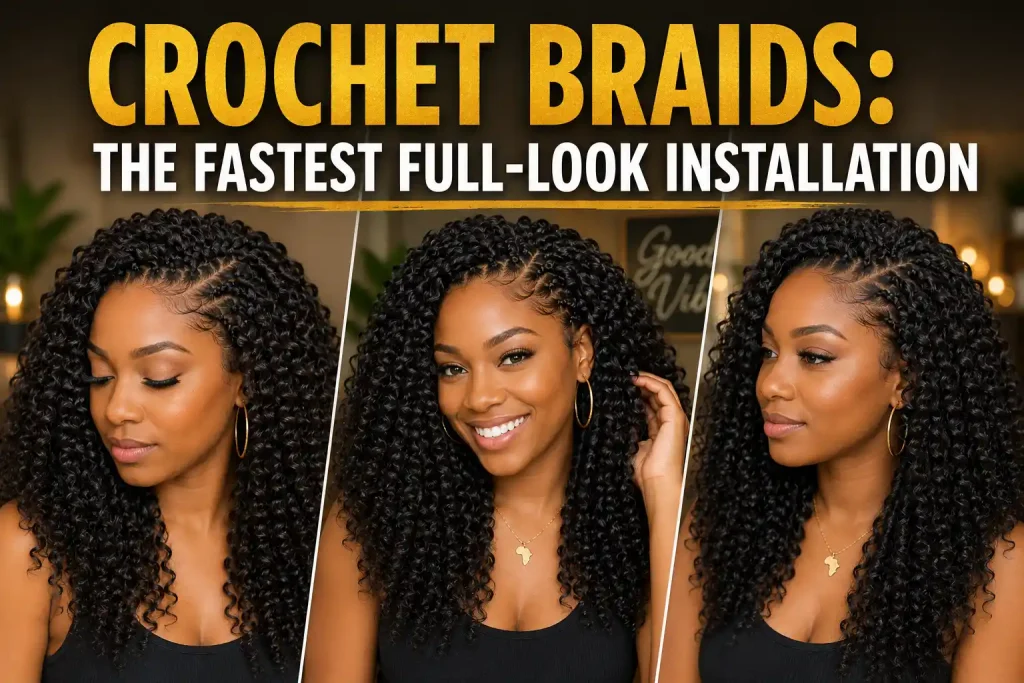
The Crochet braids are a protective style technique where extension hair is looped through cornrow base braids using a latch hook or crochet needle. Rather than braiding each individual strand from root to tip, the stylist first braids the natural hair into cornrows, then attaches the extension hair directly through the cornrow with the hook.
The result is a full braided (or curly, or straight) look installed in a fraction of the time of traditional braid methods. A full crochet install can be completed in 2–4 hours — compared to 6–12 hours for individual braided styles.
Bohemian crochet hair is one of the most popular extension textures for this technique — pre-looped synthetic hair with a loose, wavy, bohemian texture that creates a natural-looking volume and softness. Crochet box braids and crochet knotless braids using pre-made braid extensions are also widely available.
Crochet braids are excellent for:
- People who want a full braided look with minimal chair time
- Anyone whose scalp can’t tolerate long installation sessions
- A budget-friendly alternative to full hand-braided styles
- Quick braid styles and fast braid hairstyles with full visual impact
Typical wear: 4–6 weeks with proper care.
Braided Updos and Braided Bun Hairstyles
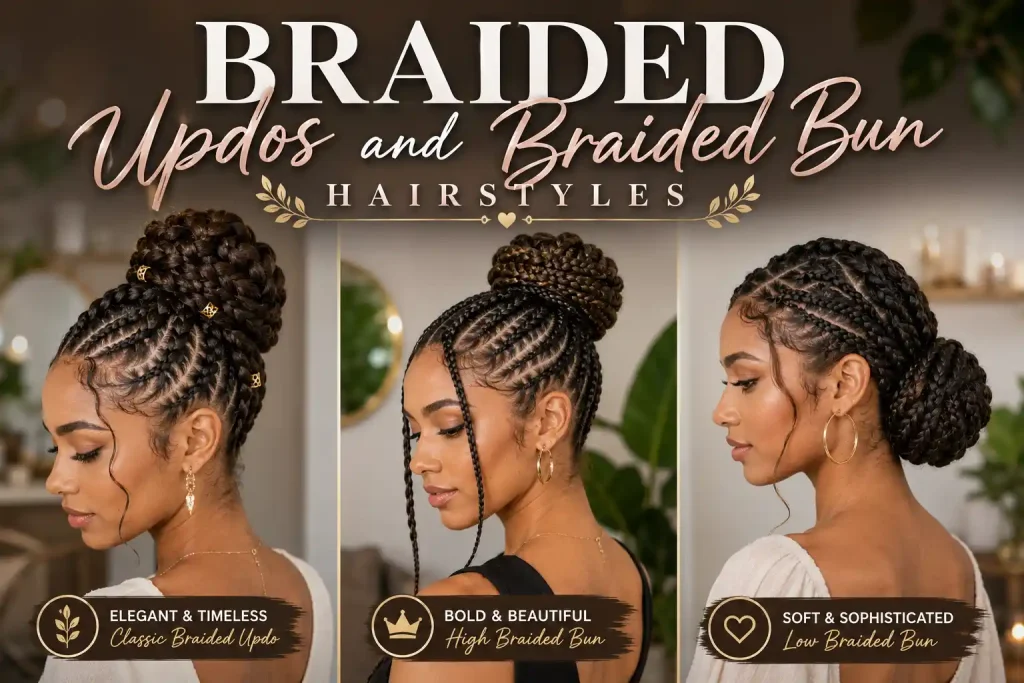
The Braided updo hairstyles bring together the elegance of formal styling with the longevity and practicality of braids. They range from simple braided buns to elaborate sculptural updos that rival any salon blowout.
Braided updos for Black hair are particularly popular for weddings, proms, graduations, and professional settings. Because the style keeps all hair up and secured, it’s also one of the most practical choices for humid climates and summer events.
Popular braided updo styles include:
- Braided bun hairstyles for Black hair — Box braids or knotless braids twisted into a high or low bun
- Braided updo hairstyles for African American women — Goddess braid or Fulani configurations styled into formal updos
- Box braids updo — Individual box braids gathered into a crown or knotted bun
- Braided crown updo — Braids wrapping around the head in a halo, often used for weddings
- Braided bun with natural hair — Natural hair braided or twisted into a bun without extensions
- Half up braided updo — Top section braided and lifted while the rest falls loose
- Low braided updo — All hair gathered and styled at the nape, sleek and formal
Stylist tip: For updos that need to hold through a full event day, loose braids near the nape will loosen faster than those closer to the crown. Ask your stylist to reinforce the lower sections.
Half Up Half Down Braided Hairstyles
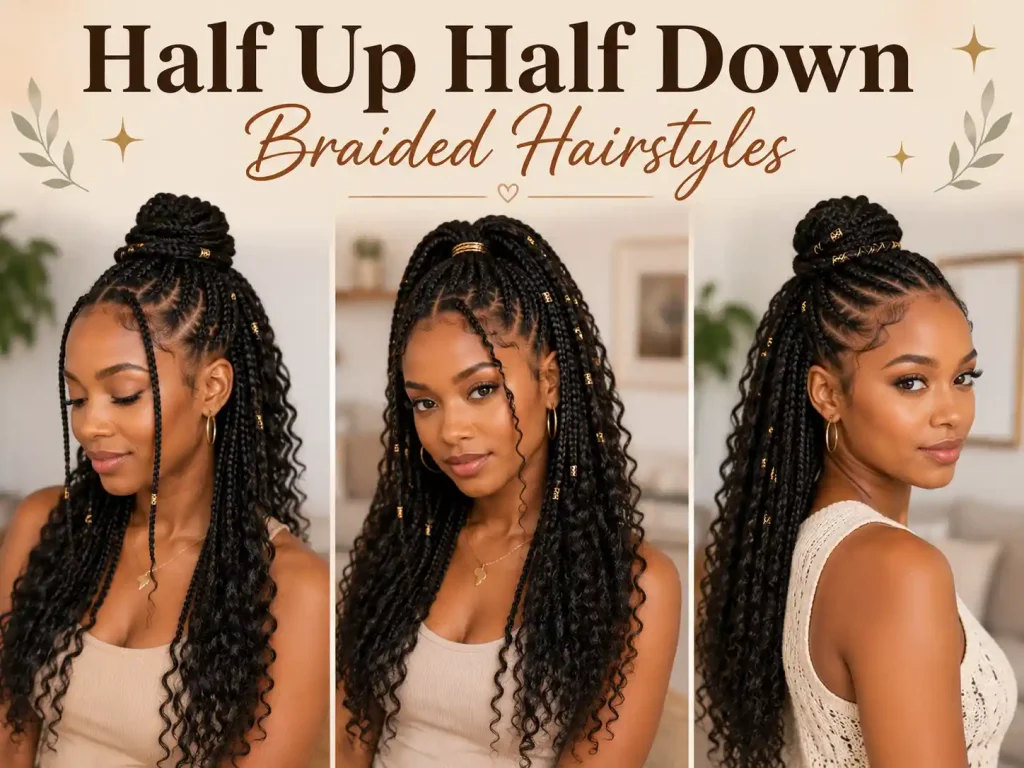
The Half up half down braided hairstyles are among the most searched and versatile braid configurations — giving you the elegance of an updo and the flowing look of loose braids simultaneously.
The style is endlessly customizable. The top section can be a single French braid, two Dutch braids, a knotted bun of gathered box braids, or a cornrow section feeding into a crown bun. The bottom section hangs loose — whether as individual box braids, knotless braids, natural curls, or straight extensions.
Popular half up half down variations include:
- Half up half down braids for Black hair — Gathered top section of box braids or knotless braids with remaining braids hanging down
- Half up half down braided hairstyles with curls — Top braids contrasting with loose defined curls below
- Braided hairstyle half up half down with weave — Extension weave in the loose lower section
- Natural hair half up half down with braids — Top braids with the lower half as a defined wash-and-go
- Half up cornrows with braids down — Cornrow section at the crown transitioning to loose individual braids
This style photographs exceptionally well and works for everything from everyday wear to prom and wedding hairstyles.
Braided Ponytail Hairstyles
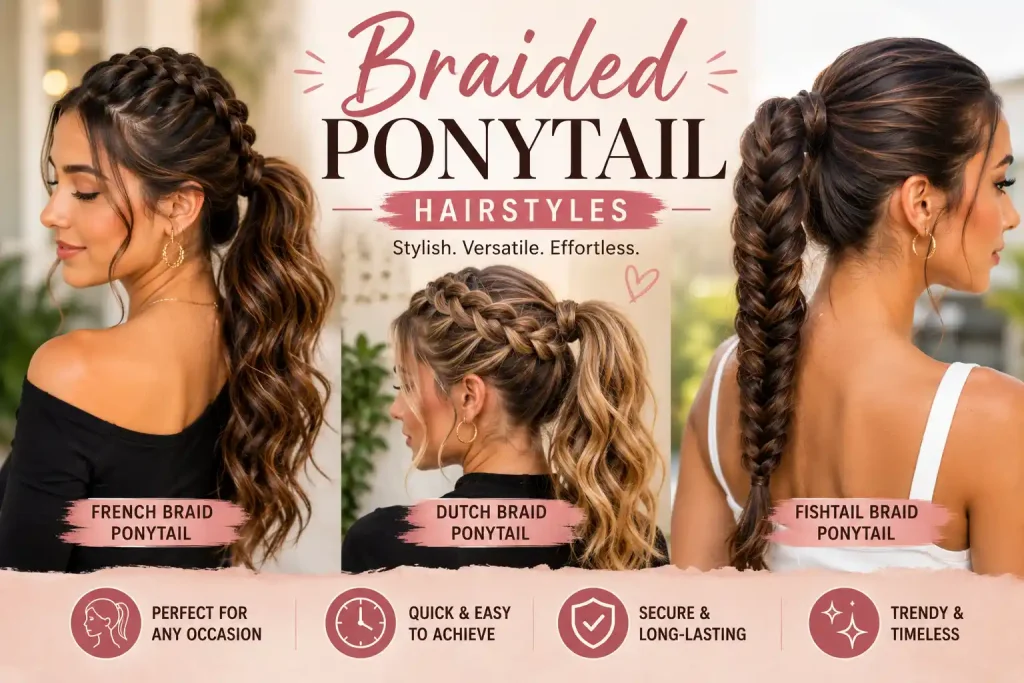
The Braided ponytail hairstyles combine the neatness of scalp braiding with the versatility of a ponytail — one of the most universally flattering hairstyle configurations.
Feed-in cornrows that converge into a high ponytail are among the cleanest and most polished versions of this style. The feed-in technique creates a seamless look from the hairline to the ponytail base, with no visible knots or attachment points.
Popular braided ponytail styles include:
- Braided ponytail for Black hair — Feed-in cornrows converging into a high pony with box braid extensions hanging down
- Braided ponytail for long hair — Multiple rows feeding into a low ponytail with long extensions
- Knotless braids in a ponytail — Individual knotless braids gathered and styled upward
- Box braids ponytail — Box braids gathered into a high or mid ponytail
- Single braid ponytail — One large central braid feeding into a ponytail
- Stitch braid ponytail — Crisp stitch cornrows feeding into a sleek ponytail base
The braided ponytail is one of the most gym-friendly and professional braid configurations — secure enough for athletic activity, polished enough for an office setting.
Braided Crown and Headband Hairstyles
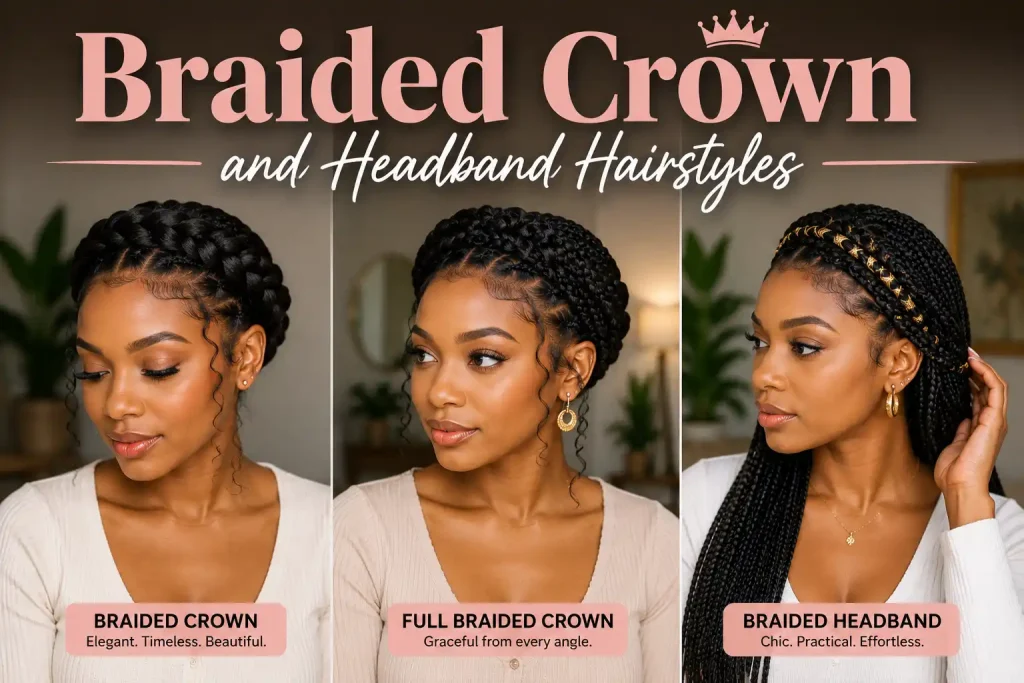
Braided crown hairstyles and braided headband hairstyles are elegant styles in which braids run along the perimeter of the head, resembling a crown or headband across the scalp.
The braided crown is a cornerstone of braided wedding hairstyles — romantic, structured, and suitable for veils or floral accessories. It also works beautifully for graduation photos, formal events, and upscale everyday styling.
Braided headband styles typically feature one or two braids running across the front of the scalp from ear to ear, creating the appearance of a headband. These work on natural hair, relaxed hair, and with extension additions.
Popular variations include:
- Goddess braid crown — Thick, sculptural crown using goddess braid technique
- Cornrow crown braid — Clean cornrow running in a crown formation
- Dutch braid crown — Raised Dutch braid creating a more three-dimensional headband effect
- Double braided crown — Two braids running in opposite directions and meeting at the back
Braided Hairstyles with Weave
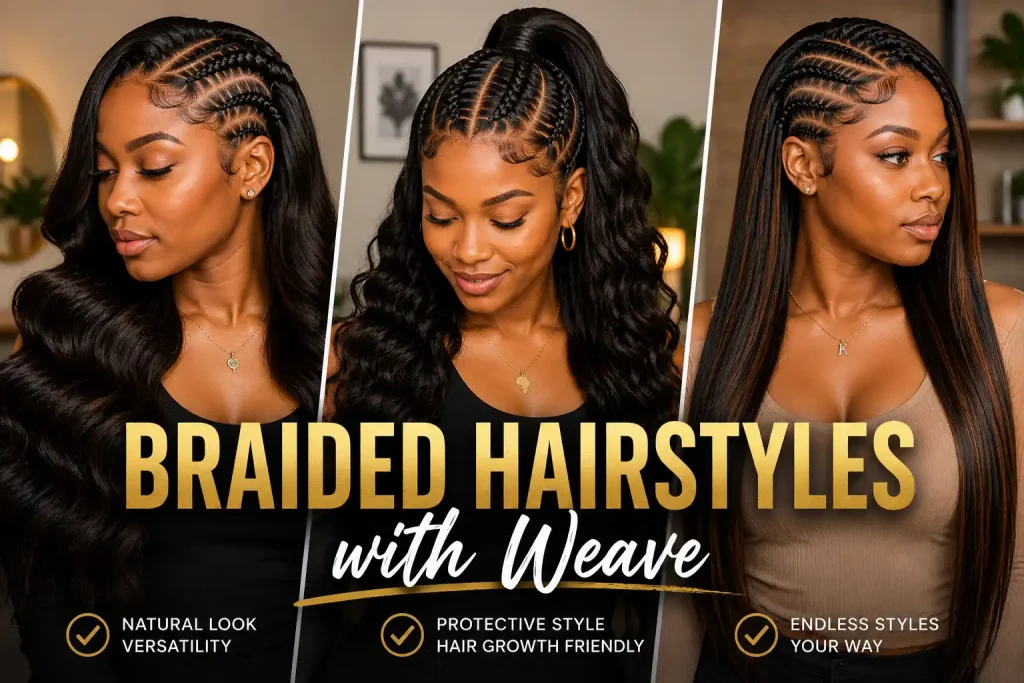
Braided hairstyles with weave combine traditional braiding techniques with weft or extension hair to add length, thickness, fullness, or color without committing to a permanent chemical process.
Weave braids are particularly popular for:
- Adding significant length to natural hair that isn’t yet long enough for the desired style
- Creating box braids with weave in colors that differ dramatically from natural hair
- Half-up styles with weave braids where the lower section is weave and the upper is braided natural hair
- Quick weave hairstyles with braids — a faster alternative to full sew-in weaves
The most important thing to understand about braids with weave is weight management. Extension weft adds considerably more mass than standard extension fiber — choosing a moderate length and avoiding very heavy bundles keeps scalp tension at a comfortable level.
Braided Hairstyles for Short Hair
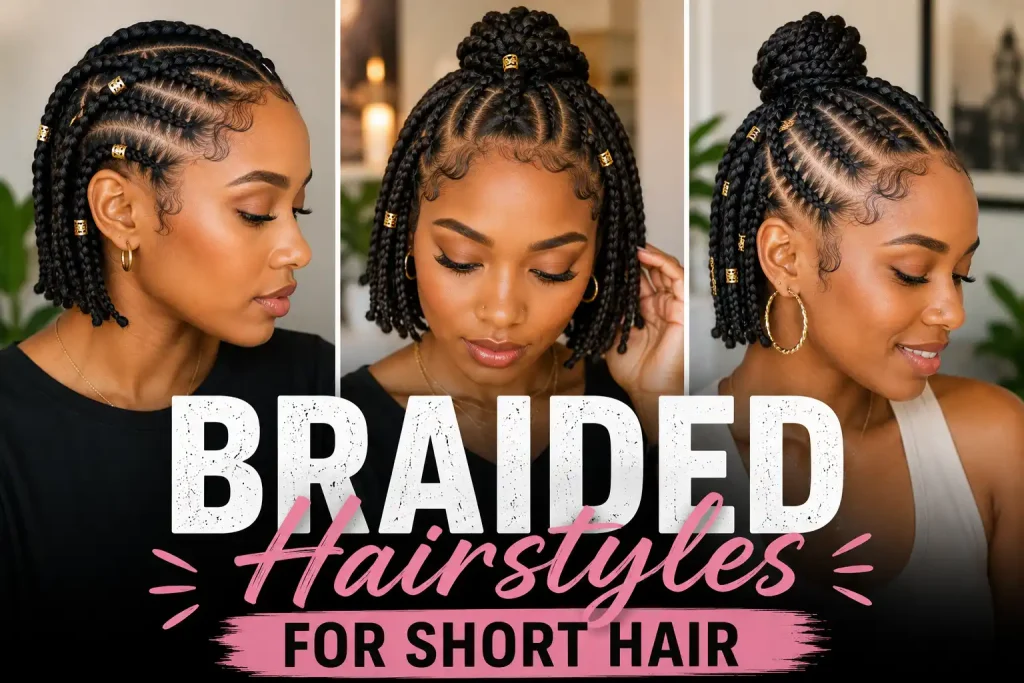
Braided hairstyles for short hair are often overlooked, but short natural hair is actually excellent for braided styles — particularly scalp-flat styles like cornrows, stitch braids, and feed-in styles that don’t require significant length to hold.
The key is working with what you have. Short braided hairstyles for Black hair most commonly include:
- Cornrows on short hair — Even very short 4C hair (as short as 2–3 inches) can hold neat cornrow rows
- Short box braids — Mini box braids with extension fiber at a short, bobbed length
- Braided mohawk for short hair — A striking option even with minimal natural length
- Feed-in cornrows for short hair — Extension hair fed into short natural hair creates the appearance of longer rows
- Short stitch braids — The cleanest look for short natural hair
- Braided bob hairstyles for short hair — Extensions installed at bob length on shorter natural hair
Braided Hairstyles for Short Natural Hair: What Actually Works
The minimum length for most individual braid styles (box braids, knotless braids) is approximately 2–3 inches of natural hair. Below that, the hair doesn’t have enough length to anchor extension fiber securely without excessive tension.
For hair shorter than 2 inches, scalp braiding styles (cornrows, stitch braids, feed-in styles) are the most appropriate and comfortable option.
Quick and Easy Braid Styles
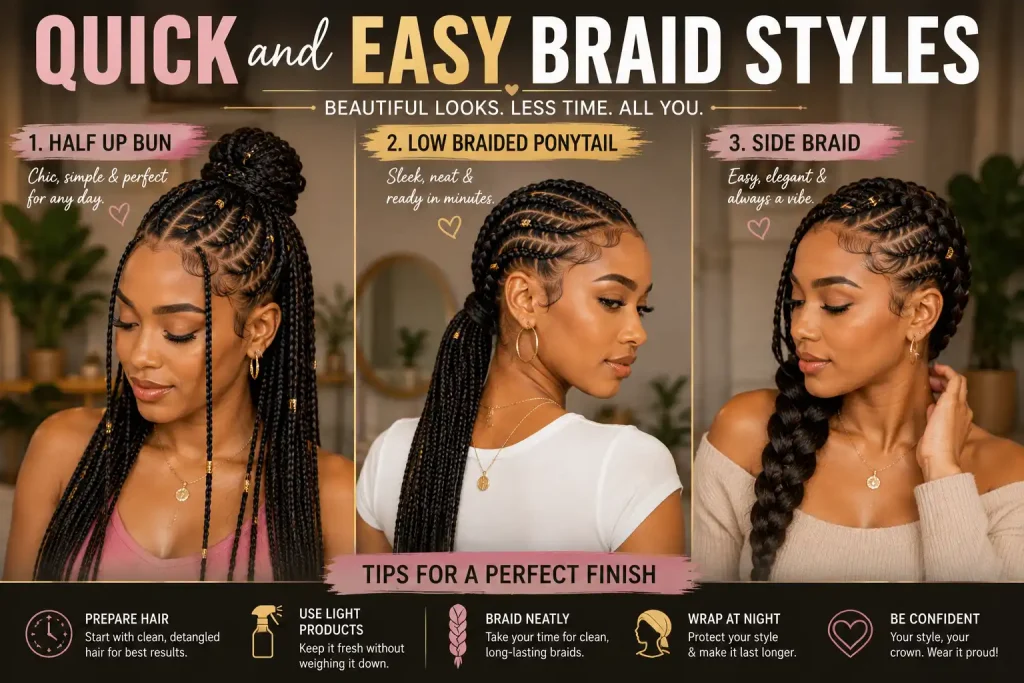
Not everyone has 6–8 hours for a braid install. Quick braid styles and easy braids serve the very real need for protective styling without a full-day appointment.
The fastest braid styles by install time include:
- 2 braids hairstyle — Two Dutch or box braids taking 20–30 minutes on pre-detangled hair
- Jumbo goddess braids — 3–4 large braids installed in 1–2 hours
- Cornrows, straight-back — A neat 6-row straight-back can be completed in under an hour by an experienced braider
- Single braid hairstyle — One large center braid in 10–15 minutes
- Bubble braid — A ponytail with elastic bubble sections, achievable in minutes
- Crochet braids — Full head completion in 2–4 hours using pre-made extensions
- Simple feed-in ponytail — Feed-in cornrows converging into a ponytail, 1–2 hours
Cute quick braid styles for at-home styling include two-strand twists with braiding hair, simple flat twists across the scalp, and single large box braids on stretched natural hair.
Braided Hairstyles for Natural Hair and 4C Hair Specifically
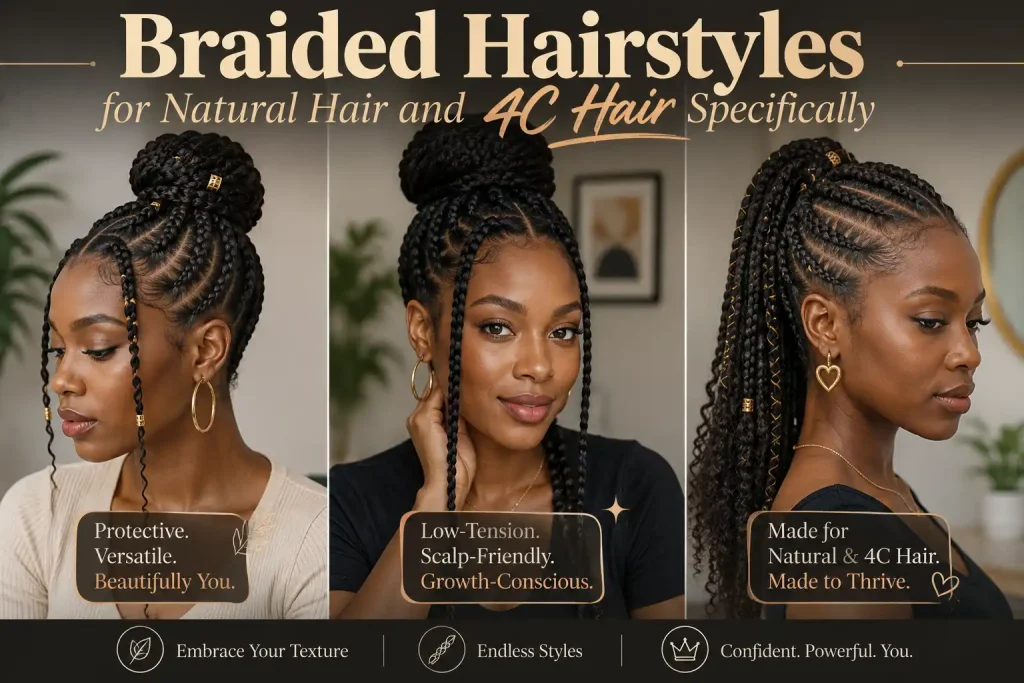
Natural braided hairstyles are the most impactful category in protective styling for Black women — and 4C hair specifically responds to braiding in unique ways that not all guides address honestly.
4C hair has the tightest coil pattern of any hair type, the most density variation, and the highest potential for shrinkage. When braided, 4C coils grip extension fiber more securely than looser textures — which is excellent for braid longevity but also means that too much grip at the wrong tension level can accelerate follicle stress.
Best Braided Hairstyles for 4C Natural Hair
- Knotless braids — The most recommended style for 4C hair because the gradual tension increase protects tight coil patterns at the root
- Feed-in cornrows — Excellent for 4C hair, which benefits significantly from the tapered, natural-looking hairline feed-in creates
- Protective updos with natural hair — Gathered styles that keep 4C hair moisturized and sheltered
- Medium box braids — Work well on 4C density when installed at appropriate tension
- Twist braids — Two-strand twists with braiding hair offer a softer protective option
4C hair-specific maintenance tip: Because 4C coils have the highest moisture demand of any hair type, scalp and strand hydration during a braid install is more important than for looser textures. Apply a light water-based moisturizer along the parts every 5–7 days, not just scalp oil.
Braided Hairstyles for African American Women
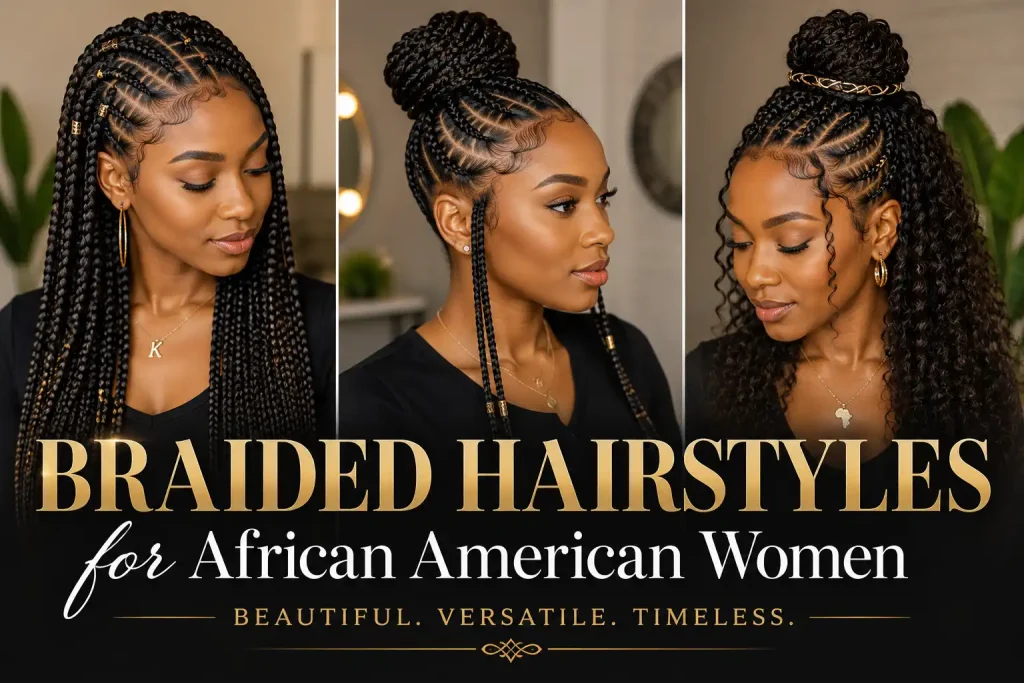
Braided hairstyles for African American women represent the broadest and most culturally rich segment of braided styling. From African hair styles rooted in specific ethnic traditions to contemporary protective styles adapted for modern lifestyles, the range is genuinely vast.
African braiding styles that have maintained cultural continuity include Fulani braids, Ghana braids, cornrows, and tribal braid patterns. Each carries specific aesthetic codes and historical significance within the communities where they originated.
Contemporary braided hairstyles for Black women span every occasion, length, and formality level — from intricate braided updo hairstyles for African American women for formal events to quick everyday cornrows for a morning workout.
Celebrity influence has shaped many modern braid trends. Jayda Wayda braids — oversized, long box braids worn by social media personality Jayda Cheaves — brought renewed attention to bold, dramatic individual braids. Alicia Keys braids hairstyles — particularly her iconic cornrow and Fulani-inspired looks from the late 1990s and 2000s — helped bring intricate cornrow artistry into mainstream visibility.
African hair braiding styles remain the technical foundation of the global braiding industry, with the most skilled practitioners often trained in traditional West African braiding techniques passed through generations.
Braided Hairstyles for Men
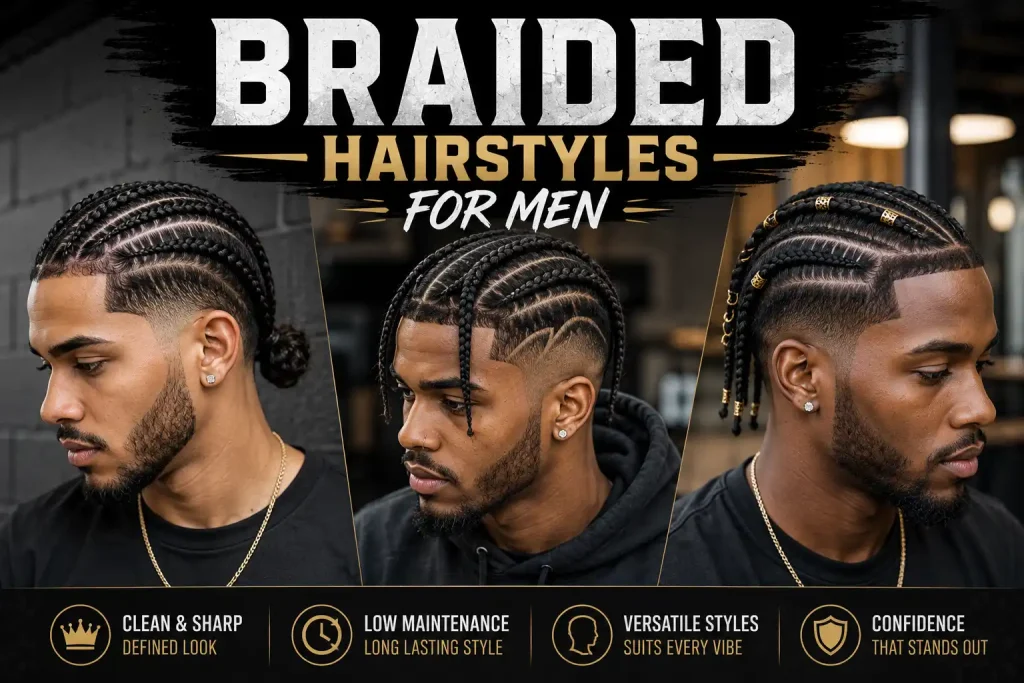
Male braided hairstyles have seen substantial growth in visibility and acceptance over the past decade. Men’s braided hairstyles now range from simple straight-back cornrows to elaborate individual braid styles, Viking-inspired designs, and man bun configurations.
Popular Braided Hairstyles for Men
- Men’s cornrows — The most common entry point. Straight-back rows, curved patterns, and freestyle designs.
- Box braids for men — Increasingly popular, particularly at medium length, often worn in a half-up or bun style.
- Braided dreads hairstyles for men — Incorporating braid techniques into dreadlocked hair or creating braid-locs with extensions.
- Male braids hairstyles for short hair — Stitch braids, short cornrow designs, and zigzag patterns on shorter natural hair.
- Viking braided hairstyles for men — Thick Dutch braids, side braids, and warrior-inspired patterns.
- Two braids hairstyle for men — Two cornrows or Dutch braids, one on each side.
- Braided man bun — Braids gathered into a bun at the crown or nape.
- Hairstyle cornrow braids for men — Custom freestyle cornrow patterns across the scalp.
- Men’s long hair braids — Individual braids on longer natural or loc-length hair.
Different types of braids for men follow the same technical principles as women’s styles, but men’s braided hairstyles often favor shorter lengths, simpler patterns, and scalp-flat styles that suit professional environments.
Braided Hairstyles for Little Girls and Kids
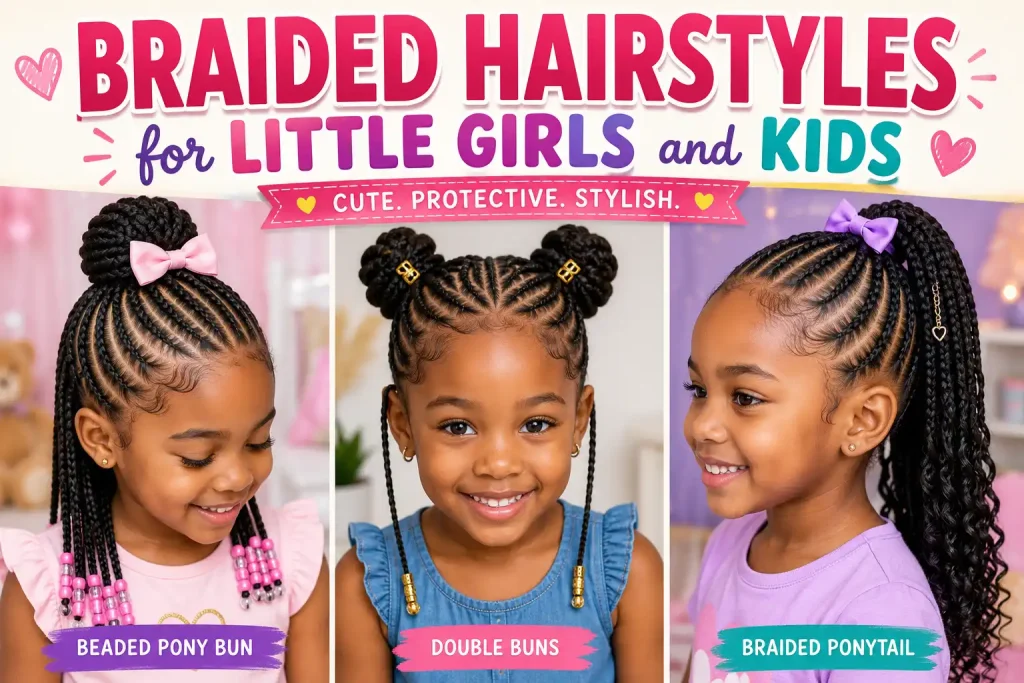
Braided hairstyles for Black girls and little black girl hairstyles with braids are among the most searched topics in the entire braided hairstyle category — and for good reason. Braided styles for children are practical, protective, school-appropriate, and often genuinely beautiful.
Key considerations for kids’ braids:
- Children’s scalps are more sensitive than adults’ — tension should be noticeably lighter than adult installations
- Styles should be comfortable enough to sleep in without significant discomfort
- Avoid styles with extremely small braids or micro-sizing on children, as cumulative tension risk is higher
Popular Braided Hairstyles for Little Girls
- Kids’ cornrows — Simple straight-back rows with colorful beads at the ends. A timeless classic.
- Little black girl braids with beads — Beads on individual braids or at the end of cornrow rows. Among the most beloved kids’ braid styles.
- Children’s braided mohawk — Side cornrows with a natural puff or braid center. Widely popular for school photos.
- Easy braids for kids — Two-strand twists, simple box braids, and single cornrows are all achievable at home by a careful parent.
- Cute little black girl hairstyles with braids — Fulani-inspired styles with smaller beads, half-up cornrow styles, and braided bun configurations.
- Braided hairstyles for 10-year-olds — At this age, medium knotless braids, braided bobs, and simple cornrow updos all work beautifully.
- Black kids braids hairstyles — Any of the above, adapted in size and length for age-appropriate comfort.
Grandmother styling traditions — often called black grandma hairstyles with braids — typically refer to simple, clean cornrows with neat parts and beads, a time-honored styling approach that prioritizes scalp health and style durability over trend.
Braided Wedding and Prom Hairstyles
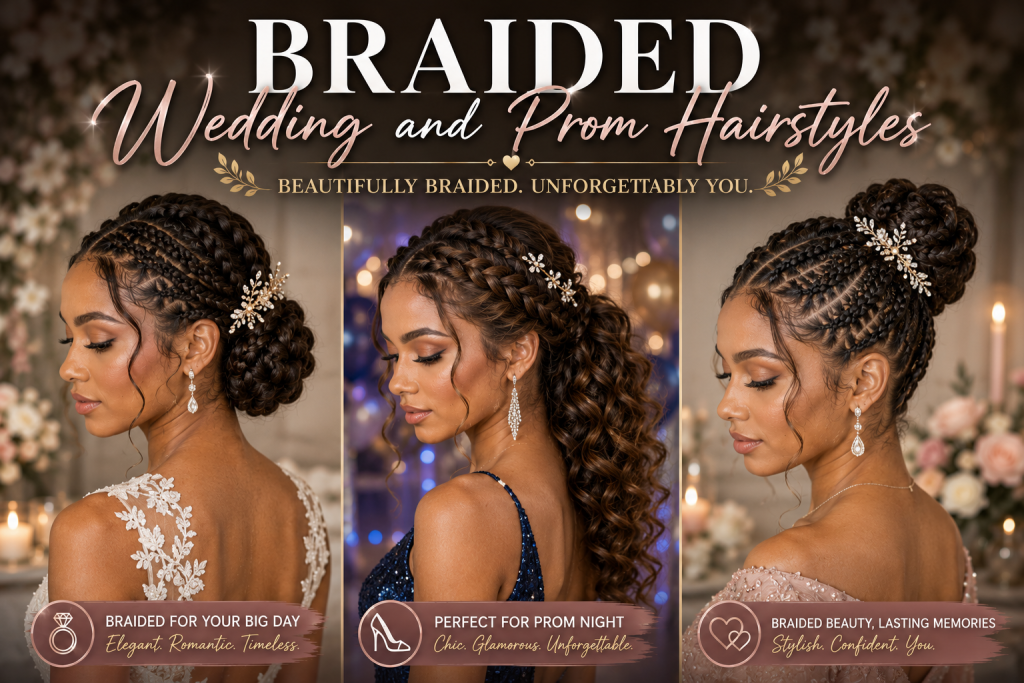
Braided wedding hairstyles and braided prom hairstyles share a common requirement: the style needs to photograph beautifully, hold up through hours of activity, and look intentional rather than casual.
Best braid styles for weddings:
- Braided crown — Halo braids wrapping the head, especially beautiful with a veil
- Low braided updo — Elegant, formal, works with any neckline
- Goddess braid bun — Sculptural and striking in photos
- Half up braided style — Top braids gathered up, remaining braids or curls falling loose
- Fulani braids for weddings — Beads and cuffs can be upgraded to gold or pearl accessories for bridal styling
Best braid styles for prom:
- Braided updo for Black hair — Classic and formal, shows off the neckline
- Half up half down braids with curls — Romantic and photogenic
- Lemonade braids into a side updo — Dramatic and statement-making
- Box braids updo — Gathered and pinned for a polished, elevated look
- Braided hairstyles with bangs — A side-swept braid with face-framing curls creates a classic prom look
For both occasions: Book your braid appointment at least 2 weeks before the event, not the week of. Braids look best in their second and third week, after the initial tightness has relaxed and before significant new growth appears.
Ombre and Colored Braids
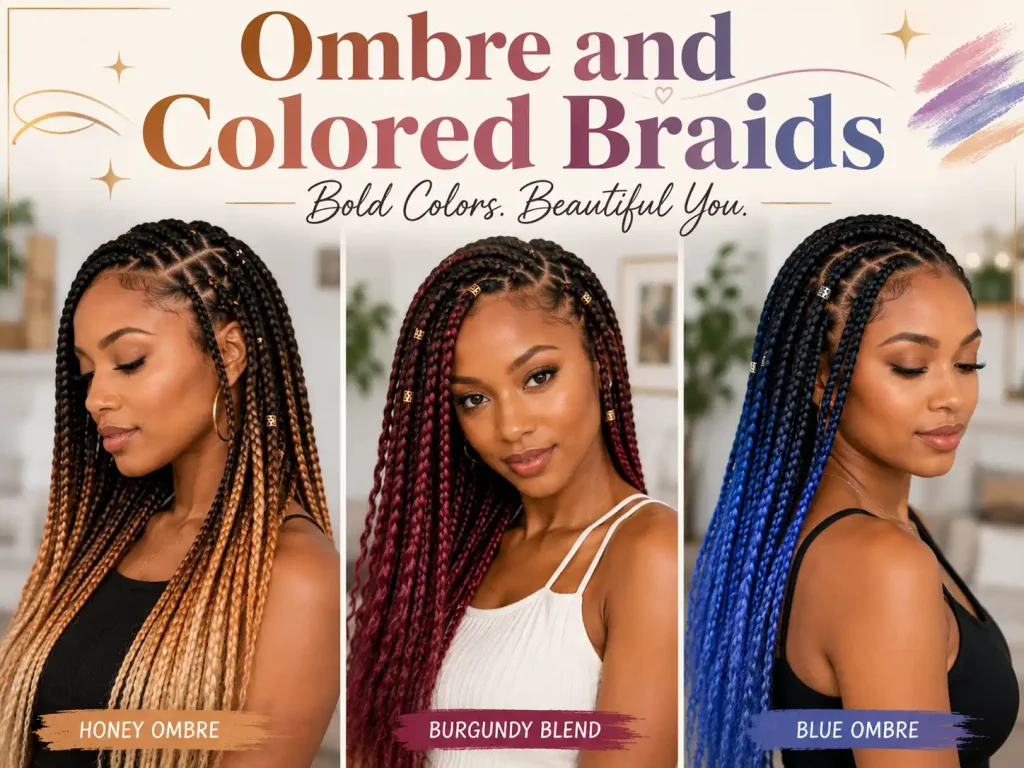
Ombre braided hairstyles and colored braids are one of the easiest ways to experiment with hair color without any chemical processing.
Extension hair is available in essentially any color before installation, so color is simply a matter of choosing the right extension shade. The most popular colored braid choices in 2026 include:
- Honey blonde ombre — Dark roots transitioning to warm golden-blonde tips
- Auburn and burgundy braids — Rich, warm tones that complement deep skin tones beautifully
- Brown and black braids — A subtle two-tone effect that adds dimension without dramatic color contrast
- Ginger and red braided hairstyles — Bold, striking, particularly popular for box braids and knotless styles
- Purple braids — Deep violet or lavender tones for a creative, artistic statement
- Blonde braids — Platinum or honey blonde braids, often as a full-color rather than ombre
- Blue and ocean tones — Deep ocean, teal, and midnight blue for the boldest color statements
Ombre hairstyles with braids typically use pre-colored extension hair with gradual color shading built in — no mixing, no processing, just selecting the right pack at the salon.
Summer Braids and Vacation Hairstyles
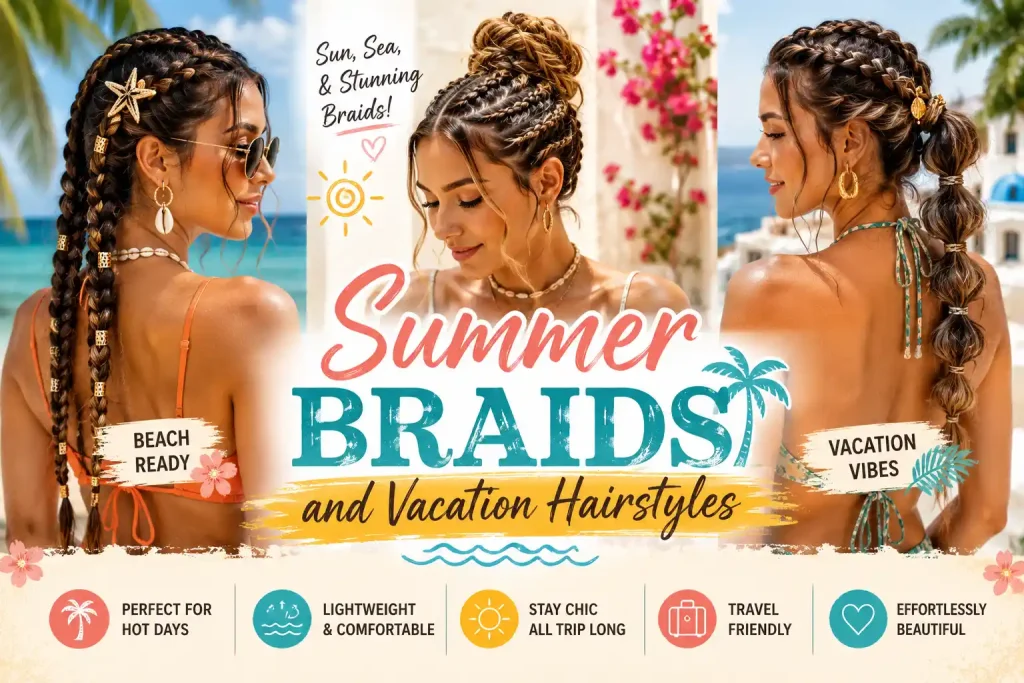
Summer braids and vacation hairstyles with braids are among the most practical category of protective styling. Heat, humidity, saltwater, chlorine, and active movement all challenge regular hairstyles — braids handle all of them better than most alternatives.
Best summer braid styles:
- Knotless braids — Lightweight, excellent in heat, ponytail-friendly for the beach
- Cornrows — Flush against the scalp, no swinging length, easy to rinse after swimming
- Braided bobs — Lower weight reduces the warmth of very long extensions in summer heat
- Boho braids — Beautiful for beach and vacation photos, though they require more curl maintenance in humidity
Summer braid maintenance tips:
- Rinse hair with clean water immediately after swimming in saltwater or chlorinated pools
- Apply a lightweight oil (coconut or jojoba) to the braids before swimming to create a moisture barrier
- Let braids dry completely before sleeping — sleeping on wet braids causes significantly faster frizzing and potential scalp irritation
90s Braids Hairstyles
90s braids hairstyles have seen a major resurgence as Y2K and 90s fashion nostalgia has dominated popular culture. The defining braid aesthetics of that era include:
- Chunky box braids — Very full, often waist-length, popularized by Janet Jackson’s 1993 film Poetic Justice
- Beaded cornrows — Rows with colorful small beads at the ends, a quintessential 90s Black girl aesthetic
- Half-up box braid styles — Top braids gathered with a scrunchie while the rest hang loose
- Micro braids with beads — Extremely fine individual braids with small colored or wooden beads throughout
- Alicia Keys’ cornrow styles — The early-2000s cornrow artistry she wore throughout her debut era remains one of the most iconic examples of detailed scalp braiding in popular culture
The appeal of 90s braids in 2026 is the combination of nostalgia with modern technique — the same visual aesthetic but installed with knotless or feed-in methods for greater comfort.
Braided Hairstyles for Straight Hair
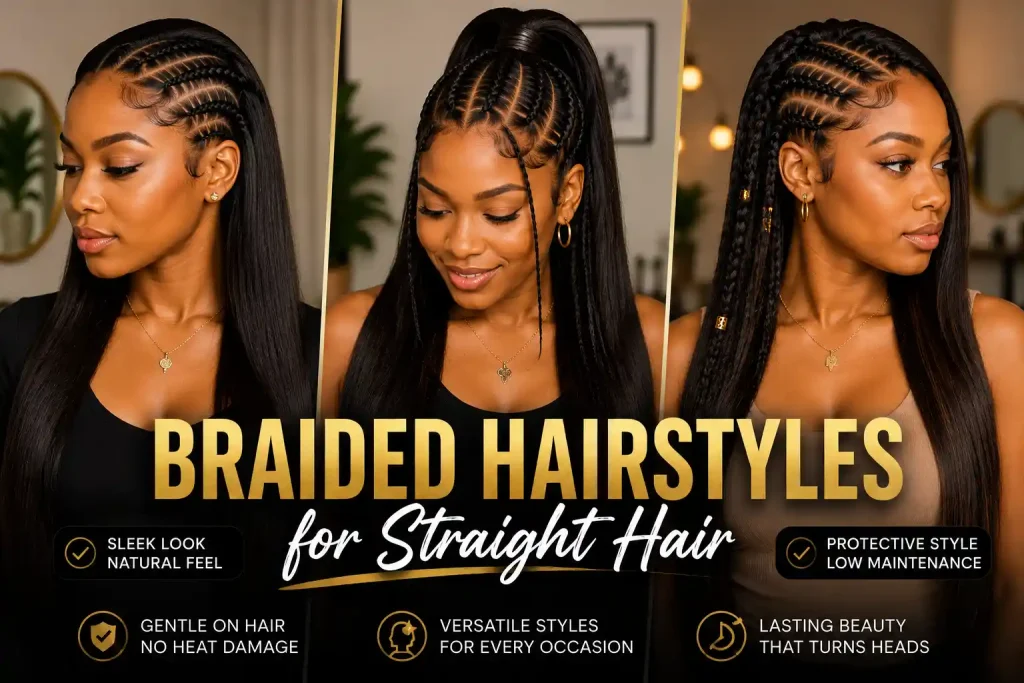
Braided hairstyles for straight hair challenge the common assumption that braids are exclusively for textured hair. Many braid styles work beautifully on straight to wavy textures — particularly Dutch braids, French braids, fishtail braids, and Viking braids, which were developed within straight-haired European traditions.
Straight hair with braids does behave differently than textured hair with braids. Straight hair has less grip on extension fiber, which can make extension-added styles slightly more prone to slipping. For most white girl braids and straight hair braid styles, either using the natural hair without extensions or choosing lightweight extension types with more texture is advisable.
Best braid styles for straight hair:
- French braid — Works on any straight or wavy texture
- Dutch braid — The raised, three-dimensional version of the French braid, excellent on straight hair
- Fishtail braid — A visually intricate style achievable at home on straight hair
- Viking braids — Thick Dutch braids and rope braids, naturally suited to straight textures
- Waterfall braid — A cascading open braid that looks particularly ethereal on straight hair
- Box braids with extensions — Achievable on straight hair with proper extension selection
Best Braids by Hair Type
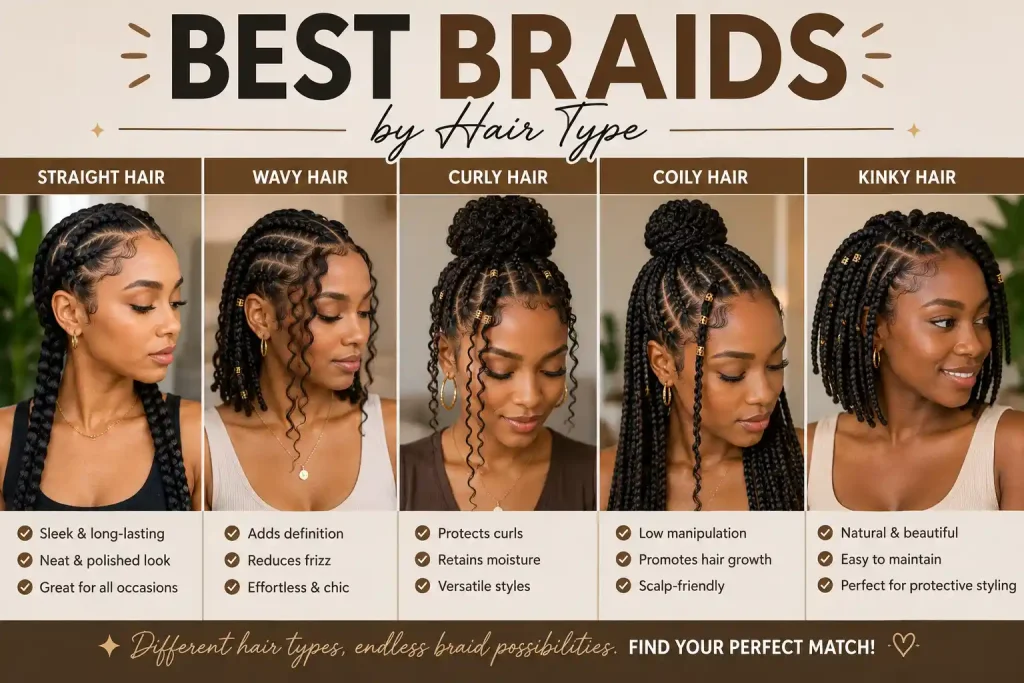
Choosing the wrong braid style for your specific texture and density can create unnecessary discomfort and risk. Using the wrong weight or tension for your hair isn’t a style failure — it’s a technical mismatch that an experienced braider can help you avoid.
Best Braids for Fine Hair
Fine-haired naturals need to think carefully about weight distribution and per-follicle tension. Fine hair has fewer strands per square inch, meaning each follicle bears a proportionally greater share of extension weight.
Best options: Medium knotless braids, feed-in cornrows, lightweight braided bobs, medium box braids at shoulder length or shorter, bubble braids (low tension).
Avoid: Micro braids (high cumulative tension), jumbo braids (concentrated weight), very long extensions past bra-strap length.
Braided hairstyles for thin hair specifically benefit from feed-in technique, which distributes extension weight more gradually and avoids heavy anchoring at delicate roots.
Best Braids for Thick Hair
Thicker, coarser hair handles braid styles well because the hair naturally grips extensions more securely. 4B and 4C textures at high density are the most compatible with the widest range of braid styles.
Best options: Box braids, goddess braids, Fulani braids, boho braids, knotless braids in medium to large sizes, stitch braids, Ghana braids.
Best Braids for Curly and Coily Hair
Curly and coily textures (3C through 4C) often hold braid styles the longest because the hair’s natural texture grips extensions very securely.
Best options: Knotless braids, box braids, cornrows, stitch braids, Ghana braids, feed-in styles.
Hair Type Compatibility Table
| Hair Texture | Best Styles | Caution Styles |
|---|---|---|
| Fine / low density | Medium knotless, feed-in cornrows, braided bob | Micro braids, jumbo braids, very long extensions |
| Medium density | Most styles | Monitor tension on any style |
| Thick / 4B–4C | Box braids, goddess braids, all cornrow styles | Even thick hair can be damaged by extreme tension |
| Relaxed / chemically treated | Cornrows, braided bobs, light knotless | Avoid heavy extensions; chemically treated hair is more fragile |
| Straight (non-textured) | Dutch braids, French braids, fishtail, Viking | Extension-added styles may slip without texture grip |
Best Braids by Face Shape
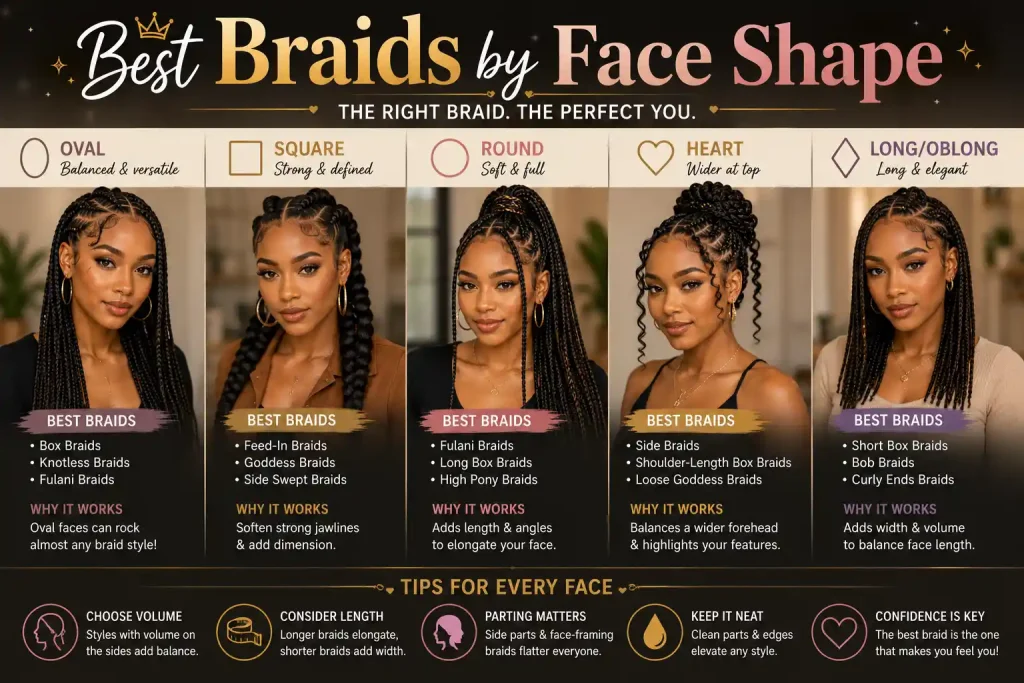
Braid choices that complement face shape create a more balanced, harmonious overall look.
| Face Shape | Features to Balance | Recommended Styles |
|---|---|---|
| Round | Reduce horizontal width | Long knotless braids, high buns, side-part styles |
| Oval | Already balanced | Nearly all styles work — experiment freely |
| Square | Soften angular jaw | Curly-end braids, boho styles, volume at the crown |
| Heart | Balance wide forehead, narrow jaw | Braided bobs, Fulani braids with face-framing pieces |
| Long | Add width, reduce vertical emphasis | Shoulder-length braids, side-swept styles, fullness at the sides |
| Diamond | Balance forehead and chin width | Half-up braid styles, medium-length knotless braids |
Practical tip: Face-framing braids and loose curly pieces soften almost any face shape and create a more flattering silhouette regardless of the base style.
Knotless Braids vs Box Braids: The Honest Comparison
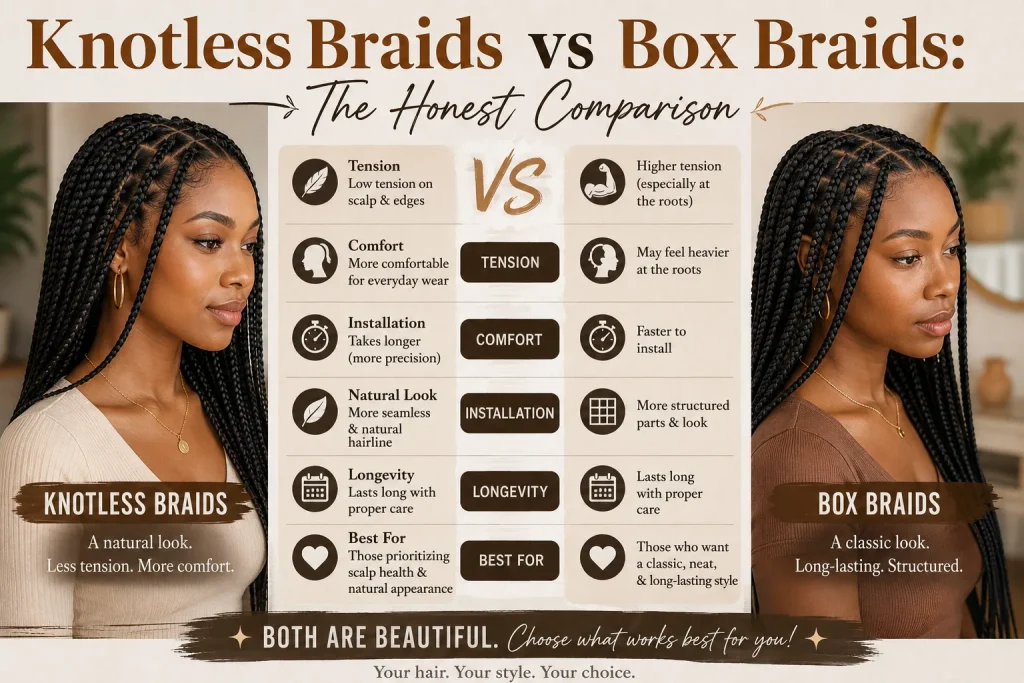
This is the most common question in the braid world, and it deserves a genuinely honest answer — not a simple “knotless is always better.”
Neither style is universally superior. They solve different problems and suit different priorities.
| Feature | Knotless Braids | Box Braids |
|---|---|---|
| Root tension | Significantly lower | Medium to high |
| Initial soreness | Minimal for most wearers | Common for first 24–72 hours |
| Natural-looking hairline | Excellent — very seamless | Less natural — knot is visible at root |
| Longevity | 4–6 weeks | 6–8 weeks |
| Install time | Longer (more technique-intensive) | Slightly shorter |
| Weight | Lighter overall | Heavier at the root |
| Cost | Usually higher | Slightly less |
| Styling flexibility | High | High |
| Braid structure | Softer, more movement | Firmer, more defined |
| Best for | Sensitive scalps, frequent updos | Maximum longevity, fuller structure |
Choose knotless if: You have a sensitive scalp, a history of tension headaches after installs, or you frequently wear braids in updos and ponytails.
Choose box braids if: Longevity is your priority, you prefer a fuller, more structured braid body, or you want a style that holds its shape with minimal effort.
How Long Do Braided Hairstyles Actually Last?
Most sources give optimistic longevity estimates. The ranges below reflect real-world wear for typical wearers — not ideal conditions.
| Style | Realistic Wear Time | Main Factors That Reduce Longevity |
|---|---|---|
| Cornrows | 2–4 weeks | Fast natural hair growth, frequent washing |
| Stitch braids | 2–4 weeks | Gel drying out, edge loosening |
| Ghana braids | 3–5 weeks | Edge frizzing |
| Goddess braids | 2–4 weeks | Larger styles loosen faster |
| Boho braids | 3–5 weeks | Loose curl sections frizzing in humidity |
| Fulani braids | 3–6 weeks | Cornrow sections at the face loosen first |
| Knotless braids | 4–6 weeks | Hair texture, activity level, maintenance |
| Box braids | 6–8 weeks | Size-dependent |
| Micro braids | 8–12 weeks | Most maintenance-intensive |
| Butterfly braids | 3–5 weeks | Loop sections catch and pull |
| Crochet braids | 4–6 weeks | Base cornrows loosening |
Real Signs That Braids Need to Come Out
- Significant frizzing at the roots that can’t be smoothed with edge control
- Scalp itching or buildup that doesn’t resolve after washing
- Visible new growth of 1.5+ inches creating tension as the braid hangs
- Tangling near the scalp when braids are moved
- Increased shedding when elastics or accessories are removed
- Skin bumps or persistent soreness — remove immediately if this occurs
Braid Maintenance: What Week-by-Week Care Really Looks Like
Week 1: Focus on scalp hydration. A lightweight scalp oil applied along the parts with a pointed applicator bottle keeps the scalp comfortable. Sleep in a satin bonnet or on a silk pillowcase every night from day one — this is the single most impactful maintenance habit for braid longevity.
Weeks 2–3: First wash. Use a diluted sulfate-free shampoo in a small applicator bottle, applying directly to the scalp along the parts. Rinse thoroughly, pat dry with a microfiber towel, and never sleep with wet braids. Apply scalp oil after washing while the scalp is still slightly damp.
Weeks 3–4: The best-looking window for most styles. Braids have relaxed slightly, the scalp has settled. Continue weekly washing and nightly bonnet use.
Weeks 4–6: Edge care becomes more critical as new growth increases. Use a soft-bristle brush with a small amount of edge control to smooth the hairline. Avoid tight ponytails that pull on new growth.
Week 6+: Honestly assess whether the style still looks intentional. Pushing past the style’s natural end point to delay a takedown appointment almost always results in more detangling damage during removal.
Best Products for Braid Maintenance
| Product | Purpose |
|---|---|
| Satin bonnet or silk pillowcase | Prevents overnight frizz and moisture loss |
| Lightweight scalp oil | Scalp hydration without product buildup |
| Sulfate-free diluted shampoo | Clean scalp without stripping extension fiber |
| Edge control | Smoothing hairline and new growth |
| Curl refresher spray | Reviving boho or curly-end sections |
| Braid mousse | Taming frizz on the braid surface |
| Microfiber towel | Gentle drying without frizz |
Avoid: Heavy grease and petrolatum buildup, excessive gel layering, and alcohol-based sprays on any braid style.
How Much Do Braids Cost in 2026?
Braid pricing varies significantly based on location, stylist experience, style complexity, and whether extensions are included. These ranges reflect general US urban area rates in 2026.
| Style | Price Range (Extensions Included) | Notes |
|---|---|---|
| Straight-back cornrows | $60–$120 | Extension cornrows cost more |
| Feed-in cornrows | $80–$180 | More technique = higher price |
| Knotless braids (medium) | $180–$300 | Size and length significantly affect price |
| Box braids (medium) | $160–$280 | Extension hair typically included |
| Box braids (small) | $220–$380 | Long install time drives higher price |
| Micro braids | $300–$600+ | Most expensive due to install time |
| Fulani braids | $150–$280 | Bead cost typically extra |
| Boho braids | $200–$350 | Curl application adds time |
| Goddess braids | $100–$200 | Faster install keeps cost lower |
| Stitch braids | $80–$200 | Depends on pattern complexity |
| Butterfly braids | $200–$400 | Specialist technique |
| Crochet braids | $80–$180 | Fast install reduces labor cost |
Always confirm: Whether the price includes extension hair. Some stylists quote labor only, requiring you to purchase extensions separately (typically $15–$40 per pack, with most styles requiring 3–8 packs).
How to Prepare Hair Before Getting Braids
What you do in the week before your appointment directly affects the comfort and longevity of your braids.
5–7 days before: Do a thorough clarifying wash to remove product buildup. Deep condition for at least 30 minutes. Trim significantly split or damaged ends.
2–3 days before: Detangle completely with a wide-tooth comb from ends to roots. Apply a lightweight moisturizer sealed with a small amount of oil (jojoba, castor, or almond oil).
Day of your appointment:
- Arrive with clean, dry, fully detangled hair
- Avoid heavy oils, butters, or styling creams the morning of — these make hair slippery, requiring more tension to grip extension fiber
- Eat before a long install. A 6–8 hour appointment on an empty stomach is genuinely uncomfortable.
- Tell your stylist your scalp sensitivity level before they begin
How to Take Down Braids Safely
Braid takedown is where most protective style hair damage happens — and it’s almost entirely preventable.
- Apply generous detangling conditioner, hair oil, or a dedicated braid removal spray to each braid before starting
- Cut or snip the very tip of each braid to remove the sealed end
- Unravel extension hair from tip to root — gently unwinding, never pulling
- Apply more conditioner to your natural hair before combing out shed hair
- Use a wide-tooth comb or fingers to detangle each section from ends to roots while conditioner is in
- Wash thoroughly, deep condition, and rest for at least one week before reinstalling braids
The rest period is not optional. Scalp skin and follicles need recovery time. Hair that looks healthy immediately post-takedown may show stress as shedding or breakage if braids are reinstalled immediately.
Can Braids Help With Hair Growth?
Braids do not make hair grow faster. Growth rate is determined by genetics and scalp health, not hairstyle.
What braids can do is help you retain the hair you grow. For people with textured or curly hair, daily manipulation — combing, brushing, heat styling — is one of the most common causes of mechanical breakage. A protective braid style that eliminates most of that daily manipulation reduces breakage rate.
The net effect: length retention improves even though growth rate doesn’t change. After 6–12 months of consistent protective styling, many people notice hair appears longer — not because it grew faster, but because less of what grew was breaking off.
The condition for this to work: braids must not themselves cause damage through excessive tension, improper installation, or poor maintenance. Tight braids can cause more damage than no braids at all. The protective benefit depends entirely on installation quality.
Common Braid Mistakes That Cause Damage
Excessive tension at installation is the most common and serious problem. Persistent pain after 48 hours, bumps along the hairline, swelling, or visible “puckering” of the skin between braids are all signs of too-aggressive tension.
Too-heavy extensions create chronic downward pulling on follicles. This damage is cumulative and often doesn’t become visible until traction alopecia is already progressing.
Skipping nighttime protection — cotton pillowcases create friction that frays extension hair, causes root tangling, and dries out both braids and scalp. A satin bonnet is the single most impactful habit for braid care.
Leaving braids in too long causes new growth to lock into the braid base, creating a tangled matrix that’s difficult to remove safely — the primary cause of significant post-braid breakage.
Reinstalling too soon after takedown doesn’t allow follicle recovery. Even a two-week break between installs makes a meaningful cumulative difference in long-term scalp health.
Constant tight ponytails throughout the install period puts the same hairline tension that protective styling was meant to prevent.
Trending Braids Hairstyles 2025–2026
The current braid landscape in 2026 is defined by several clear directions:
Soft, natural-looking installations dominate. Braids that appear to grow seamlessly from the scalp — knotless styles with thin, tapered roots — are strongly preferred over rigid, heavily-knotted finishes.
Curly texture throughout braids, not just at the ends, is the defining trend of 2025–2026. Boho knotless braids with loose curl clusters integrated throughout the braid have moved from niche to mainstream.
Mixed braid sizes within a single install — combining thick and thin braids — add dimension and an artisanal quality. Popular in Fulani and tribal installs.
Butterfly braids are the single newest technique with the most momentum in 2025–2026 for their sculptural, distinctive visual.
Color trends continue warm: honey blonde, auburn, burnt orange, and rich burgundy are consistent favorites for ombre and colored extension braids.
Braided bobs are at peak popularity among people who want protective styling without the weight of very long extensions.
New braids hairstyles 2025 also include stitch-feed braid combinations — crisp stitch cornrows at the scalp transitioning into hanging individual braids — a hybrid that combines the neatness of scalp braiding with the versatility of individual styles.
FAQ: Everything You Need to Know
How to curl hair by braiding?
To curl hair by braiding, divide slightly damp hair into sections and braid each part before sleeping. Undo the braids in the morning and gently separate the waves with your fingers for soft, heat-free curls.
How to plait my hair?
Start by dividing your hair into three equal sections and cross the outer sections over the middle one repeatedly. Continue until you reach the ends, then secure the plait with a hair tie.
How to style my braids?
You can style braids in ponytails, buns, half-up looks, or side-swept styles depending on the braid type. Accessories like beads, cuffs, and scarves also help personalize braided hairstyles.
How to French plait curly hair?
Detangle curly hair gently and apply a lightweight styling cream before braiding. Start near the crown and gradually add hair into each section while braiding downward for a smooth French plait.
How do you do braids?
Braids are created by weaving sections of hair over one another in a repeated pattern. The most basic braid uses three sections, while advanced styles may include added hair or detailed scalp patterns.
What do you call people with braids?
People with braids are simply described as having braided hair or braided hairstyles. Specific braid names may vary depending on the style, such as cornrows, box braids, or knotless braids.
How to do black hair braids?
Start with clean, moisturized hair and section it carefully before braiding. Many black hair braid styles use extensions and protective techniques like knotless braids, cornrows, or box braids.
How to style your braids?
Braids can be styled into buns, braided ponytails, updos, or loose side styles for different occasions. Using edge control and lightweight mousse can help keep the style polished longer.
How braid black hair?
To braid black hair, divide the hair into sections and braid using natural hair alone or with extensions added gradually. Protective styles like cornrows, Fulani braids, and box braids are especially popular choices.
Final Thoughts: Finding the Right Braid for Your Real Life
The best braided hairstyle isn’t the one that looks most impressive in a reference photo. It’s the one that fits your actual scalp sensitivity, your real maintenance availability, your lifestyle, and your styling preferences after three or four weeks — not just on install day.
Start with comfort and work backward. If you have a sensitive scalp or you’ve had painful experiences with braids before, knotless braids in a medium size are the most consistently comfortable starting point. If longevity is your priority and your scalp handles tension well, medium box braids give you the longest wear of any individual style. If you’re active and want something you can wash frequently with minimal upkeep, feed-in cornrows offer the most practical combination of style and function.
Talk to your stylist before your appointment — not just about the style you want, but about your scalp history, your maintenance habits, and how you’re planning to wear the braids day-to-day. A great braider uses that information to customize the technique, sizing, and tension of your specific install.
And take the rest periods seriously. Protective styling only protects when the cumulative pattern — install, maintain, remove, rest, repeat — is respected at every stage. Your hair’s long-term health is the point. The style is how you get there.