
Reviewed by: Editorial Hair & Scalp Research Team | Last Updated: June 2026
If you’ve been standing in the beauty aisle staring at a shelf of oils and wondering whether any of them actually do anything — you’re not alone, and you’re asking the right question.
The honest answer is more nuanced than most product labels admit. Some hair growth oils have genuine research supporting their use. Others are mostly marketing. And even the ones that work won’t do much if you’re using the wrong oil for your hair type, applying too much, or hoping for results in two weeks.
Here’s what this guide does differently: it’s built around what the science actually says, what dermatologists recommend, and what real hair types need — not what sells the most units. Whether your hair feels thin, dry, constantly breaking, or simply stuck at the same length it’s been for years, this breakdown will help you figure out what’s actually worth trying.
What Hair Growth Oils Actually Do (And What They Don’t)

Before diving into specific oils, it’s worth getting clear on the mechanism — because a lot of the disappointment people experience with hair oils comes from expecting the wrong things.
Hair growth oils don’t directly speed up how fast your hair grows. Hair growth rate is primarily determined by genetics, hormones, age, and overall health. Most people grow roughly half an inch of hair per month, and no topical oil is going to meaningfully change that biological rate.
What oils can do is significant, though:
- Reduce breakage, which is the most common reason hair appears stuck at a certain length
- Support scalp health, creating better conditions for existing follicles
- Improve moisture retention, especially for dry, coily, or chemically treated hair
- Minimize friction damage from styling, detangling, and protective styles
- Soothe scalp irritation, which can sometimes interfere with a healthy hair environment
The result? Hair that retains more of its growth — and over time, that looks a lot like longer, fuller, healthier hair.
Understanding the Hair Growth Cycle
Your hair isn’t always in the same phase of growth. Every strand cycles through three stages:
| Stage | Name | What’s Happening | Duration |
|---|---|---|---|
| Active growth | Anagen | Hair is actively growing from the follicle | 2–7 years |
| Transition | Catagen | Growth slows, follicle shrinks | 2–3 weeks |
| Resting & shedding | Telogen | Hair rests, then sheds | 3–4 months |
At any given time, about 85–90% of your hair is in anagen. Shedding 50–100 hairs per day is completely normal. When shedding exceeds that consistently, or when broken hair is being mistaken for shedding, that’s when a targeted oil routine can make a visible difference.
The Clinical Research: What Science Says About Hair Oils
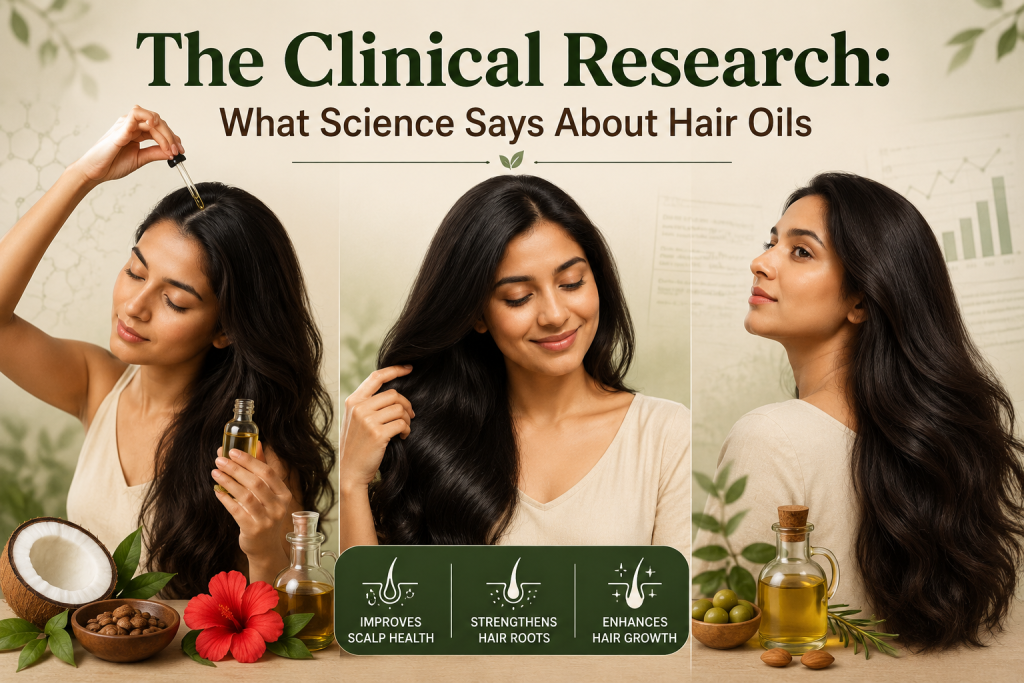
This is where most hair oil guides fall short — they skip the research entirely and just list products. Let’s look at what the evidence actually shows.
Rosemary Oil and the Minoxidil Comparison
The most significant research on a hair growth oil to date involves rosemary oil. A 2023 study published in the Journal of Dermatology compared the effects of rosemary oil extract to 2% minoxidil — one of the few FDA-recognized treatments for hair loss — over a six-month period.
The result: Both groups showed comparable increases in hair density. Participants in the rosemary oil group reported significantly less scalp itching than those using minoxidil. While rosemary oil is not a replacement for clinically diagnosed hair loss treatment, this study validated its use as a legitimate scalp care ingredient — not just a wellness trend.
The proposed mechanism involves ursolic acid, a compound in rosemary thought to improve microcirculation in the scalp, potentially supporting follicle activity.
Coconut Oil and Protein Loss Prevention
Coconut oil has been studied for its unique ability to penetrate the hair shaft — something most oils cannot do. Research published in the Journal of Cosmetic Science found that lauric acid, the dominant fatty acid in coconut oil, has a strong affinity for hair protein. Pre-washing with coconut oil was shown to reduce protein loss from the hair strand both before and after shampooing.
This is particularly relevant for heat-damaged, bleached, or frequently washed hair, where repeated processing strips proteins from the cortex.
Peppermint Oil and Scalp Circulation
A study in Toxicological Research (2014) found that peppermint oil stimulated more hair growth than minoxidil in mice, with increases in follicle depth and dermal thickness. Human clinical data is more limited, but the proposed mechanism — improved microcirculation from the cooling menthol effect — is plausible and consistent with why scalp massage itself has been studied for hair growth support.
The Limits of the Evidence
It’s important to be honest: most hair oil research is still limited in scale and duration. Animal studies don’t always translate to human outcomes. And the studies that do exist often use specific concentrations and formulations that differ from what’s sold commercially. Oils can genuinely support scalp health and reduce breakage — the evidence for that is solid. Claims about regrowing bald patches or reversing genetic hair loss through oils alone are not supported.
Best Hair Growth Oils in 2026: Detailed Breakdown
Rosemary Oil — Best for Scalp Health and Lightweight Routines

If there’s one oil that belongs in almost every scalp care routine, rosemary oil is the strongest contender — and it’s earned that status through research, not just popularity.
Why it works: Beyond the minoxidil comparison study, rosemary oil is lightweight enough to use 2–3 times per week without creating buildup. It’s absorbed relatively quickly and doesn’t leave the greasy residue that heavier oils do — which makes it far more practical for people with fine hair, oily scalps, or anyone who washes their hair regularly.
One critical point: Rosemary essential oil is highly concentrated and should never be applied directly to the scalp without dilution. Undiluted essential oils can cause contact dermatitis and scalp irritation.
How to use it correctly:
- Mix 2–3 drops of rosemary essential oil with 1 tablespoon of a carrier oil (jojoba is ideal)
- Warm the blend between your palms
- Apply directly to the scalp, focusing on areas of concern
- Massage gently with fingertips for 3–5 minutes
- Leave on for 30–60 minutes, then shampoo thoroughly
Best for: Fine hair, oily scalps, thinning-looking hair, people who want a lightweight scalp-massage oil they can use 2–3 times weekly.
Not ideal for: Extremely dry hair that needs deep moisture — rosemary oil addresses the scalp, not strand hydration.
Castor Oil — Best for Moisture Retention and Textured Hair
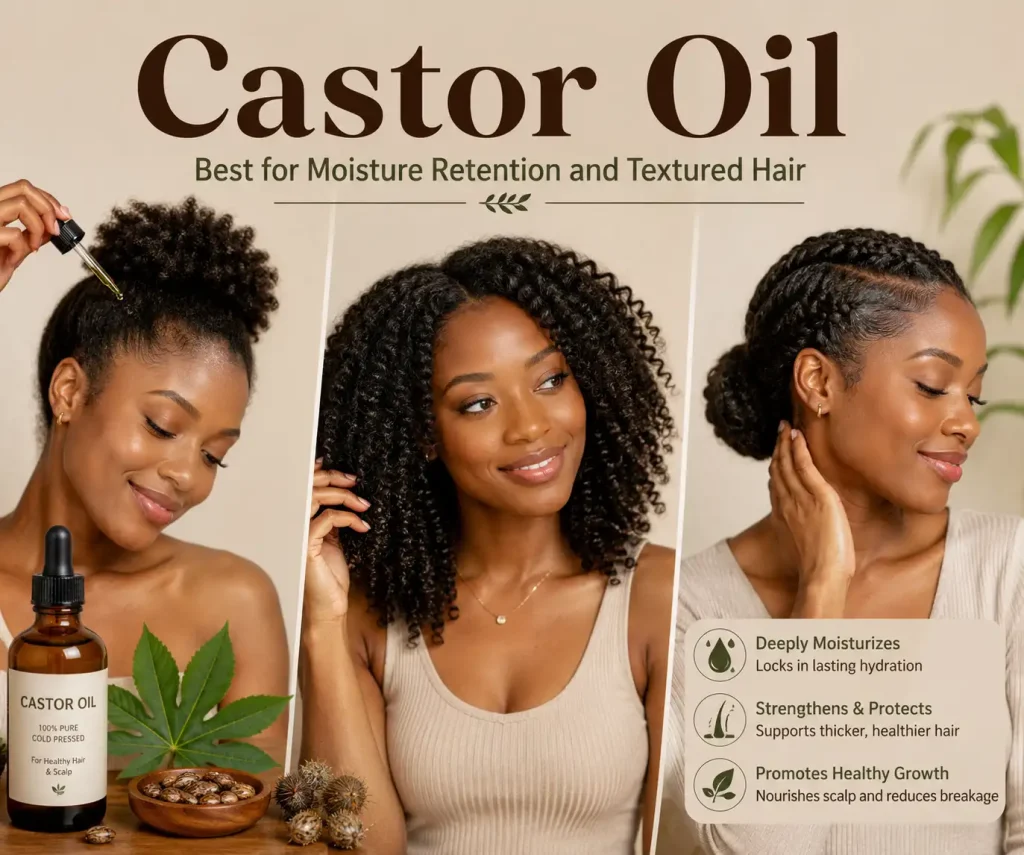
The Castor oil is the most misunderstood oil in hair care. People either swear by it or swear at it — and the difference almost always comes down to how it’s being used.
What makes castor oil different is its unusually high ricinoleic acid content (around 90%). This fatty acid is responsible for the oil’s signature thick, viscous consistency — and it’s also what makes castor oil exceptionally effective at sealing moisture into dry, porous strands. It doesn’t just coat the surface; it lingers.
For people with coily, kinky, or extremely dry hair, that sealing effect can be transformative. Hair that constantly feels rough and brittle despite regular conditioning often responds well to castor oil as a sealing step.
The catch: That same thickness makes it easy to over-apply. Too much castor oil creates product buildup that sits on the scalp, potentially clogging follicles if not properly cleansed. And on fine or low-porosity hair, it can weigh strands down completely.
Best blend for easier application:
- 1 part castor oil
- 2 parts jojoba or argan oil
This maintains the sealing benefits while making the formula significantly easier to distribute and wash out.
Best for: Dry hair, coily and kinky textures, protective styling, sealing in moisture after wash day.
Not ideal for: Fine hair, oily scalps, or anyone with low hair porosity who struggles with buildup.
Coconut Oil — Best for Damaged and Protein-Depleted Hair

The Coconut oil occupies a unique position among hair oils: it’s one of the very few that can actually penetrate the hair shaft rather than just coating it. Most oils work on the surface. Coconut oil works from within.
This matters most for hair that’s been repeatedly heat-styled, bleached, or chemically processed — because those processes break down the protein structure of the hair over time. Using coconut oil as a pre-shampoo treatment (applied 30 minutes to an hour before washing) allows the lauric acid to temporarily reinforce the cortex before the hair is exposed to the stress of shampooing.
Important nuance: Coconut oil’s penetrating ability is also why it can be problematic for some hair types. People with low porosity hair — strands where the cuticle lies flat and resists penetration — often find that coconut oil causes their hair to feel stiff, brittle, or protein-overloaded. If your hair responds badly to protein-rich products, coconut oil may not be the right choice even if your hair is damaged.
Best for: Medium to high porosity hair, heat-damaged or bleached hair, frizz control, pre-shampoo treatments.
Not ideal for: Low porosity hair, protein-sensitive hair types.
Jojoba Oil — Best All-Around Option for Scalp and Strand
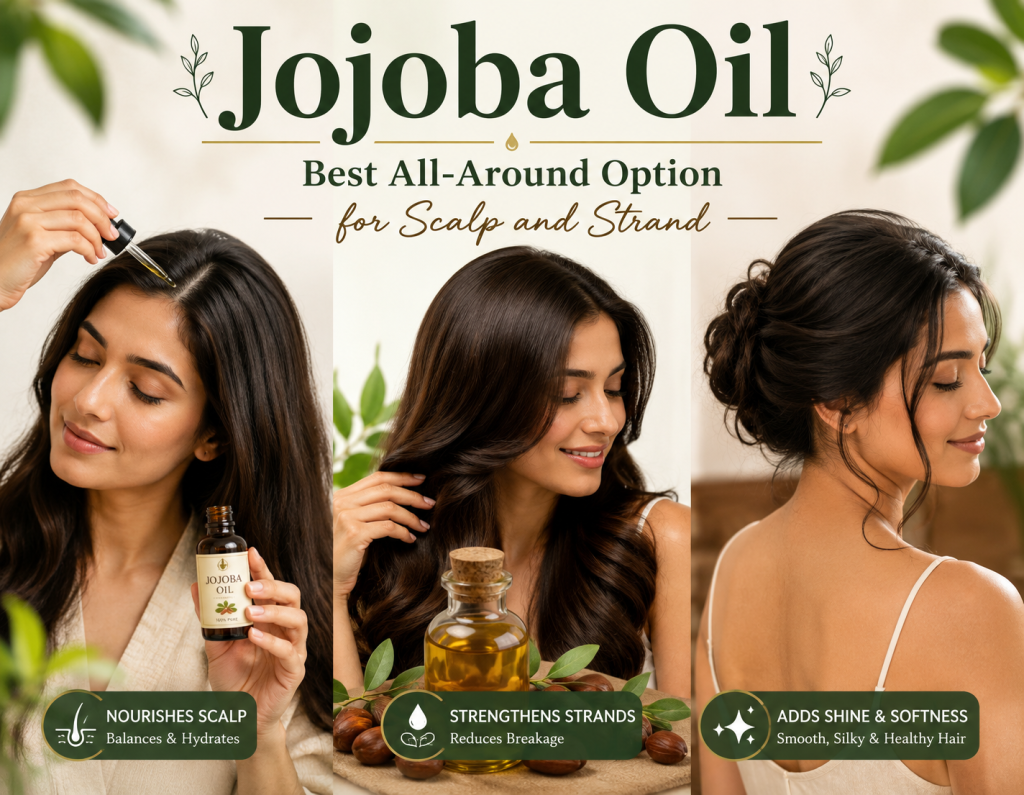
The Jojoba oil has a distinct advantage over other oils: it’s technically a liquid wax, not an oil. Its molecular structure closely resembles the sebum your scalp naturally produces — which is why it’s one of the most universally tolerated options across hair types.
Because jojoba mimics the scalp’s natural oils, it absorbs readily without leaving heavy residue. It won’t disrupt the scalp’s natural oil balance the way some heavier oils can, making it an ideal carrier oil for essential oil blends and a standalone scalp conditioner for people with sensitive or reactive scalps.
So, For oily scalp types, jojoba is often the only oil that doesn’t make things worse. For fine hair, it provides lightweight hydration without flattening. For color-treated hair, it moisturizes without stripping dye or causing buildup.
Best for: Fine hair, sensitive scalps, oily scalps, as a carrier for essential oil blends, daily lightweight hydration.
Argan Oil — Best for Frizz, Softness, and Styled Hair
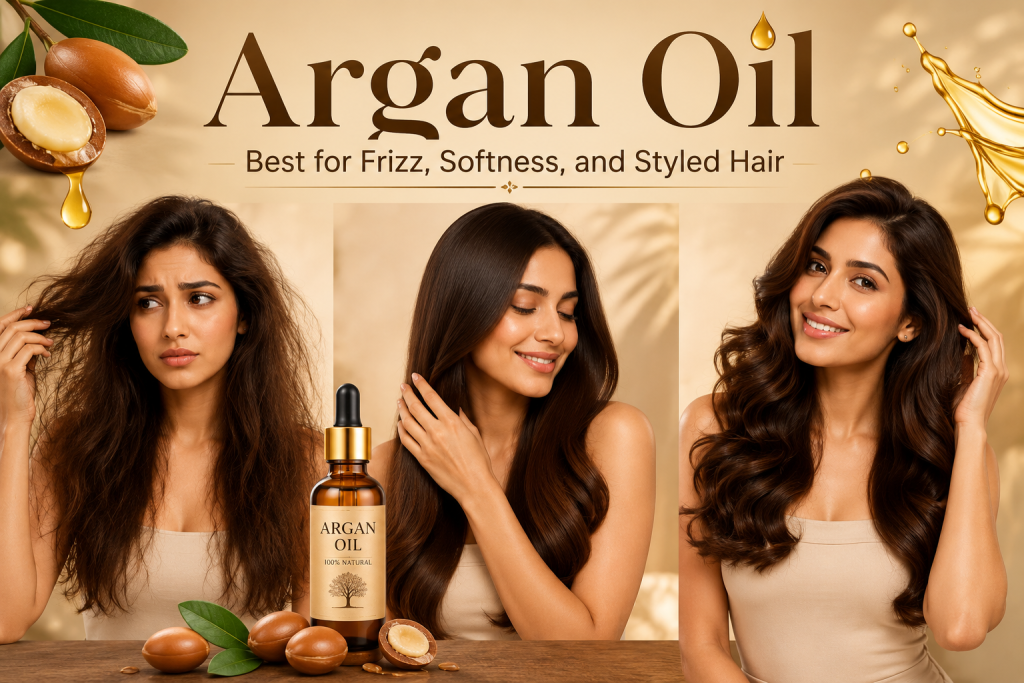
The Argan oil’s reputation as “liquid gold” is partly marketing, but the core claim holds up: it’s remarkably effective at smoothing the hair cuticle and reducing frizz without creating buildup or weighing hair down.
Rich in vitamin E and oleic acid, argan oil works primarily on the hair shaft rather than the scalp. It’s best used on mid-lengths and ends — the oldest, most processed parts of the hair — where it improves softness, adds shine, and helps protect against humidity-induced frizz.
A few drops of argan oil applied to damp hair before blow-drying also provides a degree of heat protection, though it shouldn’t replace a dedicated heat protectant for very high temperatures.
Best for: Dry ends, frizz control, blow-dried or straightened styles, daily finishing, color-treated hair.
Tip: Less is more with argan oil. Start with 2–3 drops — you can always add more, but too much makes hair look greasy.
Peppermint Oil — Best for Scalp Stimulation and Refreshing Routines
The Peppermint oil creates an unmistakable cooling sensation on the scalp, and there’s legitimate science behind why that sensation matters. The menthol in peppermint oil acts as a vasodilator — it temporarily widens blood vessels near the skin’s surface, improving circulation to the scalp.
The 2014 study mentioned earlier found peppermint oil outperformed minoxidil in mouse models, with significant improvements in follicle depth and dermal papilla activity. Human data is more limited, but peppermint oil is increasingly popular in professional scalp treatment formulations for this reason.
Critical warning: Peppermint essential oil is one of the most concentrated essential oils available and can cause severe irritation or even chemical burns if applied undiluted. Always dilute to 1–2% in a carrier oil (roughly 2 drops per tablespoon of carrier).
Best for: Oily scalps, refreshing scalp massage blends, anyone who enjoys the sensory experience of scalp stimulation.
Tea Tree Oil — Best for Flaky or Congested Scalps
The Tea tree oil (melaleuca oil) has well-documented antifungal and antimicrobial properties, which makes it useful in a specific context: scalp flaking and congestion caused by fungal overgrowth, a condition sometimes called seborrheic dermatitis or simply “dandruff.”
If your scalp produces visible flakes alongside itching or oiliness, a diluted tea tree blend used once or twice a week may provide meaningful relief. It won’t fix every type of scalp flaking — dry scalp flaking has a different cause — but for fungal-related dandruff, it’s one of the more evidence-backed natural options.
Important: Tea tree oil also requires dilution. It is toxic if ingested and should always be stored away from children and pets.
Best for: Flaky scalp from fungal causes, congested or itchy scalp, oily scalps with buildup.
Not for: Severe scalp conditions — see a dermatologist if flaking is persistent, painful, or accompanied by hair loss.
Hair Growth Oils by Hair Type: What Actually Works for You
Best Oils for Fine Hair
Fine hair is delicate in two ways: the strands themselves are thinner and more easily weighed down, and the scalp tends to produce visible oil more quickly. The goal for fine hair is lightweight hydration with minimal residue.
Best choices:
- Jojoba oil — closest to natural sebum, absorbs without residue
- Diluted rosemary oil in jojoba — lightweight scalp care without heaviness
- A few drops of argan oil on ends only, not scalp
Avoid: Castor oil, heavy overnight oil treatments, thick layered oil routines
Key tip: Apply oils to the scalp only, not from roots to ends, to prevent flat, greasy-looking hair.
Best Oils for Thick Hair
Thick hair can handle richer oil treatments without the same risk of flatness or buildup. The focus here is moisture, manageability, and softness.
Best choices:
- Coconut oil as a pre-shampoo treatment
- Castor oil mixed with argan or jojoba for weekly deep treatment
- Argan oil for daily smoothing
Best Oils for Curly Hair (Types 2C–3C)
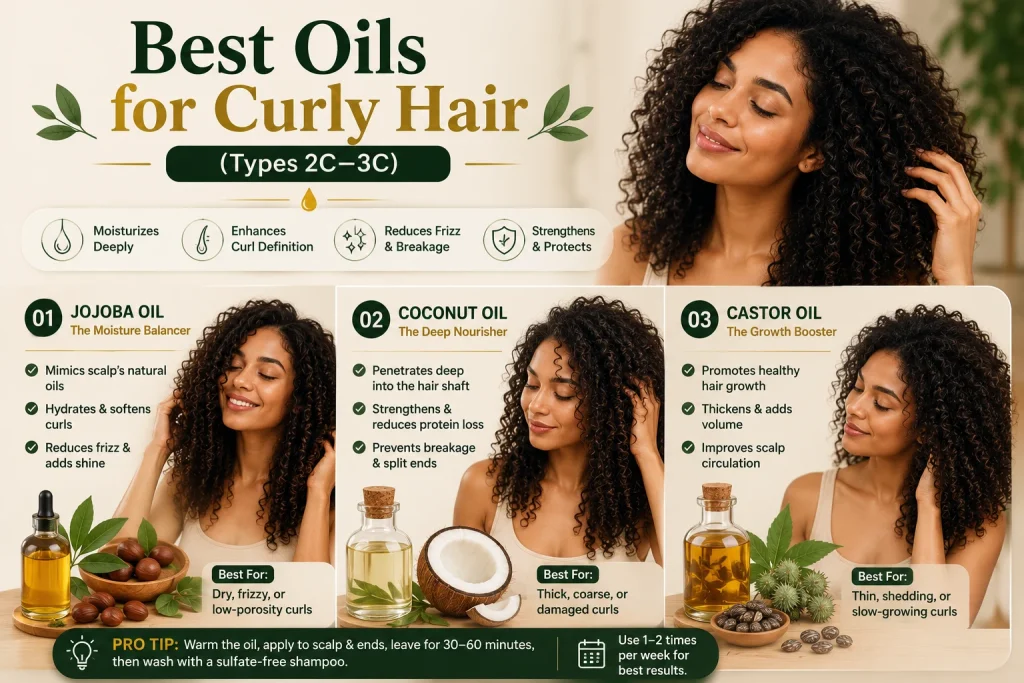
Curly hair’s coiled structure makes it naturally harder for scalp oils to travel down the hair shaft, which is why curly hair tends to be drier at the ends than at the roots. The priority is distributing moisture along the length of the hair, not just the scalp.
Best choices:
- Coconut oil as a pre-wash treatment on mid-lengths and ends
- Argan oil for frizz smoothing and humidity resistance
- Jojoba oil for scalp care
Best practice: Apply oils to damp hair after washing for better distribution. Dry curls resist absorption; damp curls absorb oils more readily.
Best Oils for Coily and Kinky Hair (Types 4A–4C)
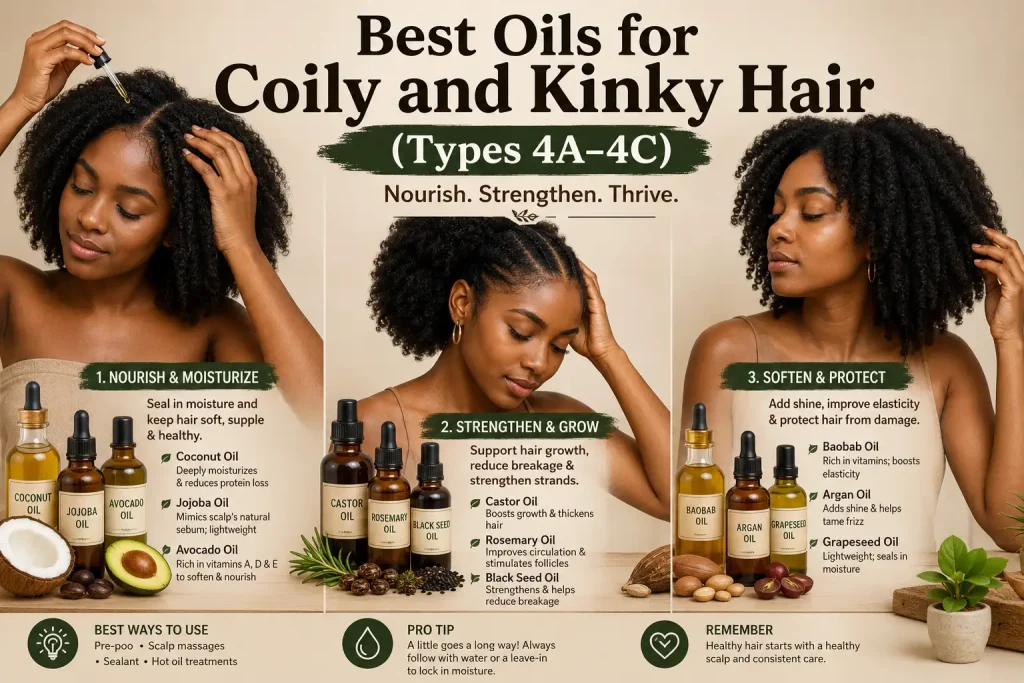
Coily hair has the highest porosity range and the most acute need for moisture retention and sealing. Hair oils aren’t just beneficial here — they’re often essential for maintaining length.
Best choices:
- Castor oil (mixed with lighter oils) for sealing moisture
- Coconut oil for protein support and pre-shampoo treatment
- Jojoba oil for scalp care
Key tip: Oils work best in coily hair routines when applied on top of a leave-in conditioner, not as a standalone step. Think of the oil as a seal over moisture you’ve already added, not as the moisture itself.
Best Oils for Color-Treated Hair
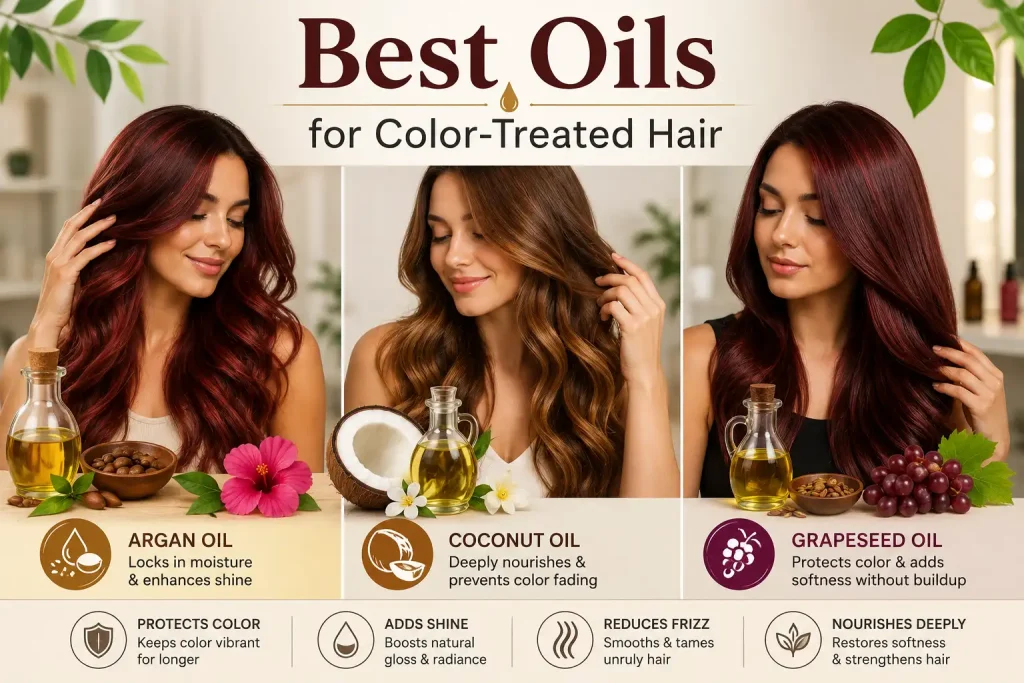
Chemical processing — whether coloring, bleaching, relaxing, or perming — compromises the hair’s cuticle layer and internal protein structure. Color-treated hair needs lightweight moisture without ingredients that cause fading or buildup.
Best choices:
- Argan oil — smooths the cuticle without heavy residue
- Jojoba oil — hydrates without interfering with color vibrancy
- Light coconut oil on ends as a pre-wash treatment
Avoid: Heavy silicone-based oil blends that create buildup, requiring more frequent washing (which fades color faster).
Best Oils for Men’s Hair and Scalp
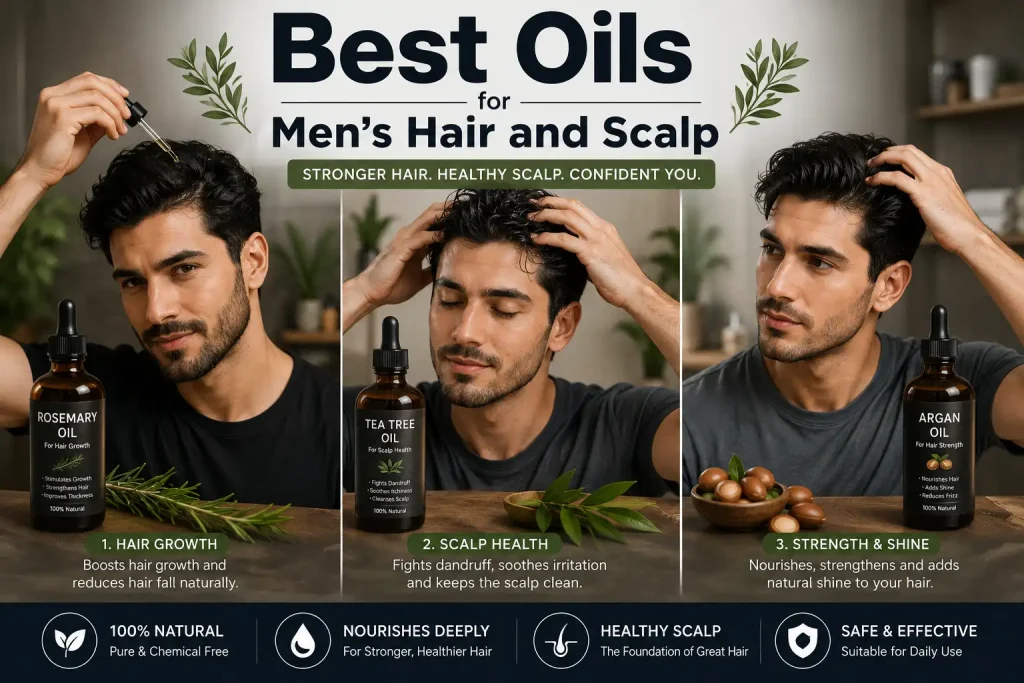
Men’s hair care needs are often underrepresented in hair oil guides, but the scalp concerns are real — male pattern baldness (androgenetic alopecia) affects roughly 50% of men by age 50 according to the American Hair Loss Association. While oils cannot reverse genetic hair loss driven by DHT (dihydrotestosterone), they can support scalp health and reduce breakage for men who still have active hair growth.
Best choices:
- Rosemary oil (diluted in jojoba) — the most research-backed natural option for scalp support
- Peppermint oil blend — for scalp stimulation and refreshing feel
- Jojoba oil for daily lightweight scalp conditioning
Key note for men: If you’re noticing a receding hairline, thinning crown, or hair that’s visibly miniaturizing (producing finer, shorter strands over time), these are signs of androgenetic alopecia — a condition driven by DHT that requires clinical evaluation, not just oil. Rosemary oil may slow the visible progression for some people, but it is not a substitute for FDA-approved treatments like minoxidil or finasteride when those are clinically indicated.
Best Oils for Postpartum Hair Loss

Postpartum hair shedding — technically called telogen effluvium — affects the majority of people who give birth. During pregnancy, elevated estrogen keeps more hairs in the anagen (growth) phase than usual. After delivery, those hormones drop sharply, and a large percentage of those retained hairs enter the telogen phase simultaneously. The result is dramatic shedding, typically beginning 2–4 months postpartum and peaking around month 4–6.
This is temporary and normal. Most people see significant improvement by month 9–12 postpartum.
Oils can help during this period by reducing additional breakage while the body rebalances — but they won’t stop the hormonal shedding process itself.
Recommended:
- Rosemary oil blend for gentle scalp massage (also provides a calming self-care ritual during a demanding period)
- Jojoba oil for sensitive scalp types
- Argan oil for softness and managing texture changes postpartum hair often brings
When to seek care: If shedding is extreme, is still worsening after 6 months, or is accompanied by other symptoms (fatigue, weight changes, feeling cold), speak with your doctor. Postpartum thyroid disorders can cause similar hair shedding and require different treatment.
Hair Porosity: The Factor Most Guides Skip
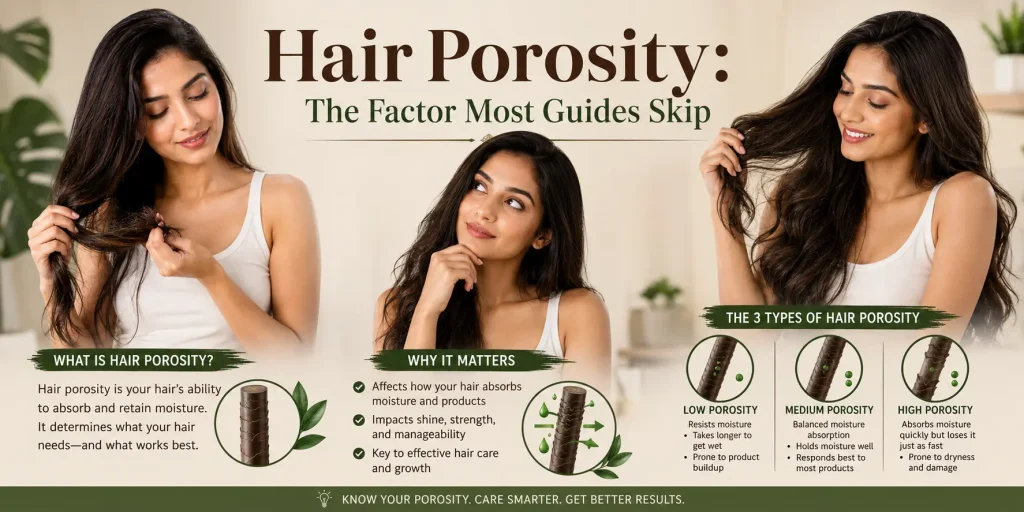
The Hair porosity — how readily your hair absorbs and retains moisture — may be the most important variable in deciding which oil works for you. Yet most hair oil guides never mention it.
How to Test Your Hair Porosity
The float test: Take a clean strand of shed hair and drop it in a glass of water. Wait 2–3 minutes.
- Floats on top → Low porosity (cuticle is tightly closed)
- Sinks slowly to the middle → Medium/normal porosity
- Sinks quickly to the bottom → High porosity (cuticle is open or damaged)
What Porosity Means for Oil Choice
| Porosity Type | What It Means | Best Oils |
|---|---|---|
| Low porosity | Cuticle resists absorption; moisture and products sit on top | Lightweight oils (jojoba, argan); avoid coconut oil |
| Medium/Normal | Balanced absorption and retention | Most oils work well |
| High porosity | Absorbs moisture quickly but loses it just as fast | Heavier sealing oils (castor, coconut); layering routines |
This explains why some people swear by coconut oil and others find it makes their hair worse. It’s not that the oil is bad — it’s that low porosity hair types often don’t need penetrating oils at all. They need lightweight surface hydration and sealing, not more protein.
Essential Oils vs. Carrier Oils: A Practical Distinction
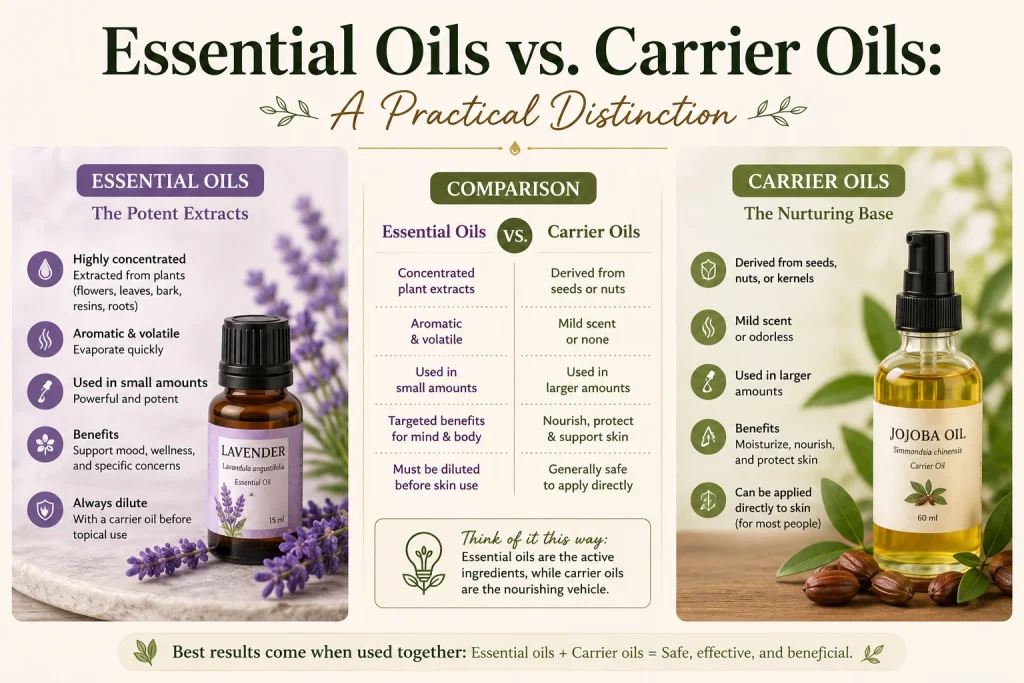
This distinction matters more than most people realize, and confusing the two is one of the most common causes of scalp irritation from oil routines.
| Feature | Essential Oils | Carrier Oils |
|---|---|---|
| Concentration | Highly concentrated plant extracts | Cold-pressed plant oils, ready for skin contact |
| Examples | Rosemary, peppermint, tea tree, lavender | Jojoba, argan, coconut, castor |
| Direct use on scalp | No — must be diluted | Yes |
| Primary function | Active scalp-focused properties | Dilute essential oils; provide base hydration |
| Shelf life | Longer | Varies; some go rancid quickly |
Safe dilution ratios for scalp use:
- General use: 1–2% (2–4 drops essential oil per tablespoon of carrier oil)
- Sensitive scalp: 0.5–1% (1–2 drops per tablespoon)
Never exceed 3% dilution for scalp applications.
How to Apply Hair Growth Oil Correctly: Step-by-Step
Using the right oil incorrectly produces poor results. Here’s how to actually get the most out of your oil routine.
For Scalp-Focused Oil Treatments
- Start with clean or lightly damp hair — applying oils on top of product buildup creates layered residue, not scalp nourishment
- Measure your oil — for most people, 1–2 teaspoons is sufficient; more is not better
- Warm the oil slightly between your palms (body temperature improves absorption)
- Part the hair in sections and apply directly to the scalp, not the hair itself
- Massage for 3–5 minutes using the pads of your fingertips (not your nails)
- Leave on for 30–60 minutes, or overnight for dry hair types on lighter oils
- Shampoo thoroughly — one wash may not be enough for heavier oils like castor
For Strand-Focused Oil Treatments
- Apply to mid-lengths and ends only — the oldest, driest part of the hair
- Work through on damp hair after washing for better distribution
- Use 2–4 drops of a lightweight oil and comb through with a wide-tooth comb
- Style as usual — no need to rinse
Common Mistakes That Reduce Results
- Applying to dirty, product-laden hair — the oil sits on buildup, not your scalp
- Using too much — creates congestion and buildup faster than it creates moisture
- Skipping dilution for essential oils — a direct route to scalp irritation
- Expecting results in one or two uses — meaningful changes take 6–12 consistent weeks
- Using the same oil for scalp and ends when your scalp and ends have different needs
How Often Should You Oil Your Hair?
Consistency matters more than frequency. A once-weekly routine maintained for three months will outperform an intensive daily routine abandoned after two weeks.
| Hair Type | Scalp Oiling | Strand/End Oiling |
|---|---|---|
| Fine hair | Once weekly | After every wash, very lightly |
| Normal/medium hair | 1–2 times weekly | After every wash as needed |
| Thick hair | 2 times weekly | 2–3 times weekly |
| Curly hair (2C–3C) | 1–2 times weekly | After every wash |
| Coily hair (4A–4C) | 2–3 times weekly | Daily or every other day on ends |
| Oily scalp | Once weekly or less | Focus on ends, avoid scalp |
| Dry/flaky scalp | 2 times weekly | As needed |
How Long Until You See Results? A Realistic Timeline
This is the question most guides avoid answering honestly — and the silence leads to abandonment of routines that would have worked if maintained.
Weeks 1–2: Scalp feels more comfortable; some improvement in dryness or tightness. No visible hair changes yet.
Weeks 3–4: Strands may feel softer; less breakage during detangling is often the first noticeable change.
Months 2–3: Reduced breakage becomes visible — fewer short pieces of broken hair on clothing, pillows, and in brushes.
Months 3–6: Hair appears fuller and may be retaining more length because breakage has decreased significantly.
Beyond 6 months: For scalp-focused routines (especially rosemary oil), some people notice improvements in hair density. This is the timeframe the minoxidil comparison study used — six months of twice-daily application.
The key insight: You’re not accelerating growth. You’re preserving growth. The length is coming in; you’re just keeping more of it.
The DHT Factor: What Oils Can’t Do
DHT (dihydrotestosterone) is the androgen responsible for androgenetic alopecia — the most common form of hair loss in both men and women. It causes hair follicles to miniaturize over time, producing progressively finer and shorter strands until they eventually stop producing hair altogether.
No hair oil directly blocks DHT. Some research suggests rosemary oil may have mild anti-androgenic effects, but the evidence is not strong enough to position it as a DHT blocker.
If you’re experiencing pattern hair loss — a receding hairline, thinning crown, or widening part — oils are a supportive tool at best. The clinically proven options are minoxidil (topical or oral), finasteride, and for women, spironolactone. These require a physician’s evaluation.
Ingredients to Look For (and Avoid) in Commercial Hair Oil Blends
Look For
- Rosemary extract or oil — evidence-backed scalp support
- Jojoba oil — scalp-compatible lightweight carrier
- Argan oil — cuticle-smoothing, frizz control
- Castor oil (in appropriate textures) — moisture sealing
- Peppermint or tea tree oil — scalp stimulation and antimicrobial support
- Biotin-infused scalp serums — supportive for fine hair routines
Approach With Caution
- Heavy mineral oil formulas — coat rather than nourish; can be difficult to wash out
- Excessive synthetic fragrance — common allergen, can irritate sensitive scalps
- Silicone-heavy blends — create a smoothing effect but can build up significantly with regular use
- Drying alcohols high on the ingredient list — counterproductive in a moisturizing product
When Hair Oils Are Not Enough: Recognizing Medical Hair Loss
Hair oils support scalp health and reduce breakage. They are not a medical treatment, and certain types of hair loss need professional evaluation rather than an oil routine.
See a Dermatologist or Trichologist If You Notice
- Sudden or rapid shedding — more than 150–200 hairs per day consistently
- Bald patches — smooth, circular areas of hair loss (possible alopecia areata)
- A receding hairline or thinning crown — signs of androgenetic alopecia
- Scalp pain, burning, or persistent inflammation
- Scarring on the scalp — some conditions (lichen planopilaris, central centrifugal cicatricial alopecia) cause permanent follicle destruction if not treated early
- Hair loss accompanied by fatigue, weight changes, or other systemic symptoms — possible thyroid disorder, autoimmune condition, or nutritional deficiency
A dermatologist specializing in hair loss (or a licensed trichologist) can perform a trichoscopy, blood work, and scalp evaluation to identify the actual cause — which determines the actual treatment.
This matters because treating androgenetic alopecia with oils while a scarring alopecia goes undiagnosed can result in permanent loss that could have been stopped.
Hair Growth Oil Myths — Addressed With Evidence
“Oils Make Hair Grow Overnight”
Hair grows from within the follicle. Nothing applied topically changes that timeline. The 6-month rosemary/minoxidil study is the gold standard for what timeline to expect from even the most evidence-backed oil — and that’s with twice-daily consistent application.
“More Oil Equals Better Results”
The research on scalp massage for hair growth (a 2019 study from Aderans Research Institute) used 4 minutes of scalp massage daily — not oil saturation. The benefit comes from circulation stimulation, not oil quantity. Excess oil creates buildup, not growth.
“One Oil Works for Every Hair Type”
Fine hair and 4C coily hair have almost opposite needs. Fine hair needs lightweight, non-residue options. Coily hair often needs layered, rich moisture sealing. Applying the same oil with the same technique to both will produce very different outcomes — and one of them will probably be disappointing.
“Natural Oils Are Always Safe for the Scalp”
Natural does not mean gentle. Tea tree, peppermint, and rosemary essential oils can all cause severe scalp reactions when used undiluted. Some people are also genuinely allergic to specific carrier oils. Always patch test a new oil on a small area of skin before applying broadly.
“Hair Oils Can Reverse Baldness”
In cases of androgenetic alopecia — especially in areas where follicles have miniaturized or become inactive — topical oils cannot restore hair growth. Follicle reactivation at that stage requires medical intervention.
Frequently Asked Questions
What is the best hair growth oil overall?
There’s no single answer that works for every person, but rosemary oil (diluted in jojoba) is the closest to a universal recommendation because it’s backed by clinical research, suitable for most hair types, and unlikely to cause buildup or irritation when used correctly. For dry, coily, or heavily damaged hair, castor oil mixed with a lighter carrier is often more effective.
How long does rosemary oil take to show results?
The most relevant clinical study ran for six months with twice-daily application before significant results were observed. For weekly use in a scalp massage routine, most people notice scalp comfort improvements within 4–6 weeks and visible hair changes at 3–6 months.
Can castor oil actually grow hair faster?
Castor oil’s primary mechanism is moisture sealing and softening, not growth acceleration. By reducing breakage, hair retains more of its natural growth over time — which can look like faster growth, but is actually just less hair breaking off. There’s no strong clinical evidence that castor oil directly accelerates the hair growth cycle.
Is coconut oil good for all hair types?
No. Coconut oil’s penetrating ability is beneficial for medium to high porosity and protein-depleted hair, but it can cause problems for low porosity hair (where it tends to sit on the cuticle and cause stiffness) and protein-sensitive hair (where it can contribute to an overload effect). Test it first on a small section before committing to a full treatment.
What oil is best for a dry, itchy scalp?
The answer depends on the cause. So, for dry scalp from dehydration, jojoba or coconut oil can help. For flaky, itchy scalp from fungal causes (seborrheic dermatitis), diluted tea tree oil has evidence supporting its use. For persistent or severe scalp issues, a dermatologist evaluation is the right first step — not more oil.
Can I leave hair oil on overnight?
For dry or coily hair types, lightweight overnight oil treatments (jojoba, argan) are generally well-tolerated. For fine or oily hair, overnight application often creates buildup that’s counterproductive. If you try it, use considerably less than you think you need and use a satin or silk pillowcase to prevent transfer.
Do hair oils clog follicles?
Heavy oils applied directly to the scalp in excessive amounts can contribute to follicular congestion — a buildup around the follicle opening that can interfere with a healthy scalp environment. This is most common with castor oil, thick mineral oil blends, and any oil applied without adequate cleansing. Using moderate amounts and washing thoroughly prevents this.
What’s the best oil for 4C hair?
Castor oil (mixed with lighter oils to reduce thickness) and coconut oil are most commonly recommended for 4C hair because of their moisture-sealing and protein-supporting properties. The LOC or LCO method — applying leave-in conditioner, then oil, then cream (or variations) — is more effective than oil alone for 4C hair’s moisture needs.
Can men use hair growth oils?
Yes. Rosemary oil and peppermint oil blends are the most relevant for men because of their scalp-focused activity. For men experiencing early-stage androgenetic alopecia, these can be used as supportive tools alongside — not instead of — clinical treatments if hair loss is a significant concern.
What do dermatologists recommend for hair growth?
For scalp health and breakage reduction, dermatologists increasingly recognize rosemary oil as a legitimate supportive option based on the 2023 clinical data. For actual hair loss conditions, the gold standard treatments remain topical minoxidil, oral minoxidil (in growing use), finasteride (for men), and spironolactone (for women with hormonal hair loss). Oils are supportive — not primary medical treatments.
Is there a difference between hair oil and scalp oil?
Yes, practically speaking. Scalp oils are typically lighter formulations designed to be applied directly to the scalp and massaged in — they focus on scalp health, microcirculation, and follicle support. Hair oils are often heavier or finishing-focused, designed to be applied to the hair shaft for softness, frizz control, and shine. Some oils serve both purposes; others are better suited to one or the other.
How do I know if a hair oil is actually working?
The clearest early sign isn’t length — it’s reduced breakage. If your brush, pillowcase, and shower drain are collecting less hair, and if detangling is producing fewer broken strands, your oil routine is working. Length retention follows. If you see no change in breakage or scalp comfort after 6–8 weeks of consistent use, the formulation or application method probably isn’t right for your hair type.
Building Your First Oil Routine: Simple Starter Guides
Beginner Routine for Fine Hair (Oily Scalp)
- Oil: Jojoba oil, or a diluted rosemary + jojoba blend
- Frequency: Once weekly, scalp only
- Amount: ½ teaspoon — less than you think you need
- Method: Apply to scalp partings before washing; leave 30 minutes; shampoo thoroughly
- Avoid: Overnight treatments, castor oil, applying to hair lengths
Beginner Routine for Dry, Curly Hair
- Scalp oil: Diluted rosemary or jojoba
- End oil: Coconut oil pre-wash, argan oil post-wash
- Frequency: Scalp 1–2x weekly; ends after every wash
- Method: Apply oils to damp hair for better distribution; focus on the mid-lengths down
Beginner Routine for Coily Hair (4A–4C)
- Scalp oil: Jojoba with optional rosemary drops
- Sealing oil: Castor oil + argan blend (1:2 ratio)
- Frequency: Scalp 2x weekly; sealing after every wash
- Method: Apply leave-in conditioner first, then seal with oil blend; don’t skip the leave-in
Conclusion: The Honest Summary
The best hair growth oil is the one matched to your actual hair type, scalp condition, and realistic expectations — not the one with the best label.
Rosemary oil has the strongest clinical backing of any natural scalp oil in 2026. Castor oil remains the gold standard for moisture sealing in coily textures. Coconut oil is uniquely effective for protein-depleted hair but isn’t right for everyone. Jojoba is the safest starting point for almost any hair type. And argan oil is one of the most practical finishing oils available.
None of them work overnight. All of them work better when used consistently, in the right amount, on the right part of the hair, with realistic expectations about what they’re actually doing.
The biggest improvements most people experience don’t come from finding a better product — they come from reducing breakage, protecting moisture, and stopping the behaviors that were quietly undoing their progress in the first place. Less heat. Less tension. Less over-manipulation. More consistency with a simple, appropriate routine.
Start simple. Give it three months. And if you’re experiencing something that oil alone isn’t addressing — sudden shedding, bald patches, rapid thinning, or scalp pain — please see a dermatologist. Some conditions respond well to early treatment and are significantly harder to address once significant loss has occurred.
Your hair is worth more than a trending ingredient. It deserves an honest routine.