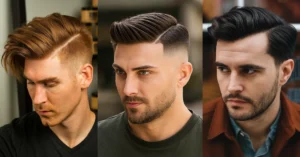
If your straight hair looks flat on top, bulky at the sides, or too blunt after a fresh cut, the problem usually is not your hair. It is the haircut.
The best haircuts for straight hair men use texture, tapering, layers, clean edges, and balanced length to make straight hair sit better. This guide helps you choose a cut that fits your face shape, hair type, lifestyle, and styling time.
You will find short haircuts, medium styles, long straight hairstyles, fades, tapers, crops, curtains, two block cuts, quiffs, mullets, product tips, maintenance advice, and barber scripts you can use before your next appointment.
Quick Answer: Best Haircuts for Straight Hair Men
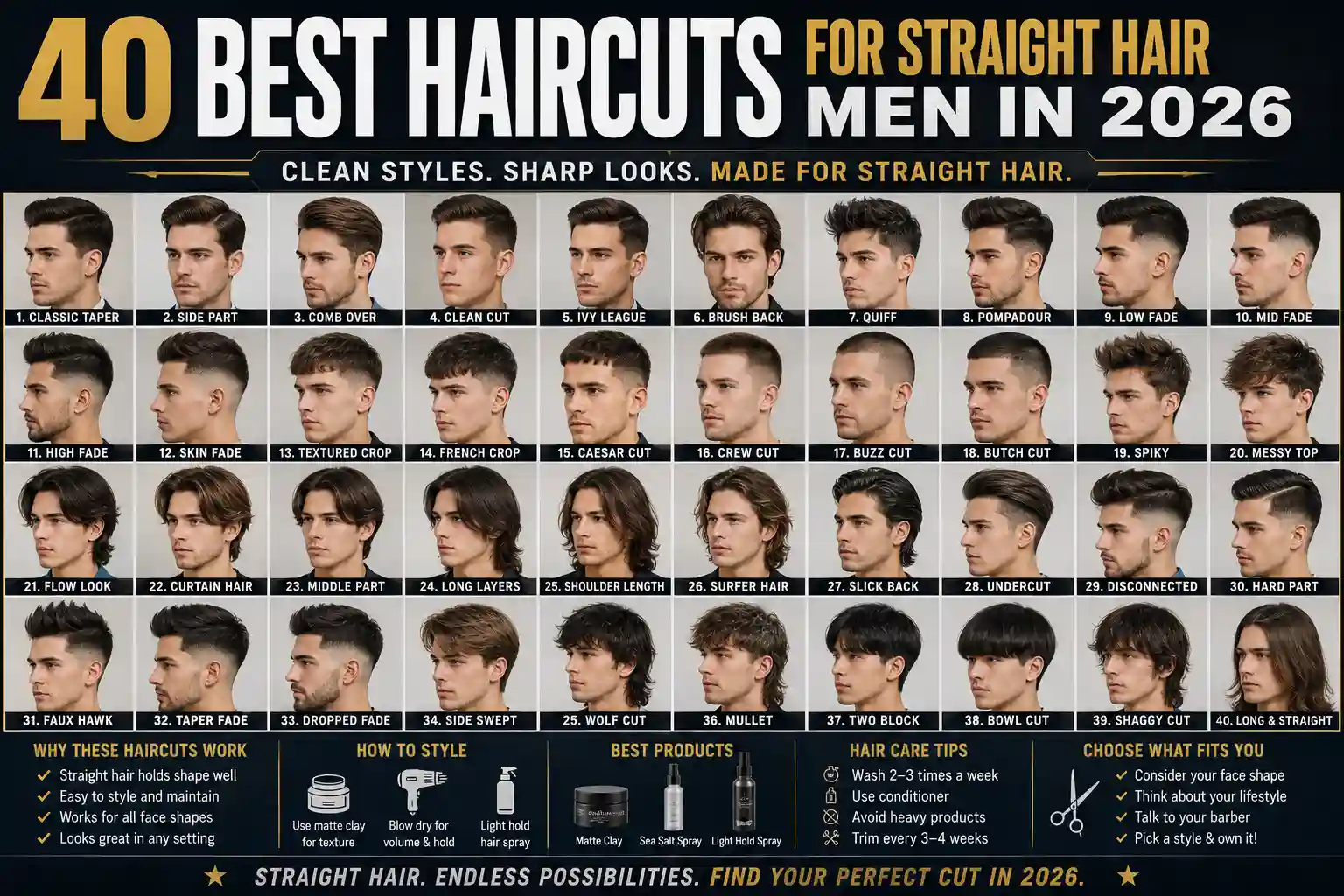
The best haircuts for straight hair men are textured crops, French crops, crew cuts, Ivy League cuts, low tapers, mid fades, curtain haircuts, two block haircuts, quiffs, side parts, modern mullets, and layered medium styles.
If your straight hair falls flat, choose texture or height. If your sides stick out, choose a taper, fade, or two block shape. If your hair is thick, ask for internal layering instead of heavy thinning.
Start Here: Choose a Haircut by Your Hair Problem
Straight hair can look amazing when the cut solves your main issue. Start with what bothers you most in the mirror.
| Your Hair Problem | Best Haircut Choice | Why It Works |
|---|---|---|
| Hair falls flat | Textured crop | Adds separation and shape |
| Sides stick out | Low taper | Controls the ears and neckline |
| Hair looks too heavy | Layered taper | Removes bulk without losing shape |
| Hair is very fine | French crop | Creates structure without thinning |
| You need a work haircut | Ivy League | Looks polished and easy to style |
| You want medium length | Curtain haircut | Adds flow and face framing |
| You want sharp sides | Mid fade crop | Gives contrast and clean edges |
| You want a bold look | Modern mullet | Adds shape, length, and attitude |
| You want a sleek look | Side part | Works naturally with straight hair |
| You have dense straight hair | Two block haircut | Keeps fullness on top and controls sides |
Why Straight Hair Needs the Right Haircut
Straight hair shows every detail. A good blend looks sharp, but a bad blend, blunt top, or uneven fringe can stand out fast.
Straight hair can also sit close to the head. Without the right cut, it may look flat even when it is clean and healthy.
A good straight-hair haircut should do at least one of these things:
• Add texture so the top does not sit like one flat sheet
• Add height if your face needs more length
• Remove bulk if your hair is thick or stiff
• Keep clean edges around the ears and neckline
• Use layers if medium or long hair feels heavy
• Follow your natural growth pattern
• Work with your cowlicks, not against them
• Fit your real morning routine
• Grow out cleanly between visits
Best Haircuts for Straight Hair Men by Goal
Use this table if you know the result you want but not the haircut name.
| Goal | Best Haircut | Best For | Styling Time | Maintenance |
|---|---|---|---|---|
| Lowest effort | Buzz cut | Men who want no daily styling | None | 4–8 weeks |
| Clean daily style | Crew cut | Fine to medium straight hair | 1–2 minutes | 4–6 weeks |
| More volume | Textured crop | Flat straight hair | 2–4 minutes | 4–5 weeks |
| Work or school | Ivy League | Professional settings | 3–5 minutes | 3–5 weeks |
| Soft grow-out | Low taper | Most straight hair types | 1–3 minutes | 3–5 weeks |
| Sharp modern sides | Mid fade crop | Medium to thick straight hair | 2–4 minutes | 2–4 weeks |
| Medium flow | Curtain haircut | Straight hair with front length | 5–8 minutes | 6–8 weeks |
| Thick hair control | Layered taper | Heavy straight hair | 3–6 minutes | 5–7 weeks |
| Bold 2026 style | Modern mullet | Medium to thick straight hair | 5–8 minutes | 4–6 weeks |
| Smooth classic finish | Side part | Fine, medium, or thick hair | 3–6 minutes | 3–5 weeks |
| Youthful straight-hair shape | Two block haircut | Dense, smooth straight hair | 3–6 minutes | 4–6 weeks |
| More height | Short quiff | Flat top or round face shape | 4–7 minutes | 3–5 weeks |
Best Short Haircuts for Straight Hair Men
Short haircuts are great for straight hair because they keep the shape controlled. They also make the sides, neckline, and hairline easier to manage.
The key is avoiding a blunt top. Ask your barber for point-cut texture, soft blending, or a taper so the cut does not look stiff.
Crew Cut
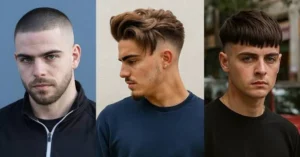
A crew cut is short, clean, and easy to wear. The top stays slightly longer than the sides, which gives straight hair a simple shape.
This cut works for fine, medium, and thick straight hair. It is also one of the easiest styles for work, school, sports, and daily grooming.
Best for: low-maintenance routines, active lifestyles, simple styling
Styling difficulty: very easy
Maintenance: every 4–6 weeks
Ask your barber: “Keep the top short but not flat, taper the sides, and add light texture.”
Buzz Cut
A buzz cut is the easiest haircut for straight hair men who do not want to style their hair. It works best when you like a clean, strong, no-fuss look.
Choose a longer guard if you want a softer finish. A very short buzz cut can look sharp, but it also shows head shape more clearly.
Best for: low effort, hot weather, strong facial features
Styling difficulty: none
Maintenance: every 4–8 weeks
Ask your barber: “Use one even guard, or keep the top slightly longer than the sides.”
French Crop
A French crop has short sides and a forward fringe. It is one of the best straight-hair cuts because it adds shape without needing long styling.
This cut works especially well if your hair naturally falls forward. Ask for a soft fringe instead of a thick, heavy line.
Best for: flat straight hair, fine hair, low styling time
Styling difficulty: easy
Maintenance: every 4–5 weeks
Ask your barber: “Give me a textured French crop with a soft fringe and tapered sides.”
Textured Crop
A textured crop breaks up straight hair so it does not look like one solid sheet. The top has choppy, piece-like texture, while the sides stay neat.
This is one of the best modern choices because it works with a low taper, mid fade, skin fade, or natural sides.
Best for: fine hair, thick hair, round faces, casual style
Styling difficulty: easy to medium
Maintenance: every 4–5 weeks
Ask your barber: “Keep 1.5 to 3 inches on top and add point-cut texture.”
Caesar Cut
A Caesar cut has a short fringe across the front. It gives straight hair a tidy, controlled shape.
It is a good option if you want a short haircut but do not want a buzz cut. Keep the fringe soft so it does not look too harsh.
Best for: short straight hair, simple routines, mature hairlines
Styling difficulty: easy
Maintenance: every 4–6 weeks
Ask your barber: “Give me a short Caesar with a soft fringe and clean taper.”
Short Quiff
A short quiff gives straight hair lift at the front. It is useful if your hair looks flat or your face shape benefits from more height.
The front should not be too long. If it is too heavy, it may fall forward during the day.
Best for: round faces, fine straight hair, medium-density hair
Styling difficulty: medium
Maintenance: every 3–5 weeks
Ask your barber: “Leave the front longer for lift and keep the sides tapered.”
Best Medium Haircuts for Straight Hair Men
Medium straight hair gives you more styling options. You can wear it parted, swept back, pushed forward, or loose with layers.
The main goal is balance. If the top is too heavy, it falls flat. If the sides are too bulky, the haircut can look wide.
Curtain Haircut
A curtain haircut uses a center part or soft off-center part. The front pieces fall on both sides of the face.
This style works best when the front reaches the eyebrows, cheekbones, or jaw area. Straight hair makes the curtain shape clear and smooth.
Best for: medium straight hair, oval faces, heart faces, longer foreheads
Styling difficulty: medium
Maintenance: every 6–8 weeks
Ask your barber: “Keep the front long enough to part, add soft layers, and clean up the sides.”
Medium Side Part
A medium side part is classic, but it still looks current when the finish is natural. The top should be long enough to sweep without looking stiff.
This cut works for work, school, dates, interviews, and formal events. A matte finish usually looks better than hard shiny gel.
Best for: professional style, straight hair with body, oval or round faces
Styling difficulty: easy to medium
Maintenance: every 3–5 weeks
Ask your barber: “Follow my natural part and leave enough length for a soft sweep.”
Bro Flow
A bro flow is a relaxed medium-length cut that moves back from the face. It works best when straight hair has enough length to bend naturally.
The ends still need shaping. Without trimming, this style can look like an unfinished grow-out.
Best for: medium to thick straight hair, relaxed style, grown-out looks
Styling difficulty: medium
Maintenance: every 6–8 weeks
Ask your stylist: “Shape the ends, remove bulk, and keep the flow natural.”
Layered Sweep Back
A layered sweep back keeps the top and front longer, then shapes the hair back with soft layers. It looks cleaner than messy medium hair.
This style works well if you want movement without a center part. A quick blow-dry helps lift the roots.
Best for: thick straight hair, medium length, work-to-weekend style
Styling difficulty: medium
Maintenance: every 5–7 weeks
Ask your barber: “Keep the top longer and add layers so it sweeps back easily.”
Medium Taper
A medium taper keeps length on top while cleaning the sideburns, neckline, and ears. It is softer than a fade but cleaner than a natural grow-out.
This cut is ideal if you want shape without looking too sharp. It also grows out better than a skin fade.
Best for: most straight hair types, office wear, school rules
Styling difficulty: easy
Maintenance: every 3–5 weeks
Ask your barber: “Taper the neckline and sideburns, but keep the sides natural.”
Best Long Hairstyles for Straight Hair Men
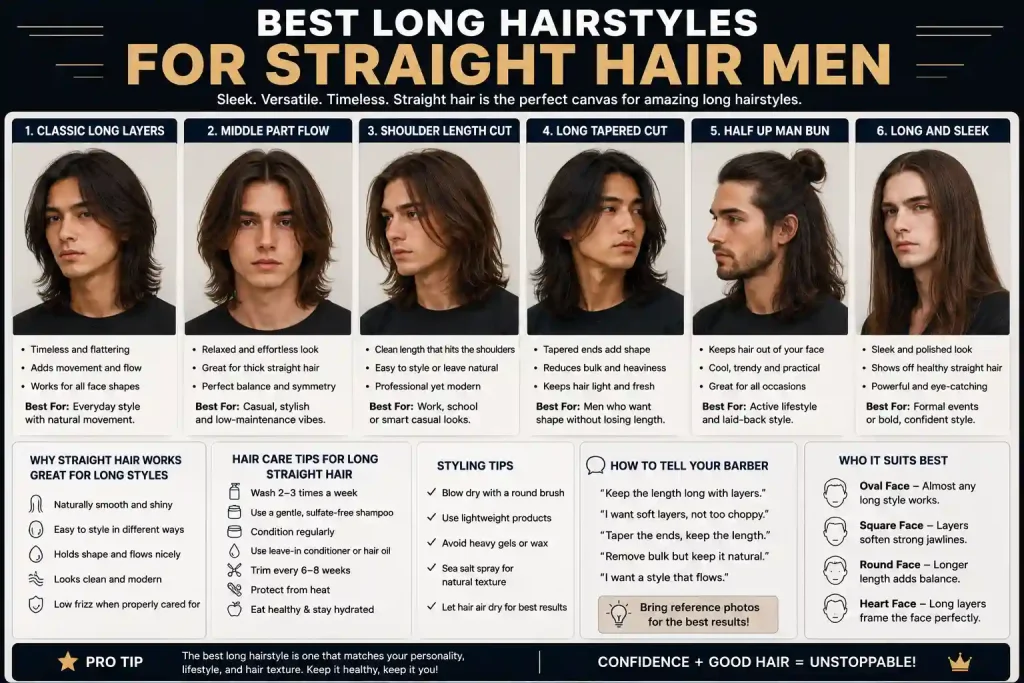
Long straight hair can look sharp, calm, and confident when the shape is right. The ends, layers, and front pieces matter more than most people think.
A long haircut should not hang in one heavy block. Ask for soft layers, face framing, or internal weight removal if your hair feels dense.
Long Layered Cut
A long layered cut keeps the length but adds movement. It stops straight hair from hanging flat against the head.
This cut is useful for thick hair because it reduces weight. Fine hair needs softer layers so the ends do not look thin.
Best for: shoulder-length straight hair, thick hair, clean long styles
Styling difficulty: medium
Maintenance: every 8–12 weeks
Ask your stylist: “Keep the length but add soft layers for movement.”
Shoulder-Length Flow
A shoulder-length flow is simple and strong when the ends are clean. It works well if you like a natural look.
The haircut should be shaped around the jaw, neck, and shoulders. That keeps it from looking like random growth.
Best for: medium to thick straight hair, relaxed style
Styling difficulty: easy to medium
Maintenance: every 8–12 weeks
Ask your stylist: “Clean the ends and shape the front without removing too much length.”
Long Center Part
A long center part gives straight hair a balanced look. It works best when the hair falls evenly on both sides.
This style needs healthy ends and light control. A small amount of styling cream can reduce flyaways without making the hair greasy.
Best for: oval, heart, and diamond face shapes
Styling difficulty: easy
Maintenance: every 8–12 weeks
Ask your stylist: “Keep the part natural and add light face-framing layers.”
Long Undercut
A long undercut keeps the top long while the sides or back are cut short. It creates strong contrast.
This style is bold and needs regular upkeep. It works best on thick straight hair that can hold a clean top shape.
Best for: thick straight hair, bold style, tied-back looks
Styling difficulty: medium
Maintenance: every 3–5 weeks for the sides
Ask your barber: “Keep the top long and disconnect the sides cleanly.”
Low-Maintenance Haircuts for Straight Hair Men
A low-maintenance haircut should still have shape. It should look good with quick styling and grow out without becoming messy too fast.
For straight hair, the best easy cuts are short enough to control but not so blunt that they look stiff.
| Haircut | Daily Styling | Trim Timing | Best For |
|---|---|---|---|
| Buzz cut | None | 4–8 weeks | Lowest effort |
| Crew cut | 1–2 minutes | 4–6 weeks | Clean daily wear |
| French crop | 2–3 minutes | 4–5 weeks | Flat straight hair |
| Classic taper | 1–3 minutes | 3–5 weeks | Work and school |
| Ivy League | 3–5 minutes | 3–5 weeks | Polished look |
| Low taper crop | 2–4 minutes | 3–5 weeks | Modern but easy |
| Caesar cut | 1–3 minutes | 4–6 weeks | Short fringe control |
| Short textured crop | 2–4 minutes | 4–5 weeks | Flat or fine hair |
Best Low-Maintenance Picks
• Buzz cut if you want almost no styling
• Crew cut if you want clean but not too short
• French crop if your hair falls forward
• Low taper if you want soft edges
• Ivy League if you need a polished haircut
• Caesar cut if you want a neat short fringe
• Short textured crop if your hair looks flat
• Classic taper if you want easy grow-out
Fade Haircuts for Straight Hair Men
Fades look sharp on straight hair because the blend is easy to see. That can be a strength, but poor blending also shows quickly.
Choose the fade height based on your face shape and upkeep level. Low fades are softer, while high fades create stronger contrast.
Low Fade
A low fade starts lower near the ears and neckline. It gives straight hair clean sides without looking extreme.
It works well with crops, side parts, and quiffs. It is also easier to wear in professional settings.
Best for: subtle contrast, work-friendly style, most face shapes
Ask your barber: “Give me a low fade that stays natural near the temples.”
Mid Fade
A mid fade sits between subtle and bold. It works with most straight-hair cuts.
This is a good choice if your sides grow thick or stick out. It controls width without going too high.
Best for: straight hair with density, crops, quiffs, side parts
Ask your barber: “Start the fade around the middle and blend it smoothly into the top.”
High Fade
A high fade creates a stronger shape. It makes the top look more defined.
This cut works best if you like sharp contrast. It also needs more frequent touch-ups.
Best for: bold styles, strong contrast, thick straight hair
Ask your barber: “Give me a high fade, but keep enough weight on top for styling.”
Skin Fade
A skin fade goes down to bare skin on the sides. It looks crisp, but it needs regular maintenance.
Straight hair makes skin fades look very sharp. If you want softer grow-out, choose a low taper instead.
Best for: sharp barbered looks, short crops, high-contrast styles
Ask your barber: “Blend the skin fade smoothly and avoid a harsh line near the crown.”
Drop Fade
A drop fade curves down behind the ear. It adds shape to straight hair without making the back look flat.
It works well with textured crops, fringe cuts, and modern mullets.
Best for: textured crops, fringe, mullets, thicker hair
Ask your barber: “Drop the fade behind the ear and keep the top textured.”
Taper Haircuts for Straight Hair Men
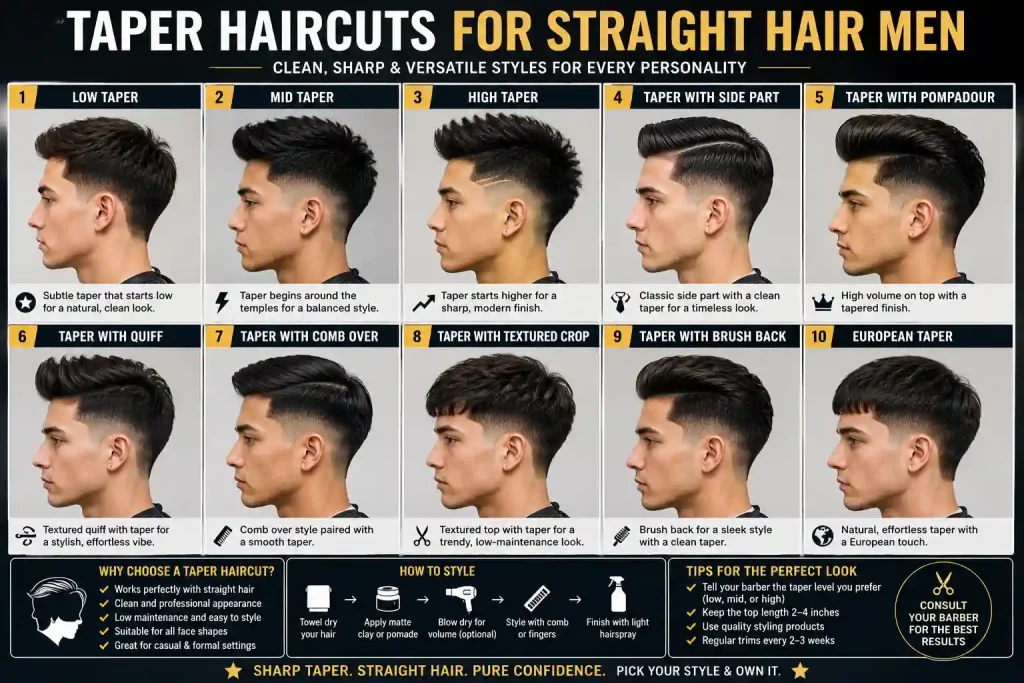
A taper is cleaner than a regular haircut but softer than a fade. It shortens the sideburns, neckline, and edges while keeping more side coverage.
This is one of the best options if you want a neat haircut that grows out well.
Classic Taper
A classic taper keeps the overall haircut natural. The sides and back are shorter, but not heavily faded.
It works with side parts, crops, quiffs, and medium styles.
Best for: clean daily style, work, school, most hair types
Ask your barber: “Give me a classic taper with a natural neckline.”
Low Taper
A low taper cleans the edges without changing the whole haircut. It is subtle and easy to maintain.
This is a great choice for work, school, and conservative dress codes.
Best for: soft grow-out, straight hair that sticks out near the ears
Ask your barber: “Taper only the sideburns and neckline, and keep the rest soft.”
Mid Taper
A mid taper gives more shape than a low taper. It is still softer than a mid fade.
This cut works well if your straight hair gets bulky around the ears.
Best for: medium-density hair, thick sides, clean but natural style
Ask your barber: “Take the taper a little higher around the ears, but keep it blended.”
Scissor Taper
A scissor taper looks softer than a clipper taper. It is great for medium straight hair.
Choose this if you want clean sides without a tight barbered look.
Best for: medium styles, longer straight hair, natural finish
Ask your stylist: “Use scissors to taper the sides and keep the shape natural.”
Fade vs Taper for Straight Hair: Which Is Better?
Both cuts work well on straight hair, but they create different results. A fade gives sharper contrast. A taper gives a softer, cleaner grow-out.
If you are unsure, start with a low taper. It is easier to adjust later than a high fade.
| Feature | Fade | Taper |
|---|---|---|
| Look | Sharper and more defined | Softer and more natural |
| Best for | Crops, quiffs, bold styles | Work, school, everyday cuts |
| Grow-out | Shows faster | Grows out easier |
| Upkeep | Higher | Lower to medium |
| Best starting choice | Low or mid fade | Low taper |
| Good for straight hair? | Yes, but blending must be clean | Yes, very flexible |
Choose a Fade If
• You want stronger contrast
• You like sharp barbered sides
• You can visit the barber often
• Your top style needs clean separation
• You want a crop, quiff, or mullet shape
Choose a Taper If
• You want easier grow-out
• You need a work-friendly haircut
• Your sides stick out but you dislike skin fades
• You want a softer look
• You are growing medium-length hair
Undercut Haircuts for Straight Hair Men
An undercut gives straight hair strong contrast. The top stays longer while the sides are cut much shorter.
This cut can look sharp, but it is not always easy. If the top is too long or too heavy, straight hair may fall awkwardly.
Classic Undercut
A classic undercut has short sides and a longer top with little blending. It works best on thick straight hair.
Style it back, to the side, or forward depending on your length.
Best for: thick straight hair, bold contrast
Styling difficulty: medium
Ask your barber: “Keep the sides short and leave the top disconnected.”
Textured Undercut
A textured undercut softens the top so it does not look like a heavy sheet of hair.
This is better than a slick undercut if you want a more relaxed finish.
Best for: medium straight hair, dense hair, modern style
Styling difficulty: medium
Ask your barber: “Add texture through the top and keep the sides short.”
Side-Part Undercut
A side-part undercut creates a clean, sharp shape. The top sweeps over while the sides stay tight.
It works best when the part follows your natural growth pattern.
Best for: oval, square, and round faces
Styling difficulty: medium
Ask your barber: “Keep enough top length to part and sweep to one side.”
Quiff and Pompadour Haircuts for Straight Hair
Straight hair can work well with height. A quiff or pompadour adds lift and can make the face look longer.
The key is not overloading the hair with heavy product. Straight hair often collapses when the product is too greasy.
Short Quiff
A short quiff gives lift at the front without too much length. It is easier than a tall pompadour.
It works well with a taper, low fade, or mid fade.
Best for: round faces, fine straight hair, clean style
Styling difficulty: medium
Ask your barber: “Leave extra length in the front and texture the top.”
Modern Quiff
A modern quiff is taller and more styled. It works best on medium-density straight hair.
Use a blow dryer to lift the roots before applying product.
Best for: men who can style for 5–8 minutes
Styling difficulty: medium to high
Ask your barber: “Keep the front longer, blend the sides, and add top texture.”
Pompadour
A pompadour has more height and a smoother shape. It is bold but still classic.
Straight hair can hold this style well if it has enough density. Fine hair may need texture powder or sea salt spray first.
Best for: thick straight hair, formal style, strong side contrast
Styling difficulty: high
Ask your barber: “Keep the front long enough to lift back into a pomp.”
Slick Back and Comb Back Styles for Straight Hair
Straight hair is naturally good for slick backs and comb backs. The challenge is making the style look controlled, not greasy.
A modern slick back should have movement. Avoid too much shiny gel unless you want a formal wet finish.
Classic Slick Back
A classic slick back pushes all the hair back from the face. It works best on medium-length straight hair.
It needs enough top length to stay back without fighting your growth pattern.
Best for: medium to thick straight hair
Styling difficulty: medium
Ask your barber: “Leave enough top length to brush back cleanly.”
Natural Comb Back
A natural comb back is softer than a slick back. It has light volume and less shine.
This is a better everyday choice for most men.
Best for: office style, medium hair, clean casual looks
Styling difficulty: easy to medium
Ask your barber: “Keep the top layered so it brushes back without looking heavy.”
Tapered Slick Back
A tapered slick back keeps the sides neat while the top moves back. It is cleaner than a full medium-length cut.
Use matte cream or light clay for a natural finish.
Best for: straight hair with medium density
Styling difficulty: medium
Ask your barber: “Taper the sides and keep the top long enough to push back.”
Fringe and Curtain Haircuts for Straight Hair
Fringe cuts work well when straight hair naturally falls forward. They can soften the face and add style without needing high volume.
Curtain haircuts are one of the strongest medium-length choices for straight hair. They give movement, shape, and a relaxed 2026 feel.
Textured Fringe
A textured fringe has choppy pieces that sit forward. It is great if you want a modern cut that does not need perfect styling.
This cut is better than a blunt fringe if your hair is fine or flat.
Best for: fine to medium straight hair, oval and heart faces
Styling difficulty: easy to medium
Ask your barber: “Point-cut the fringe and keep it soft, not heavy.”
Blunt Fringe
A blunt fringe has a stronger line across the front. It works best on dense straight hair.
This cut can look bold, but it needs clean edges and the right face balance.
Best for: thick straight hair, bold style
Styling difficulty: medium
Ask your barber: “Keep the fringe straight but soften the top texture.”
Curtain Fringe
A curtain fringe splits near the middle and frames the face. It works well with medium straight hair.
The front should be long enough to move. Too short, and it may stick up or split badly.
Best for: medium length, oval, heart, and diamond faces
Styling difficulty: medium
Ask your barber: “Leave the front long enough to part and add soft layers.”
Side-Swept Fringe
A side-swept fringe moves across the forehead instead of splitting in the middle. It is softer and easier to wear than blunt bangs.
It works well for straight hair with a natural side direction.
Best for: round, heart, and oval faces
Styling difficulty: easy to medium
Ask your barber: “Cut the fringe to sweep naturally to one side.”
Two Block and Korean-Inspired Straight Haircuts
The two block haircut is one of the best straight-hair styles because it uses the natural fall of the top. The sides and back are shorter, while the top stays fuller.
This cut can look soft, clean, or bold depending on the side length. It works especially well with smooth, dense straight hair.
Soft Two Block
A soft two block has shorter sides without extreme contrast. The top falls naturally over the sides.
This is the easiest version to wear every day.
Best for: dense straight hair, medium top length
Styling difficulty: easy to medium
Ask your barber: “Keep the top full and blend the sides softly.”
Curtain Two Block
A curtain two block combines the two block shape with a center part. It frames the face and works well on straight hair.
The top needs enough length to split without sticking up.
Best for: medium straight hair, oval and heart faces
Styling difficulty: medium
Ask your barber: “Leave curtain length on top and keep the sides controlled.”
Textured Two Block
A textured two block adds separation through the top. This helps thick straight hair feel lighter.
It is a good option if your hair looks too heavy in a regular two block.
Best for: thick straight hair
Styling difficulty: medium
Ask your barber: “Remove some internal weight but keep the top full.”
Modern Mullet and Wolf-Inspired Straight Haircuts
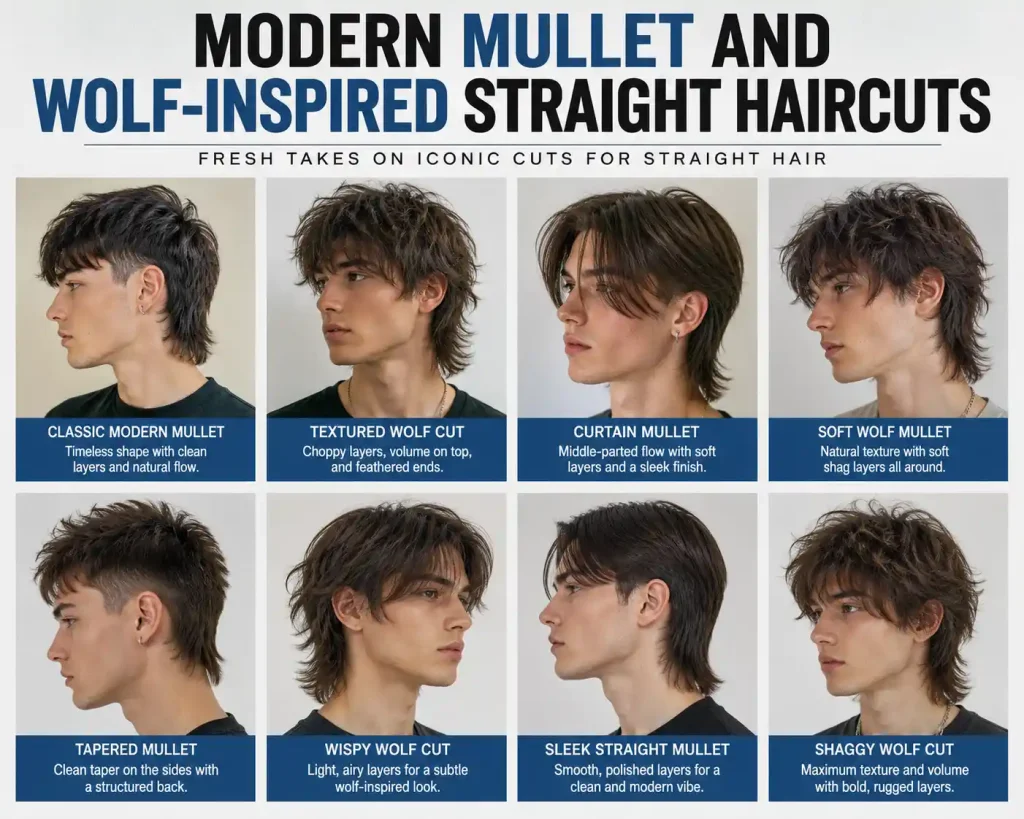
The modern mullet is more wearable than older versions. The 2026 version usually has cleaner sides, controlled layers, and a better shape around the ears.
Straight hair works well for this cut when the layers are planned carefully. Without layers, the back can look too heavy.
Modern Mullet
A modern mullet keeps the front and sides cleaner while leaving more length in the back. It looks best when the top has texture.
This cut is bold but can still be wearable with a taper or burst fade.
Best for: medium to thick straight hair, bold style
Styling difficulty: medium
Ask your barber: “Keep the back longer, taper the sides, and texture the top.”
Burst Fade Mullet
A burst fade mullet fades around the ears while keeping length at the back. It gives the haircut a cleaner outline.
This is a strong choice if you want edge without messy sides.
Best for: thick straight hair, sharp contrast
Styling difficulty: medium to high
Ask your barber: “Give me a burst fade around the ears and keep the back shaped.”
Wolf-Inspired Straight Cut
A wolf-inspired cut uses layers around the crown and back. It creates movement without looking too polished.
Straight hair needs careful layering here. Too much thinning can make the ends look weak.
Best for: medium to long straight hair
Styling difficulty: medium
Ask your stylist: “Add shaggy layers, but keep enough weight in the ends.”
Best Haircuts for Fine Straight Hair Men
Fine straight hair needs shape without losing density. The goal is to make the hair look fuller, not thinner.
Avoid deep thinning shears if your hair is already fine. Ask for light texture, soft layers, and clean edges.
Best Cuts for Fine Straight Hair
• Textured crop: adds separation and makes the top look fuller
• French crop: gives shape without needing thick hair
• Crew cut: reduces flatness and keeps the style simple
• Ivy League: adds polish while keeping enough top length
• Short quiff: creates front height with light product
• Soft side part: gives direction without exposing thin areas
• Caesar cut: short fringe keeps the front controlled
• Low taper crop: clean sides make the top look stronger
• Curtain fringe: works if you have enough front density
• Scissor crop: avoids harsh clipper lines on fine hair
Fine Hair Barber Script
“Keep the top full, add light point-cut texture, and avoid heavy thinning. I want the sides clean, but not so tight that the top looks sparse.”
Common Fine Hair Mistake
Do not ask for too much thinning. Fine straight hair usually needs shape and light texture, not heavy removal.
Best Haircuts for Thick Straight Hair Men
Thick straight hair can look great, but it can also feel heavy. The biggest problems are side bulk, stiff tops, and hair that sticks out after a cut.
The fix is internal layering, controlled tapering, and smart weight removal. Do not remove so much weight that the hair becomes hard to control.
Best Cuts for Thick Straight Hair
• Layered crop: removes top weight while keeping shape
• Textured quiff: uses thickness for natural lift
• Two block haircut: keeps fullness where it looks best
• Modern mullet: works well with dense straight hair
• Medium taper: controls side bulk without a harsh fade
• Layered side part: gives thick hair direction
• Long layered cut: keeps length but reduces heaviness
• Undercut: removes side bulk with strong contrast
• Burst fade: controls the ears and side shape
• Scissor taper: softens thick sides without over-fading
Thick Hair Barber Script
“My hair gets bulky on the sides. Please remove internal weight, taper around the ears, and avoid making the top too blunt.”
Common Thick Hair Mistake
Do not let the top stay too square. Thick straight hair often needs internal texture so it does not puff out or sit like a block.
Best Haircuts for Silky or Stiff Straight Hair
Silky straight hair can slip out of place. Stiff straight hair can stick out, especially around the sides and crown.
Both need the right cut before product can help. If the haircut fights your growth pattern, styling will be hard every day.
For Silky Straight Hair
• Choose light layers so the hair has movement
• Use texture powder instead of heavy pomade
• Avoid very long, heavy fringes
• Try a curtain cut, side part, or textured crop
• Keep the neckline clean for a sharper finish
• Use light hold instead of oily shine
For Stiff Straight Hair
• Choose a taper to control side growth
• Keep the top short enough to sit well
• Avoid disconnected cuts if the sides stick out
• Try a crop, crew cut, or short quiff
• Ask for blending that follows your growth pattern
• Avoid leaving too much weight near the temples
Haircuts for Straight Hair Men by Face Shape
Face shape should guide the haircut, not limit it. The same cut can be adjusted with different side lengths, fringe shapes, or top height.
Use this section as a starting point. A good barber can adjust the details after seeing your hair and head shape.
| Face Shape | Best Straight-Hair Cuts | What to Avoid |
|---|---|---|
| Oval | Most cuts, curtains, crop, taper, side part | Very heavy fringe if it hides the face |
| Round | Quiff, textured crop, mid fade, side part | Flat fringe with wide sides |
| Square | Crew cut, Ivy League, crop, slick back | Overly boxy sides if hair is thick |
| Long | Curtain cut, side part, medium taper | Too much height on top |
| Heart | Curtain fringe, medium layers, side sweep | Very tight sides with tall top |
| Diamond | Fringe, curtains, textured crop | Too much width at the cheekbones |
| Triangle | Layered top, medium taper, side part | Very narrow top with heavy jaw focus |
Round Face
For a round face, choose height and cleaner sides. A quiff, crop with fade, or side part can add balance.
Avoid heavy straight fringe that sits flat across the forehead. It can make the face look wider.
Square Face
For a square face, most short cuts work well. Crew cuts, crops, and Ivy League cuts can highlight strong angles.
If your hair is thick, avoid sides that become too boxy. Ask for soft blending around the temples.
Long Face
For a long face, avoid very tall hair. Choose curtains, side parts, or medium layers that add balance.
Keep some width at the sides instead of fading too high.
Oval Face
An oval face can wear most straight-hair cuts. Crops, tapers, curtains, and side parts all work well.
Choose based on hair density and styling time instead of face shape alone.
Heart Face
A heart-shaped face often works well with curtains, fringe, and medium layers. These cuts soften the upper face and add balance.
Avoid very tight sides with a very tall top if you want a softer look.
Haircuts for Asian Men With Straight Hair
Many Asian men have straight hair that is dense, smooth, and strong. That can make haircuts look sharp, but it can also cause the sides to stick out.
The best cuts use tapering, layering, and controlled top length. A barber should follow your growth pattern instead of forcing a generic fade.
Best Options
• Two block haircut: works well with dense straight hair
• Curtain two block: adds face framing and movement
• Textured crop: controls strong straight strands
• Low taper: keeps sides clean without harsh contrast
• Medium layered cut: adds flow without too much bulk
• Side part taper: polished and easy to wear
• Short fringe crop: keeps the front controlled
• Modern mullet: bold option for thick straight hair
• Scissor taper: softer than a tight clipper fade
• Layered sweep back: good for medium-length hair
Barber Script
“My hair is straight and dense, and the sides can stick out. Please taper around the ears, shape the top with texture, and avoid leaving the sides too bulky.”
Haircuts for Straight Hair Men With Cowlicks
Cowlicks can change how straight hair sits. The front, crown, and neckline are the most common problem areas.
Do not choose a haircut that fights the cowlick every morning. Work with the direction instead.
Best Cowlick-Friendly Cuts
• Textured crop: hides uneven front direction
• Short quiff: uses front lift instead of fighting it
• Side part: follows natural growth direction
• Crew cut: keeps cowlicks less noticeable
• French crop: works if the front falls forward
• Medium sweep: lets the cowlick blend into movement
• Layered top: softens crown separation
• Low taper: keeps the neckline cleaner
• Curtain cut: works if the front naturally splits
• Scissor crop: lets the barber adjust growth patterns carefully
What to Tell Your Barber
“I have a cowlick here. Please cut the top and fringe so it works with the growth direction, not against it.”
Cowlick Mistake to Avoid
Do not bring a reference photo with a completely different growth pattern. A good barber can match the feeling of the style, not always the exact fall of the hair.
Professional Haircuts for Work, School, and Formal Settings
Professional haircuts do not have to be boring. They just need clean edges, controlled length, and a style that looks neat without too much effort.
Straight hair is great for polished cuts because parts, tapers, and outlines stay visible.
Best Professional Straight-Hair Cuts
• Ivy League: clean, polished, and flexible
• Classic taper: neat without looking too sharp
• Side part: timeless and easy to dress up
• Low taper crop: modern but still clean
• Crew cut: simple and reliable
• Short quiff: adds shape without looking loud
• Medium side sweep: good for straight hair with body
• Tapered comb back: controlled but not greasy
• Soft curtains: works in flexible dress-code settings
• Scissor taper: clean for medium straight hair
Professional Barber Script
“I need a clean haircut for work or school. Keep it neat around the ears and neckline, but leave enough top length to style naturally.”
Best Styling Products for Straight Hair Men
The wrong product can flatten a good straight haircut or make it look oily. Heavy gels and greasy pomades are often too much for fine straight hair.
Most straight-hair styles work better with matte, lightweight, flexible products. Start small, then add more only if needed.
| Product | Best For | Avoid If |
|---|---|---|
| Texture powder | Fine hair, flat roots, crops | Your scalp gets dry easily |
| Matte clay | Thick hair, quiffs, crops | You want a very soft finish |
| Styling cream | Curtains, medium hair, longer flow | Your hair gets oily fast |
| Sea salt spray | Volume and grip | Your hair feels very dry |
| Light pomade | Side parts, comb backs | You dislike shine |
| Leave-in cream | Long straight hair | Your hair is very fine |
| Hairspray | Holding height | You want a fully natural feel |
| Molding paste | Two block cuts, textured tops | You dislike product feel |
Product by Hair Type
| Hair Type | Best Product | Why |
|---|---|---|
| Fine straight hair | Texture powder or sea salt spray | Adds lift without weight |
| Thick straight hair | Matte clay or molding paste | Adds control and hold |
| Silky straight hair | Light paste or texture spray | Adds grip |
| Stiff straight hair | Cream plus light clay | Softens and controls shape |
| Long straight hair | Leave-in cream | Smooths ends and flyaways |
Simple Styling Routine
- Start with damp, towel-dried hair.
- Add a small amount of product.
- Blow-dry roots for lift if needed.
- Use fingers for natural texture.
- Use a comb for side parts or slick backs.
- Finish with a small amount of product.
- Avoid heavy buildup near the scalp.
- Wash product out regularly.
Straight Haircut Maintenance Guide
Maintenance depends on how sharp your haircut is. Fades need more frequent visits than tapers or medium layered cuts.
Straight hair shows growth quickly around the ears and neckline. Keeping those areas clean can make the whole cut last longer.
| Haircut Type | Best Trim Schedule | Why |
|---|---|---|
| Skin fade | 2–3 weeks | Sharp fade grows out fast |
| Low or mid fade | 3–4 weeks | Blend needs regular cleanup |
| Textured crop | 4–5 weeks | Top loses shape as it grows |
| Crew cut | 4–6 weeks | Short shape stays controlled |
| Classic taper | 3–5 weeks | Neckline and sideburns need cleanup |
| Ivy League | 3–5 weeks | Part and sides need shape |
| Curtain haircut | 6–8 weeks | Longer shape grows out softer |
| Long layered hair | 8–12 weeks | Ends need shaping, not constant cutting |
| Modern mullet | 4–6 weeks | Shape around ears needs control |
| Two block haircut | 4–6 weeks | Sides and back need cleanup |
Between-Visit Tips
• Keep the neckline clean if you can do it safely
• Use less product as the cut grows out
• Brush or blow-dry in the same direction daily
• Book sooner if the sides start sticking out
• Take fresh photos when the haircut looks best
• Use those photos at your next appointment
What to Tell Your Barber If You Have Straight Hair
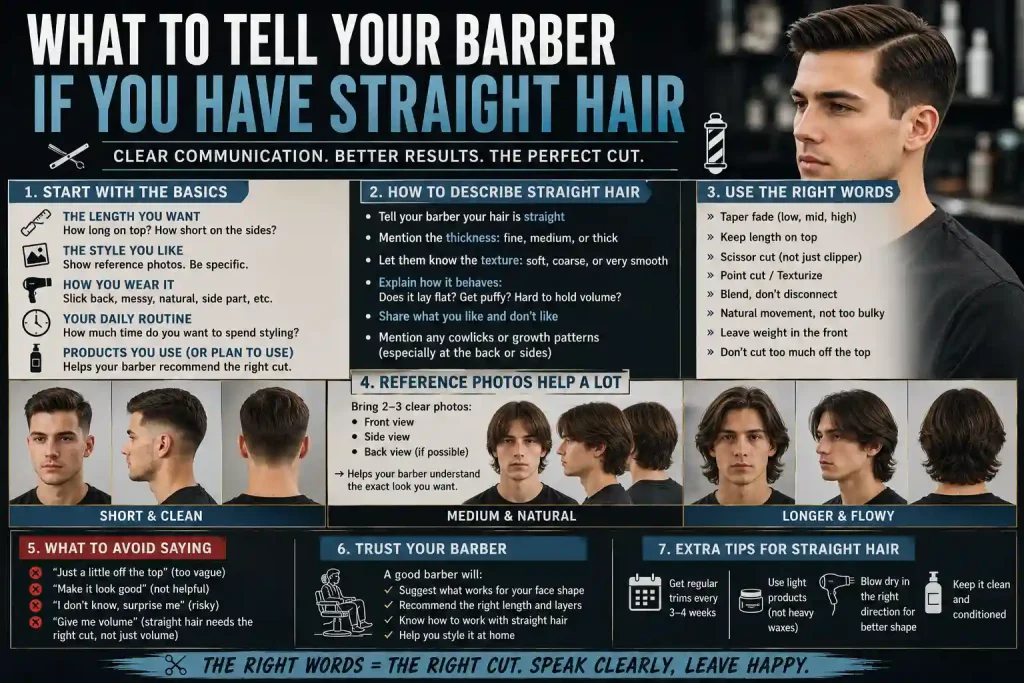
Clear wording matters because straight hair shows details. If the barber cuts the top too blunt or the sides too high, you will notice it every day.
Bring photos from the front, side, and back. Choose photos with hair similar to your own texture, density, and length.
What to Mention Before the Cut
• How much length you want on top
• Whether you want a fade, taper, or natural sides
• Whether your hair is fine, thick, silky, or stiff
• How much time you style each morning
• Whether you want the fringe forward, parted, or brushed back
• If your sides stick out as they grow
• If you have a cowlick at the front or crown
• Whether you prefer matte, natural, or shiny styling
• How often you want to come back for trims
• Whether your workplace or school has style rules
Copy-and-Paste Barber Scripts
Textured Crop Script
“Keep the top around 1.5 to 3 inches, add point-cut texture, and give me a low taper or mid fade. I want it to look natural, not blunt.”
Low Taper Script
“Clean up the sideburns, around the ears, and the neckline with a low taper. Keep the top natural and easy to style.”
Curtain Haircut Script
“Leave the front long enough to part in the middle, add soft layers, and keep the sides controlled without cutting them too tight.”
Thick Straight Hair Script
“My hair gets bulky. Please remove internal weight, taper the sides, and avoid leaving the top too square.”
Fine Straight Hair Script
“My hair is fine, so please keep some density. Add light texture, but avoid heavy thinning.”
Cowlick Script
“My hair has a cowlick here. Please shape the fringe and crown so the cut works with the growth direction.”
Common Mistakes Men With Straight Hair Should Avoid
Straight hair can look great, but small haircut mistakes show fast. Avoid these issues if you want a cleaner result.
• Cutting the top too blunt
• Taking the fade too high for your face shape
• Using heavy gel on fine straight hair
• Over-thinning thick straight hair
• Choosing a fringe that fights your cowlick
• Leaving the sides too bulky
• Growing medium hair without shaping the ends
• Asking for a style without knowing the upkeep
• Copying a photo with a different hair type
• Skipping neckline cleanups between cuts
• Using too much product at the roots
• Choosing a long top with no layers
Best Haircut Ideas for Straight Hair Men
Use these haircut ideas before your next barber visit. Each one works well with straight hair when adjusted to your density, face shape, and styling time.
Clean and Classic Ideas
• Crew cut with taper: simple, neat, and easy to maintain
• Ivy League with side part: polished but not outdated
• Classic taper: clean edges with natural sides
• Side part with volume: professional with a modern finish
• Comb back taper: smooth without looking greasy
• Short quiff: adds height to flat straight hair
• Caesar cut: short fringe with low effort
• Scissor crop: soft shape for fine straight hair
• Tapered side sweep: easy for medium straight hair
• Soft business cut: clean enough for formal settings
Modern and Textured Ideas
• Textured crop fade: sharp sides with choppy top movement
• French crop taper: neat fringe with softer edges
• Textured fringe: casual front shape with separation
• Messy crop: controlled texture without stiff styling
• Mid fade quiff: clean sides with front height
• Burst fade crop: bold around the ears
• Edgar-inspired cut: blunt front with a sharper outline
• Faux hawk taper: weekend style that can be brushed down
• Drop fade fringe: curved fade with a modern front
• Short textured Caesar: classic shape with more movement
Medium and Longer Ideas
• Curtain haircut: center-parted movement for straight hair
• Two block haircut: full top with shorter sides
• Medium side sweep: soft, clean, and flexible
• Bro flow: relaxed length with shaped ends
• Layered sweep back: controlled movement for medium hair
• Long layered cut: better shape for shoulder-length hair
• Modern mullet: bold but wearable with clean sides
• Wolf-inspired layers: textured shape for medium-long hair
• Long center part: balanced shape for longer straight hair
• Shoulder-length flow: natural length with clean ends
What Photos to Bring to Your Barber
Haircut photos help, but only if they match your hair. A photo with wavy, curly, or very thick hair may not work the same on straight hair.
Bring at least two photos: one front view and one side view. A back view is even better if you want a fade, taper, mullet, or two block cut.
Choose Reference Photos That Show
• Hair similar to your texture and density
• The side length clearly
• The front fringe or part clearly
• The back neckline if possible
• A realistic finish, not only studio styling
• A cut you would style on a normal morning
• Your preferred fade or taper height
• How much volume you want on top
Avoid Reference Photos That Show
• Hair much thicker than yours
• Hair with a different natural texture
• Wet or heavily styled hair only
• Hats, shadows, or unclear sides
• Celebrity photos with hidden extensions or heavy styling
• A haircut that needs more upkeep than you want
FAQs About Haircuts for Straight Hair Men
What haircut is best for men with straight hair?
The best haircut depends on your hair thickness, face shape, and styling routine. Textured crops, French crops, crew cuts, Ivy League cuts, tapers, two block cuts, and curtain hairstyles are all strong options.
If your hair is fine, choose light texture and avoid heavy thinning. If your hair is thick, ask for internal layering and side control.
What haircut makes straight hair look thicker?
A textured crop, short quiff, French crop, Ivy League, or Caesar cut can make straight hair look fuller. These cuts reduce flatness and create shape.
Use light products like texture powder, sea salt spray, or matte clay. Avoid heavy gel because it can make fine hair look thinner.
Is a taper or fade better for straight hair?
A taper is better if you want a softer, easier grow-out. A fade is better if you want sharper contrast and cleaner sides.
Straight hair works with both. Choose a taper for work-friendly style and a fade for a bolder haircut.
Should men with straight hair get layers?
Yes, layers can help straight hair look less flat and less heavy. The key is choosing the right kind of layers for your density.
Fine straight hair needs soft, light layers. Thick straight hair can handle deeper internal layering to reduce bulk.
What haircut is best for straight hair that sticks out?
A crop, crew cut, low taper, two block, or layered taper can help control straight hair that sticks out. The sides should be tapered or blended based on your growth pattern.
Avoid leaving the sides too long and boxy. Ask your barber to check how your hair grows around the ears.
What is the easiest haircut for straight hair men?
The easiest choices are a buzz cut, crew cut, French crop, Caesar cut, or classic taper. They need little daily styling.
If you want easy but still modern, choose a short textured crop with a low taper. It gives shape without much work.
Is a two block haircut good for straight hair?
Yes, a two block haircut works very well with straight hair, especially if your hair is dense or smooth. The fuller top uses straight hair’s natural fall, while the shorter sides control bulk.
Ask for a softer blend if you want easier grow-out. Choose a stronger undercut version if you want more contrast.
How do I add volume to straight hair men?
Choose a haircut with texture, layers, or height at the front. A textured crop, short quiff, Ivy League, or layered sweep back can help.
For styling, use a blow dryer at the roots and finish with texture powder, sea salt spray, or matte clay.
How often should men with straight hair get a haircut?
Short fades usually need a trim every 2–4 weeks. Crops, crew cuts, tapers, and Ivy League cuts often need trims every 3–6 weeks.
Medium and long straight hair can usually go 6–12 weeks, but the ends still need shaping. Book sooner if the sides start sticking out.
Conclusion
The best haircuts for straight hair men are not just popular styles. They are haircuts that match your hair density, face shape, growth pattern, styling time, and maintenance level.
If you want the safest upgrade, start with a textured crop, low taper, Ivy League, side part, curtain haircut, or two block cut. Save two reference photos, choose one barber script, and pick a haircut you can style on a normal morning.