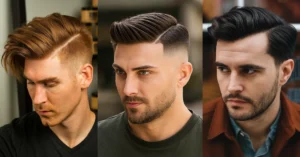
Choosing a haircut shouldn’t feel complicated. Simple haircuts for men are cuts you can describe in one sentence, get right at almost any barbershop, and walk out wearing without a single extra step. If you’ve ever left a barber chair disappointed because a trendy request got lost in translation, or you’re tired of fighting your hair into shape every morning, a simple cut solves both problems at once. This guide covers what actually makes a haircut simple, the best options by hair type and face shape, exactly what to say to your barber, and how to style each look in under five minutes. You’ll also find a side-by-side comparison table, common mistakes to avoid, and answers to the questions men ask most before booking a chair.
Quick Answer
The best simple haircuts for men are short-to-medium cuts built around one clear shape with minimal layering, such as the buzz cut, crew cut, Caesar cut, Ivy League, French crop, and classic side part. These styles are easy to describe to any barber, forgiving if the cut isn’t executed perfectly, and typically need nothing more than a towel-dry or a light comb to look finished. They work across most hair types and face shapes, which is exactly why they’ve stayed popular for decades.
TL;DR
- A simple haircut has one dominant shape, minimal layering, and doesn’t depend on a precise daily styling routine
- The most reliable options are the buzz cut, crew cut, Caesar cut, Ivy League, French crop, butch cut, high and tight, classic side part, low taper crop, and comb-over fade
- Simple is not the same as low-maintenance: simple describes how easy a cut is to request and execute, while low-maintenance describes how long it lasts between trims
- Straight and wavy hair show these shapes the cleanest; curly and coily hair usually need some texturizing to keep the same silhouette simple
- Most simple cuts need a trim every 3 to 5 weeks to hold their shape
- These styles read as neat rather than overdone, which makes them a safe choice for interviews, offices, and school
What Makes a Haircut “Simple”?
A simple haircut is built around one dominant length instead of several competing lengths. There’s little to no intricate design work, no hard-etched part lines, and no dependence on a specific blow-dryer angle to look right. The cut leans on strong, even clipper or scissor work rather than elaborate technique, which makes it easier for almost any barber to execute correctly the first time.
Four traits define a simple haircut:
- One clear shape — the top, sides, and back follow a single logical transition instead of multiple competing sections
- Low technique risk — the cut doesn’t rely on a specialized fade blend, a razor-thin part, or a complex undercut disconnection
- Easy verbal description — you can explain the whole haircut in one or two sentences
- Minimal styling dependency — the cut looks intentional whether or not you use product that day
Simple vs. Low-Maintenance: What’s the Difference?
These two ideas overlap constantly, but they answer different questions. Simple is about how easy the cut is to communicate and execute — the risk of walking out with something you didn’t ask for. Low-maintenance is about how long the cut lasts between barber visits and how much daily upkeep it needs at home.
A low taper fade, for example, can be relatively low-maintenance because it grows out evenly, but it isn’t always the simplest first-time request, since the quality of the blend depends heavily on the barber’s skill. A classic side part is simple to describe and execute, but if you want a sharp, defined part every day, it isn’t the lowest-maintenance option on this list. If your priority is stretching out the time between trims rather than the simplicity of the cut itself, our Low Maintenance Haircuts for Men guide covers that angle in more depth.
Who a Simple Haircut Is Best For
- Guys visiting a new barber or salon and want to minimize the risk of a bad cut
- Anyone short on time in the morning
- First-time short-hair transitions, especially after wearing hair long for years
- Professionals who want the same look regardless of who cuts their hair
- Students and teenagers who want a look that works every day without effort
- Frequent travelers who need a cut that reads the same in any city
Hair Length Options for Simple Haircuts
Simple haircuts generally fall into three length categories, and picking the right one comes down to how short you’re comfortable going and how much shape you want on top.
- Very short — buzz cut, high and tight. Nearly uniform length, close to the scalp, essentially zero styling.
- Short — crew cut, Caesar cut, French crop, butch cut. A bit more length on top for slight texture or a soft fringe, still fast to style.
- Short-medium — Ivy League, classic side part, low taper crop. Enough length on top to comb, part, or push back, while the sides stay tight and simple.
Best Simple Haircuts by Hair Type
The same haircut can look different depending on your natural texture. Here’s how each hair type tends to behave with these simpler shapes.
Straight Hair
Straight hair shows a clean, simple shape better than any other texture. Crew cuts, Caesar cuts, and classic side parts hold their line well and often need only a comb to look finished.
Wavy Hair
Wavy hair adds natural movement to simple cuts like the French crop or Ivy League without extra styling. A small amount of matte product can keep waves from looking undone in humid weather.
Curly Hair
Curly hair can wear a simple haircut, but the barber usually needs to leave a bit more length on top and remove some bulk with thinning shears so the curl pattern doesn’t puff the shape out of proportion. A curly Caesar or a slightly longer buzz often works better than a very tight crop.
Coily Hair
Coily hair tends to shrink visually, so a “simple” length often needs to be a little longer than it looks to avoid an uneven appearance once it dries. A uniform buzz or a low, even taper are usually the most foolproof starting points.
Thick Hair
Thick hair can look bulky in longer simple cuts, so some weight removal on top keeps the shape clean. A crew cut or French crop with light thinning tends to hold its line without becoming heavy.
Fine or Thin Hair
Fine hair benefits from shorter, denser-looking simple cuts rather than long layered ones, since too much length can make thin hair look flat. A buzz cut, butch cut, or short crew cut usually reads as fuller.
Simple Haircuts by Face Shape
Face shape is a useful guide, not a rule. The same simple cut can look great on two men with the same face shape but different hairlines, jaw definition, or hair density.
| Face Shape | Often Works Well | Why |
|---|---|---|
| Oval | Nearly all simple cuts | Balanced proportions suit most shapes without adjustment |
| Round | Crew cut, French crop, Ivy League with height on top | Added height can create the appearance of more length in the face |
| Square | Buzz cut, Caesar cut, classic side part | These cuts often complement a strong jawline rather than compete with it |
| Oblong | Crew cut, butch cut with fuller sides | Keeping some width at the sides can help balance a longer face |
| Heart | Side part, textured French crop | A side-swept top can soften a wider forehead |
| Diamond | Ivy League, low taper crop | Length on top tends to balance narrower cheekbone-to-jaw proportions |
| Triangle | Crew cut, high and tight | Tighter sides can help balance a wider jaw relative to the forehead |
These are general tendencies, not guarantees. Hairline shape, forehead height, and hair density all affect the final result as much as face shape does.
The 10 Simplest Haircuts for Men
1. Buzz Cut
Uniform length all over using a single clipper guard, typically a #2 to #4. Essentially zero styling. Works on nearly every hair type, though very curly hair may look slightly different in texture than straight hair at the same guard length.
2. Crew Cut
Short, evenly tapered sides with slightly more length left on top, blended into a soft, brushable finish. One of the most barber-proof simple cuts because the transition is gradual rather than sharp.
3. Caesar Cut
Short, uniform length all over with a straight, horizontal fringe. Easy to describe and easy to maintain, though it depends on a relatively straight hairline to look its cleanest.
4. Ivy League
Essentially a crew cut with a bit more length on top, long enough to comb or part to one side. Reads as slightly more polished, which makes it a strong choice for offices.
5. French Crop
Short, tapered sides with a textured, slightly longer top and a soft fringe. Simple to request but benefits from scissor-over-comb texturizing rather than a single clipper pass.
6. Butch Cut
A step longer than a buzz cut, usually a #4 to #6 guard, giving a bit more visual density while staying essentially maintenance-free.
7. High and Tight
Very short, closely clipped sides with a slightly longer top section. Extremely low-risk for the barber to execute and virtually impossible to style incorrectly.
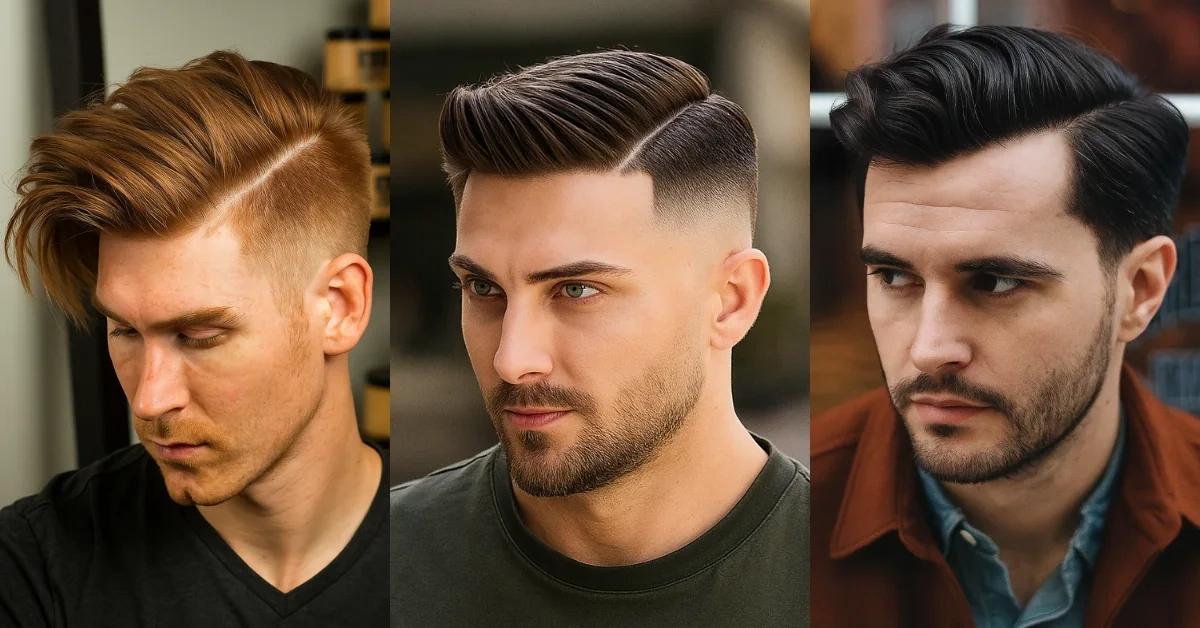
8. Classic Side Part
Short sides with enough length on top to create a defined, combed side part. Slightly more styling-dependent than the buzz-length options, but still a one-sentence request.
9. Low Taper Crop
A gentle, low taper on the sides that blends into short, textured length on top. Slightly more skill-dependent than a straight clipper cut, but still a simple, well-understood request at most barbershops.
10. Comb-Over Fade
A side-swept top paired with a tapered or low-faded side. It takes a bit more barber precision than the very shortest cuts on this list, but the verbal request (“comb-over on top, taper on the sides”) remains simple and widely understood.
Comparison Table: Simple Haircuts at a Glance
| Haircut | Best Hair Types | Maintenance | Styling Time |
|---|---|---|---|
| Buzz Cut | All types | Low | 0 minutes |
| Crew Cut | Straight, wavy, thick | Low | 1–2 minutes |
| Caesar Cut | Straight, wavy | Low | 0–1 minutes |
| Ivy League | Straight, wavy, curly | Low-medium | 2–3 minutes |
| French Crop | Straight, wavy, curly | Low-medium | 2–3 minutes |
| Butch Cut | All types | Low | 0 minutes |
| High and Tight | Straight, wavy, thick | Low | 0–1 minutes |
| Classic Side Part | Straight, fine | Medium | 3–4 minutes |
| Low Taper Crop | Straight, wavy, curly | Medium | 2–3 minutes |
| Comb-Over Fade | Straight, wavy, thick | Medium | 3–5 minutes |
How to Ask Your Barber for a Simple Haircut
Clear, specific language gets a more consistent result than a single style name alone, since names for the same haircut can vary between shops. A useful template:
“I want the top left at about [length in inches or fingers], with the sides tapered down to a #2 or #3 guard and blended into the neckline. No hard part line, and I’d like it low-maintenance enough to wear without much product.”
Clipper guard numbers are a standard reference point, though exact lengths can vary slightly between clipper brands:
- #1 — about 1/8 inch
- #2 — about 1/4 inch
- #3 — about 3/8 inch
- #4 — about 1/2 inch
- #5 — about 5/8 inch
- #6 — about 3/4 inch
What to Bring to the Barbershop
A reference photo removes most of the guesswork, especially for first-time visits to a new barber. Bring a photo that closely matches your own hair type and density rather than a celebrity photo with noticeably different hair texture, since the same haircut can look different depending on how thick, straight, or curly the hair is. Mention your face shape preference only if you have one — otherwise, let the barber suggest proportions once they’ve seen your hairline and growth pattern in person.
How to Style a Simple Haircut in Under 5 Minutes
- Towel-dry hair until it’s damp, not soaking wet
- For buzzed or very short cuts, skip product entirely or use a small amount of matte cream for a slight sheen reduction
- For crew cuts and French crops, work a dime-size amount of matte paste through with your fingers, then lightly press the top into shape
- For a side part, comb the top in the direction of the part while damp, then let it air-dry or blast briefly with a hair dryer on low heat
- Check the neckline and sideburns in a mirror — trimming stray hairs here keeps the cut looking sharp between barber visits
Maintenance and Trim Frequency
Shorter simple cuts, like the buzz cut and high and tight, tend to need a trim every 2 to 3 weeks to stay sharp, since any regrowth is immediately visible at such a short length. Slightly longer simple cuts, like the crew cut, Ivy League, and French crop, usually hold their shape for 4 to 6 weeks. On average, scalp hair grows at a well-documented rate of roughly half an inch per month, which is one reason very short cuts need more frequent upkeep than longer ones — even a small amount of regrowth is proportionally more noticeable. For general hair-type and hair-care guidance, the American Academy of Dermatology’s healthy hair tips are a solid, dermatologist-reviewed reference.
Simple Haircuts for Work and Professional Settings
The Ivy League, Caesar cut, crew cut, and classic side part tend to read as polished without looking overstyled, which makes them safe choices for interviews, client-facing roles, and formal offices. They photograph consistently well and don’t require touch-ups during a long workday.
Simple Haircuts for School, Sports, and Active Lifestyles
The buzz cut, butch cut, and high and tight hold up well under helmets, sweat, and repeated washing, since there’s no styled shape to disturb. These are also the fastest options to maintain during busy school or training schedules.
Common Mistakes When Choosing a Simple Haircut
- Confusing “simple” with “boring.” A well-cut simple haircut still looks intentional — it just doesn’t rely on an elaborate technique.
- Bringing a reference photo with a different hair type. The same haircut name can look very different on straight versus curly hair.
- Skipping regular trims. Even the simplest cuts grow out unevenly if left too long between visits.
- Overusing product. Too much pomade or paste can make a clean, simple cut look greasy rather than neat.
- Ignoring cowlicks or hairline quirks. A “simple” side part can be surprisingly difficult to maintain if your hair naturally grows against the direction of the part.
Simple Haircut vs. Trendy Haircut: Pros and Cons
| Pros | Cons | |
|---|---|---|
| Simple Haircut | Low risk of a bad cut, cheaper long-term upkeep, versatile across settings | Less distinctive, may feel plain to men who want a stronger personal statement |
| Trendy Haircut | More personal expression, can look striking when done well | Higher upkeep, more dependent on barber skill, can date quickly |
When a Simple Haircut Might Not Be the Right Choice
If you want a haircut as a form of personal expression, or you’re specifically trying to camouflage a receding hairline or thinning crown with strategic styling, a more customized cut with a specialist’s input may serve you better than one of the simplest, most standardized shapes. Men who prefer longer hairstyles with heavy layering or intentional asymmetry will also find that “simple” isn’t really the goal they’re after, and that’s a perfectly valid preference.
Frequently Asked Questions
What is the easiest haircut to maintain for men?
The buzz cut is generally considered the easiest, since it requires no daily styling and uses a single clipper length. It does need a trim every 2 to 3 weeks to stay sharp.
Is a buzz cut too simple for work?
No. A clean, evenly maintained buzz cut reads as neat and professional in most workplaces. Pairing it with well-groomed facial hair often reinforces a polished look.
Can curly hair get a simple haircut?
Yes. Curly hair usually needs slightly more length left on top and some thinning to keep the shape simple, since curls add visual volume that straight hair doesn’t.
How often should I get a simple haircut trimmed?
Most simple cuts need a trim every 3 to 5 weeks. Very short styles like the buzz cut or high and tight usually need trims closer to every 2 to 3 weeks.
What should I say to my barber for an easy haircut?
Name the style, give an approximate guard number or length for the sides, describe the top length, and mention that you want minimal daily styling. Bringing a reference photo with similar hair type helps.
Is a simple haircut the same as a low-maintenance haircut?
Not exactly. Simple refers to how easy the cut is to describe and execute correctly. Low-maintenance refers to how long it lasts between trims and how much daily upkeep it needs. Many cuts are both, but not always.
Test Your Understanding
1. What best defines a “simple” haircut?
A. The most expensive haircut at a barbershop
B. A cut built around one dominant shape with minimal layering and low technique dependency
C. Any haircut shorter than two inches
D. A haircut that only works on straight hair
2. Which of these is the main difference between “simple” and “low-maintenance”?
A. There is no difference; the terms mean exactly the same thing
B. Simple describes hair color, low-maintenance describes hair length
C. Simple refers to ease of request and execution; low-maintenance refers to time between trims and daily upkeep
D. Low-maintenance always requires more styling time than simple cuts
3. Approximately how much does scalp hair grow per month, on average?
A. About 2 inches
B. About half an inch
C. About 4 inches
D. Hair does not grow at a measurable average rate
4. Which adjustment is commonly recommended for curly hair getting a simple haircut?
A. Cutting it noticeably shorter than the requested guard number
B. Leaving slightly more length on top and thinning some bulk
C. Avoiding clippers entirely
D. Adding a hard, etched part line
5. Which of these cuts is generally considered the most barber-proof and fastest to style?
A. Classic side part
B. Comb-over fade
C. Buzz cut
D. Low taper crop
Answer Key
1. B — A simple haircut is defined by one dominant shape, minimal layering, and low reliance on advanced technique, not by price, exact length, or hair type.
2. C — Simple is about ease of communication and execution; low-maintenance is about the interval between trims and daily upkeep.
3. B — Scalp hair grows at an average rate of roughly half an inch per month, which is why very short cuts need more frequent trims.
4. B — Curly hair typically needs a bit more length left on top along with some thinning so the curl pattern doesn’t distort the intended shape.
5. C — The buzz cut uses a single clipper guard with no layering or parting, making it the fastest and most consistent cut to execute and style.
Conclusion
A simple haircut isn’t a compromise — it’s a deliberate choice to reduce risk, save time, and get a result that looks intentional at any barbershop. Whether you land on a buzz cut, a crew cut, or a classic side part, the key is matching the shape to your hair type and being specific when you describe it. Once you find the version that fits your hair and lifestyle, a regular trim schedule is really all it takes to keep it looking sharp.
Related Haircut & Hairstyle Guides
Low Maintenance Haircuts for Men Easy Style Guide
15 Best Professional Haircuts for Men to Look Sharp Instantly
Best Haircut for Thinning Hair for Men